
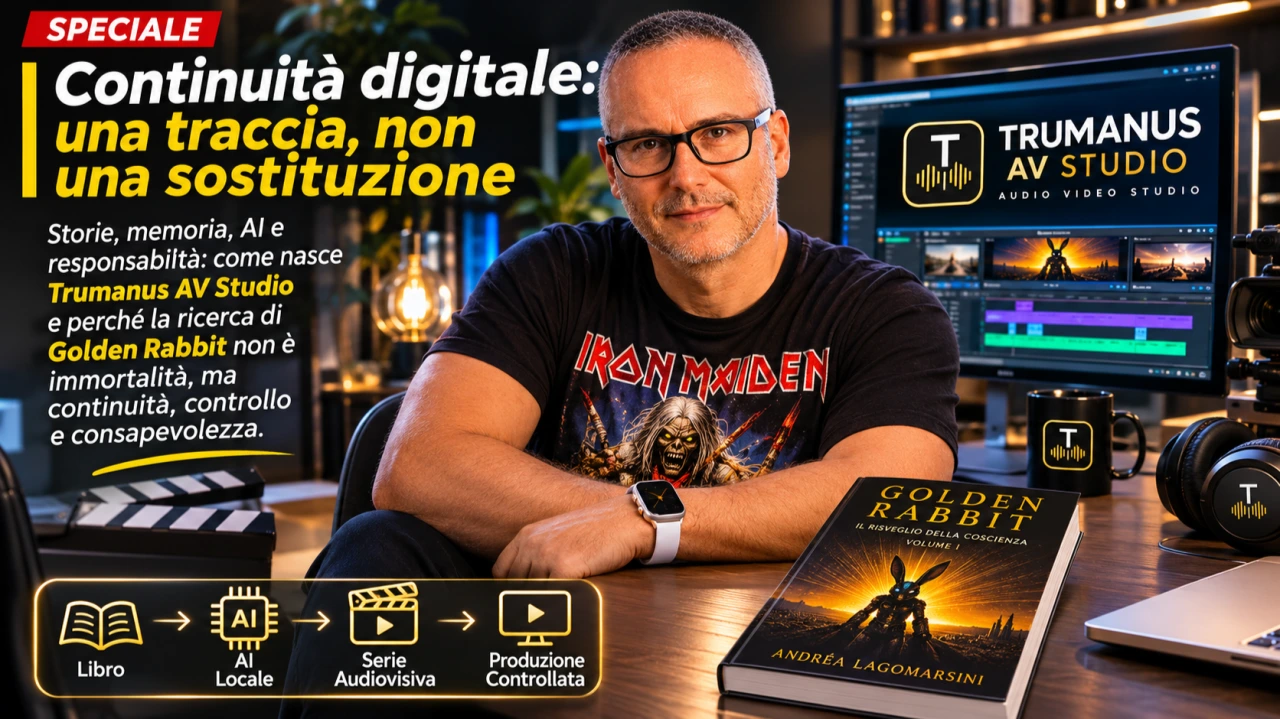
For years I published photographs, videos, images. Fragments of days, thoughts, attempts to tell my story. I did it to communicate, to share, perhaps also to leave a trace. I never imagined that, one day, those fragments would become the raw material for building something that resembles me so closely that it forces me to stop and look it in the eyes.
After fifteen years of trying, I have got there.
Today I have a system that can reconstruct a very large part of my presence: my way of thinking, my voice, my singing, my avatar. It can start from a thought retrieved from the memory I have built from years of myself, develop it and place me within a scene.
It can appear as me.
Even when I am not in control.
That sentence moves me. And, at the very same instant, it frightens me.
I have not uploaded a life. I have left traces
For years we handed images and words over to the internet without truly knowing what form they might take in the future. A photograph seemed like a photograph. A video, a video. A written thought, a written thought.
But traces, as they accumulate, begin to tell the story of a person. Not all of it. Not the whole person. They tell what that person chose to show, their interests, their habits, the rhythm of their speech, the ideas they return to.
The memory I built with RAG, from years of my own materials, is not my consciousness. It does not contain everything I am. It is an organized collection of materials and thoughts the system can draw on. Yet when the machine finds a fragment, connects it to a voice and brings it into an image, the result stops looking like an archive.
It becomes presence.
Or, at least, something that imitates presence well enough to make us hesitate.
The moment the double answers
The voice is mine. The face is mine. The singing can have my timbre. The words can arise from thoughts I have written or entrusted to that memory.
But if a scene is generated when I am not there to guide it, who is speaking?
I do not want to pretend that the answer is simple. It is not me, in the full, human sense of the word. My consciousness is not inside that system. There is a construction made from my materials, models, rules and choices. Yet someone watching it might recognize me. They might trust it. They might attribute to me a sentence, a promise, an emotion that I did not choose at that moment.
This is where emotion meets responsibility.
Because being able to create a double is not enough. We must know when it can speak, what it can say, in which contexts it can appear and how to make clear that this presence has been generated.
Eternity is not a function
“We are near to eternity” does not mean that we have defeated death. It does not mean that a machine can preserve a person, or that an avatar can take the place of someone who is no longer here.
Perhaps it means something more human and, precisely for that reason, more unsettling: that our traces can continue to be rearranged and staged again long after we have stopped updating them.
For centuries we entrusted memory to letters, photographs, books and recordings. Now we can give it a voice that responds, a face that moves, singing that seems to return. The difference is not merely in the faithfulness of the copy. It is in the interaction: what we leave behind can be used to produce something new, in our name.
This can be wonderful. It can allow us to tell a story in another form, give substance to an idea, preserve a way of expressing ourselves. But it can also confuse memory with the person, resemblance with consent, voice with intention.
The boundary I want to defend
My double can help me create. It can enter a scene, interpret a thought, sing. But technical possibility must not automatically turn into authorization.
I want to be able to distinguish what I have said from what the system has generated. I want to know which materials it started from. I want to be able to decide when my avatar can appear and when it must remain still. And I want anyone watching to know whether it is really me speaking at that moment.
Not because technology itself should be feared. But because my identity cannot become a license without boundaries simply because I shared photographs, videos and words.
Perhaps this is the most important step after fifteen years of trying: not having demonstrated that I can clone myself. Having understood that I can build a system capable of conveying a part of me — and that, precisely for that reason, I must decide carefully what I allow it to do.
We are close to something that resembles eternity. Not because we will continue to live inside a machine, but because what we leave behind will be able to keep speaking.
The question, then, is not merely: how much will it resemble me?
It is: who will have the right to make it speak, and who will take responsibility for the words it utters?