
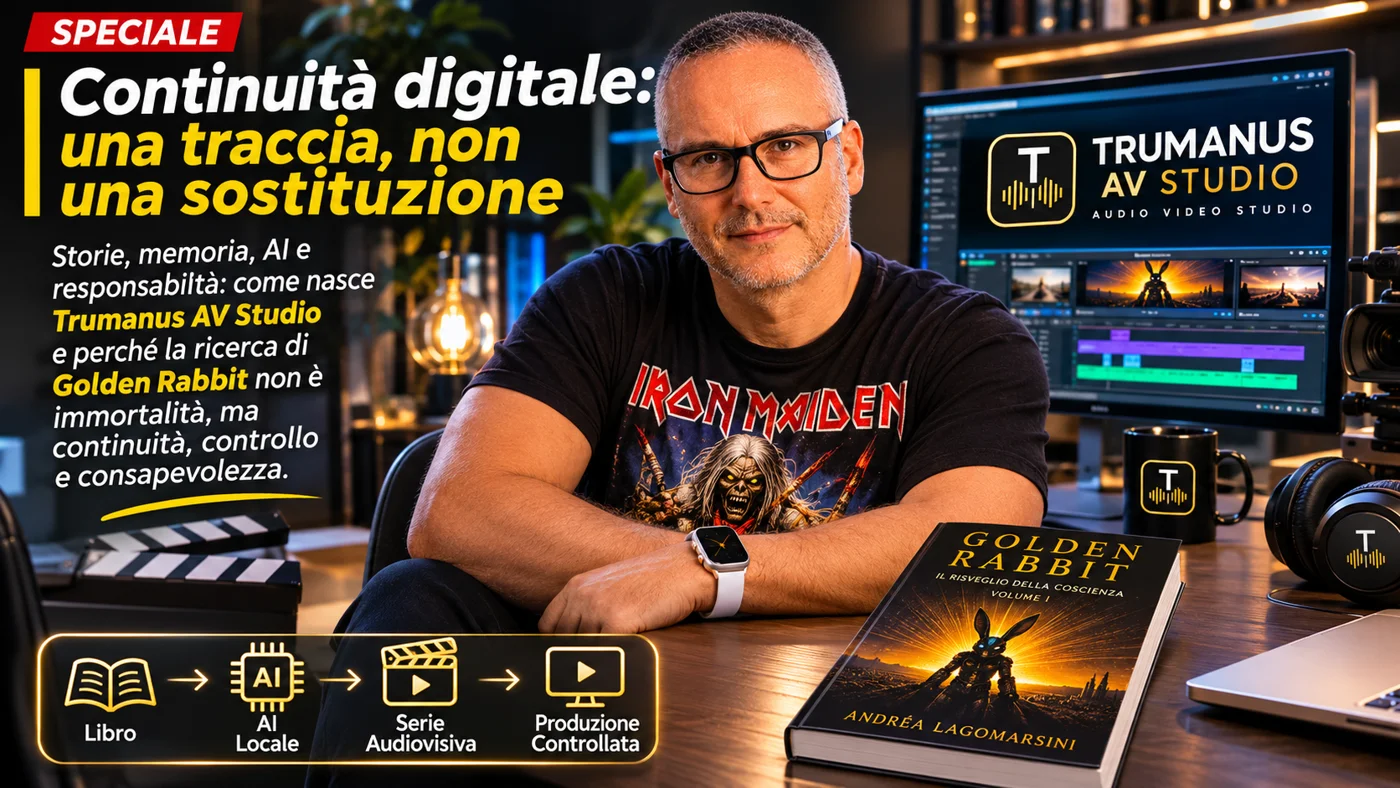
This is not a question born in a laboratory. It was born with a friend, his family, and what technology can — or can't — do in the face of loss.
My friend Federico died at the age of thirty. His parents were not alone: my family and I were close to them for more than fifteen years. Over time, the love we shared with Federico meant that they became part of our family.
This very bond made me think: what would I have liked to be able to keep for them? Federico's stories, words, memories. Not to replace it. Not to pretend he was still there. But so that something of his voice and his story could continue to be told.
I have been working on digital continuity for eighteen years. For a long time I approached it as a question of architectures, networks, memory and software. Today that path meets a concrete and personal question: can we use technology to preserve a trace without confusing the trace with the person?
It is also from this question that Trumanus Audio Video Studio was born, a project in development that explores how to transform a book into an audiovisual series using AI and tools that remain in your network.
A laboratory that works in its own network
I am developing Trumanus Audio Video Studio on a private network and on the computers I have available. The goal is to build a pipeline that can start from one of my books and accompany its transformation into a series.
The system is taking shape and work is slow. But slowness, in this case, is part of the research: it allows us to observe each step, correct the process and understand where human judgment is needed.
An important aspect is being able to work without depending on tokens from services such as OpenAI or Anthropic. This does not mean that every component is automatically secure, nor that local infrastructure is cost-free. It means being able to experiment with greater control over where materials are processed and which tools participate in the process.
For content creators, control isn't just about privacy. It's also about knowing which text a scene comes from, which version of the template was used, what changes were made and who approved the result.
The machine can help develop possibilities. It should not erase the provenance of the work or make people's work invisible.
Golden Rabbit: continuity does not mean consciousness
Trumanus AV Studio is the use case. Golden Rabbit is the research that leads me to question memory, continuity and change over time.
The idea is not to claim that a machine is conscious, has emotions, or can become a person. The question is more concrete: what must a system be able to preserve? What might influence his future responses? With what rules, responsibilities and possibilities of control?
A chat may seem consistent for a few turns and then start from scratch. A system designed to maintain continuity must face different problems: distinguishing occasional data from information that deserves to remain, explaining why a memory has been preserved and allowing it to be corrected or removed.
Golden Rabbit explores precisely these boundaries: not a promise of artificial life, but an architecture for thinking about persistent memory, selection, rules and responsibility over time.
A memory is not a person
If we recreate a voice using materials left behind by someone, are we preserving a memory or building an imitation? Can it offer comfort, or make the absence more painful? And who can give consent when the person is no longer there?
I don't have a simple answer. This is why I believe that a digital continuity project must start from clear limits, not from promises of immortality. A reconstruction does not restore a person. A system cannot speak for those who have not chosen to be represented.
We need consensus, transparency on the origin of the materials, protection of the people involved and a clear way to distinguish a testimony from an artificial generation. Technology can store and reprocess contents; it cannot decide for us what it means to remember someone.
The real use case is not to clone the author
Trumanus AV Studio can be read as a creative laboratory: a book becomes source material for exploring another format, keeping the author in the process. AI can help expand, transform and organize; the decisions on what to tell, what to keep and what not to attribute to the author remain to be governed.
This is already a useful use case, regardless of any promise of "cloning": it shows how local tools can be coordinated to work on proprietary content, support creative production and keep visible the path that leads from source to result.
The value isn't just in producing faster. It also lies in being able to experiment with one's own materials, preserving the relationship with the original work and building skills that remain in the project.
Writing a book takes me months, sometimes years. Turning it into a series with tools that operate in my network takes time, testing and fixing. It is not a shortcut that eliminates work: it is a new way of organizing it and asking ourselves what we want to entrust to machines.
Leave a trace or try to stay?
I have always written books. Perhaps, in part, to leave something of myself. But today I wonder if the real purpose of Trumanus AV Studio is to clone me on a machine.
And, if possible, for whom?
Maybe the task isn't to make yourself immortal in a simulation. Maybe it's carrying the baton a little further: leaving stories, ideas, tools and questions that can be useful to those who come later.
Trumanus AV Studio and Golden Rabbit are, for me, two different ways of approaching this question: one through a creative use case, the other through research into the architecture of continuity. They are not a definitive answer. They are a laboratory to understand what we can build, what we should avoid and what responsibilities we cannot delegate.
Technology can help us keep a record. Deciding what that track means — and to whom — remains our choice.
#DigitalContinuity #ArtificialIntelligence #GoldenRabbit #TrumanusAVStudio #AI #DigitalMemory #Creativity #Ethics