
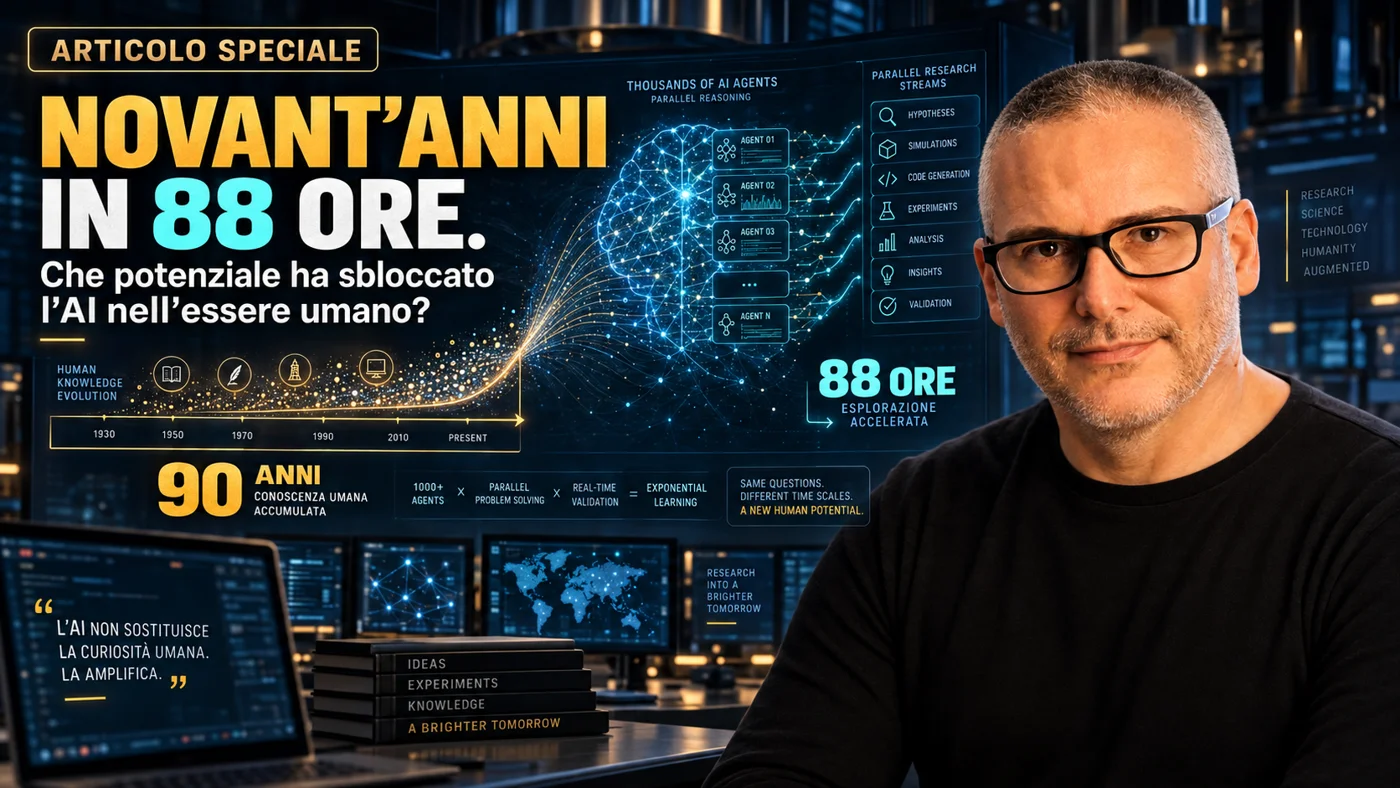
Special article
On September 8, 2026, a problem that had persisted for about ninety years fell.
He didn't fall in a classroom. He didn't fall after a career. It fell in 88 hours.
And the part that almost no one is telling isn't the math part.
It's that, for the first time in history, a human being could ask a difficult question and receive a real answer in a matter of a weekend.
Let's stop for a moment on this sentence. Because it's the one that changes everything.
📷 Insert image: Speciale-88ore-copertina.pngWhat happened, in simple words
The Navier–Stokes equations describe how fluids move. Air, water, blood. They are the mathematics behind the design of a wing, behind a weather forecast, behind the way we imagine circulation in our arteries.
They work by treating the fluid as one continuous thing: not billions of molecules, but a smooth substance.
The open question was brutal in its simplicity:
Can this description break on its own?
That is: starting from a perfectly smooth and still fluid, can the equations lead - by themselves, in a finite time - to a speed that increases without limit? A point where the model stops making physical sense?
Jean Leray had laid the foundations of the problem in 1934. In 2000 the Clay Mathematics Institute included it among the seven Millennium Prize Problems, with one million dollars on the table.
Ninety years of silence.
On September 8, 2026, OpenAI published a proof — with formalization in Lean, i.e. verified by a machine line by line — that yes: the singularity can form. A vortex that wraps around itself, stretches like spaghetti, tightens and accelerates, while the energy remains finite as physics dictates.
The model breaks. And now we know for sure.
📷 Insert image: Speciale-88ore-vortice.png
(infographic: the vortex that tightens and lengthens - speed that explodes, energy that remains finite)The numbers you should look twice
Not the math numbers. The numbers of the method.
| AI agents in parallel on the problem | ~10,000 |
| Hours from launch to solution | 88 |
| Hours for formal verification in Lean | +17 |
| Messages exchanged between agents (Navier–Stokes) | 2.7 million |
| Produced tokens (Navier–Stokes) | ~130 billion |
| Years in which the problem remained open | ~90 |
And before that, as a dress rehearsal: an “easier” problem — the Euler, Navier–Stokes equations without viscosity — solved by about 100 agents in 50 hours.
Ten thousand artificial minds arguing with each other for three and a half days.
No mathematics department in the world can do this. No one ever had the chance.
📷 Insert image: Speciale-88ore-numeri.png
(infographic: 90 years → 88 hours · 10,000 agents · 2.7 million messages)But the real point is another
Here comes the question that really interests me, and that almost no one is asking:
Have we realized what potential AI has unlocked in humans?
Because the easy reading is: “AI solved a problem that humans couldn't solve”.
This is a wrong reading. And, if we stop there, we miss the most important thing of the last twenty years.
Let's look at what really happened, step by step.
1. The spark was human
OpenAI says it launched the operation on September 1st, after hearing a rumor: someone was about to solve a Millennium Problem.
It wasn't an algorithm that decided. It was a group of people who heard a noise in the air and thought: let's try it now.
The intuition of the right moment cannot be automated. It has remained ours.
2. The foundation was human
The result does not arise from nothing. It is based on ten years of work by Diego Córdoba and Luis Martínez-Zoroa, mathematicians who built, piece by piece, the technique that made everything else thinkable.
Charles Fefferman — the Princeton mathematician who wrote the official statement of the problem for the Clay Institute — indicated them as the true protagonists of the story.
The AI raced on a track that humans had built.
3. The question was human
The officers were not told “solve Navier–Stokes”. They were divided into groups and each group was given a different variant of the problem: some were looking for a proof, others a disproof.
Someone had to decide how to break the question. Someone decided to shift resources from one problem to another when the first good signal arrived. Someone used Codex to make groups talk to each other and cross-reference partial intuitions.
That's not calculation. It's directed.
4. The criterion of truth remained human
The evidence was not accepted because “the AI says so”. It has been formalized in Lean and mechanically verified.
That is: we demanded proof that did not require trust. A standard that humans have chosen to raise, not lower.
The real unlock: a scarcity has fallen, not a competence
Throughout human history, the scarcest resource has not been intelligence.
It was thinking time applied to a problem.
A good researcher has a few thousand useful hours per year. A good department puts together a few tens of thousands of them. An idea can wait twenty years for the right person to pass by and see it.
Ninety years of Navier–Stokes is not ninety years of human stupidity. That's ninety years of there not being enough hours of simultaneous thinking to throw at that wall.
Now that bond has been broken.
It's not that AI has become smarter than us. It's that, for the first time, a single person can afford to think on an industrial scale.
And that's you, not mathematicians.
📷 Insert image: Speciale-88ore-scarsita.png
(infographic: before — a few hours of thinking · now — thinking on an industrial scale)What this means for those who don't solve Millennium Problems
The right question to take home is not “when will AI solve the next famous problem”.
It is this:
What problem have you stopped addressing because “it would take too long”?
Because each of us has one. A company that has lived with a broken process for eight years because it costs too much to redo it. A doctor with an intuition that has never been verified because months of literature would be needed. A craftsman with a firm product idea because he doesn't have a team. A researcher with a hypothesis in a drawer.
Those waivers were rational, until yesterday. They were the correct calculation made on the right costs.
Today those costs have changed. And if we don't redo the calculation, we will continue to give up out of habit things that have become possible.
Unlocked potential is not in the machine. It is in the ambition that we can afford.
The questions that remain open
An honest article doesn't stop at enthusiasm. Not because there is something to report, but because a transformation of this magnitude brings with it questions that we have not yet answered.
1. The times of science have changed
On the evening of September 7, a few hours before the announcement, Tristan Buckmaster (NYU) and Levent Alpöge (Anthropic) had published their proofs on Euler's problem — also verified in Lean, also obtained with heavy use of AI.
Two groups, independent, on the same ground, on the same weekend. A public debate arose about who had arrived first and on what: Sébastien Bubeck, of OpenAI, clarified that “we did not use their prompts or their demonstrations to train our models”.
Regardless of how it ends, the interesting fact is another: when a result matures in 88 hours instead of eight years, the habits of the scientific community - who cites who, who waits for whom, how it is announced - do not have time to activate.
It's nobody's fault. They are rules created for a different rhythm. They will have to be rethought, and sooner than we think.
2. Quality doesn't scale alone
Buckmaster said of one of his three works that “can only be described as AI slop” — AI-produced material of insufficient quality.
It is the most precious observation of the entire story, and it comes from those who were inside: the same lever that produces historical results also produces credible and empty text. The difference is made by those who still have the criteria - and the honesty - to distinguish them. Even in your work.
3. Cost and access
Ten thousand agents for 88 hours, 130 billion tokens: we are talking about millions of dollars of calculation for a single demonstration, with the energy and infrastructure that this entails.
Today such a lever is within the reach of few. The real question is how quickly it will become accessible to many — because that's where you decide whether it will be a revolution or just an advantage.
4. Transparency
The demonstration comes from an internal, non-public model. The proof is verifiable by anyone, thanks to Lean — and that's a huge plus for the method. The system that produced it, for now, does not.
It is a reasonable and stated tension, not a deception. But a tension remains, and it's worth keeping an eye on.
📷 Insert image: Speciale-88ore-bilancia.png
(infographic: unlocked potential vs open questions — science timing, quality, access, transparency)The thing that keeps me awake
OpenAI said a sentence that is worth more than all mathematics:
We do not intend to claim the prize.
A million dollars left on the table. Because the prize wasn't the point. The point was to tell the world how fast we are going.
And then the question returns, bigger than before.
Ninety years of human work on a wall. Then three and a half days.
Not because we suddenly got smarter.
But because we have built a tool that multiplies what we already were: our curiosity, our ability to formulate the right question, our obstinacy in demanding proof.
AI has not replaced the mathematician.
It revealed how little, so far, we have been able to use the mathematician that was there.
And this applies to every profession. For yours.
What to do starting tomorrow morning (even without being a researcher)
- Do the calculation again. Go back to the list of things you discarded for "too much time, too many resources". That calculation is old.
- Train the question, not the answer. The rare skill is no longer knowing how to do it. It's knowing how to ask well, and knowing when the answer is wrong.
- Demand proof. Lean is the lesson of the century: don't trust, verify. If you don't have a way to verify, you don't have a result.
- Don't delegate responsibility. If you publish, if you deliver, if you sign — it's you.
- Look at scale, not single use. The potential is huge. The costs — energy, access, concentration — too.
🔥 An open question
What problem have you stopped addressing because “it would take too long”?
That calculation, today, may no longer be valid.
One line in the comments is enough.
Ninety years against 88 hours is not the story of a machine that surpassed us. It's the story of how much human potential was waiting, and no one knew.
Sources: OpenAI, On the Navier–Stokes Millennium Prize Problem (8 September 2026) · Quanta Magazine · Scientific American · preprint Alpöge–Buckmaster (7 September 2026)