
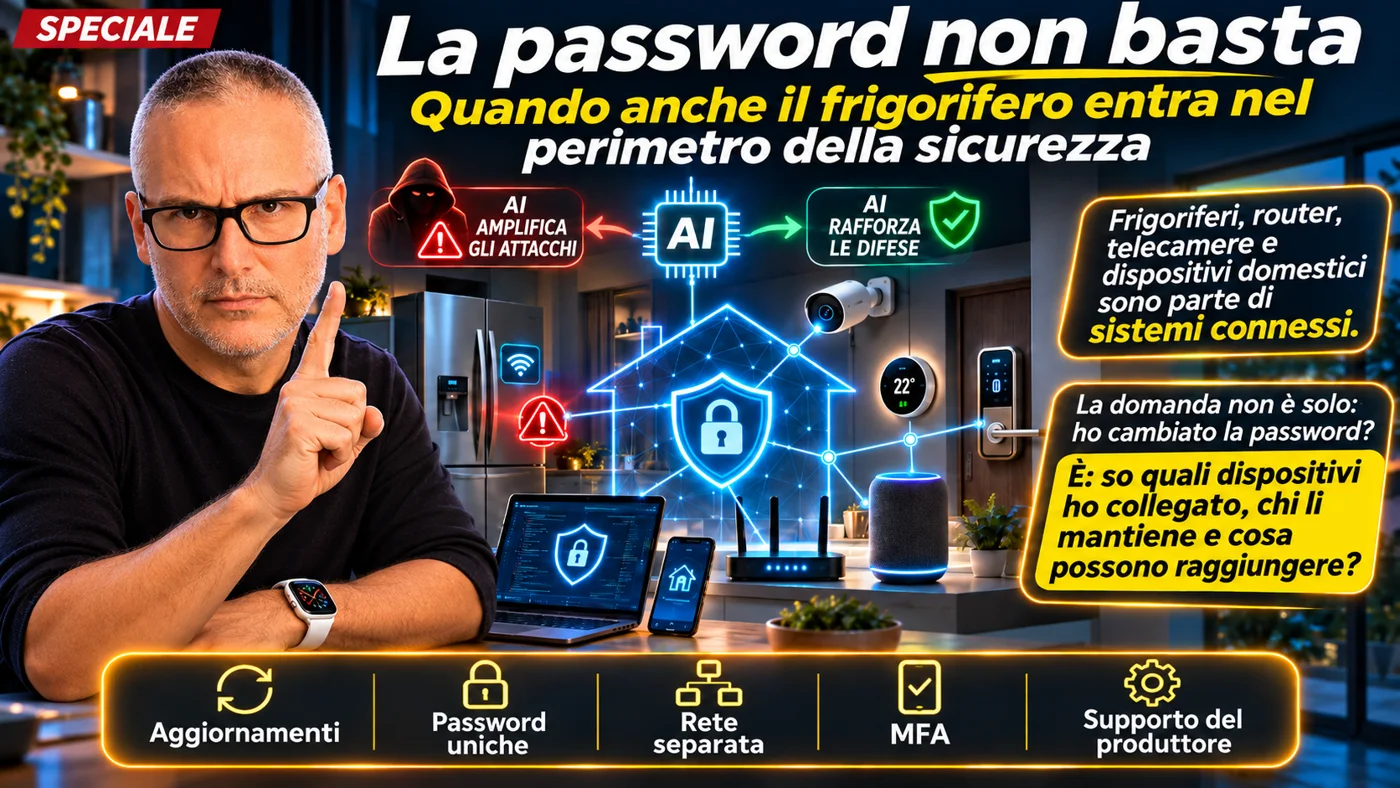
ENISA's alarm does not only concern companies or ministries. Refrigerators, routers, cameras and home devices are now part of connected systems. And when one of these systems is vulnerable, the problem can leave your front door.
A refrigerator shouldn't make headlines for a cyber attack. Yet this is precisely what happened in a series of accidents involving refrigeration systems in supermarkets and blood banks in several European countries.
In its article of November 10, Euronews reports the warning of Juhan Lepassaar, executive director of ENISA, the European Union Agency for Cybersecurity: after refrigerators, routers and other household appliances could be targeted. The problem cited is not science fiction: systems with outdated software and vulnerabilities left unfixed.
The article also refers to the acceleration introduced by artificial intelligence. AI can help attackers scan for vulnerabilities, prepare more convincing phishing messages, and manipulate information. But it can also help advocates identify problems and intervene more quickly. It is not a technology "on someone's side": it amplifies the capabilities of those who use it.
The question, then, is not whether we should change the refrigerator password. It's whether we understood what we connected to the home network — and what it could achieve.
The house has become a computer system
In many homes there are routers, cameras, video intercoms, voice assistants, televisions, thermostats, smart plugs, robot vacuum cleaners, electronic locks and health devices. They often communicate with an app on the phone and with services managed by external platforms.
Each product, taken alone, may seem harmless. The risk changes when we consider them as parts of a system:
- the router connects all other devices to the Internet;
- the app account can control multiple objects and contain personal data;
- the manufacturer's service may store videos, habits, location or usage history;
- home Wi-Fi can be shared with work computers and phones;
- an abandoned or no longer updated device can remain connected even when the owner forgets about it.
It doesn't mean that every camera is under attack or that a criminal can enter your home through any smart light bulb. It means that each connected device adds software, an account and a trust relationship to maintain.
What are the concrete risks?
1. A device becomes a gateway
A product with known vulnerabilities, weak credentials, or never installed updates can be compromised. In some cases it can be used to attack other systems, send malicious traffic or attempt to move around the local network.
The risk increases if all devices share the same network without separation: a poorly protected object can be too close to a computer containing documents, credentials or corporate access.
2. A stolen account opens more than one screen
Many devices are controlled by a centralized account. If someone obtains your credentials, they could access your images, recordings, schedules and habits, or change settings and automations.
For a camera or video intercom, the impact is not just digital: information about the times when the house is empty can have consequences in the physical world. For a medical or assistive device, the loss of availability or alteration of notifications can create an additional risk.
3. A remote service stops working
A device can continue to be powered on but lose some functions if the manufacturer shuts down the cloud service, stops support, or experiences an accident. It is a continuity risk: the light bulb remains a light bulb, but the app, remote controls or automations may no longer work.
4. Home can become a bridge to work
The distinction between home and office is less clear than it used to be. A work laptop, VPN, or personal device may be on the same network as out-of-date home products. It's not proof that those devices can automatically compromise work; However, it is a concrete reason to separate contexts and apply company rules also to remote work.
5. AI makes deception more credible
Fake messages, calls and voices can be more personalized and convincing. An attacker could pretend to be the manufacturer's technical support, a courier or a family member, asking to install an app, communicate a code or deactivate protection.
In these cases the weak point is not the device, but trust. The speed and quality of the message can make it more difficult to recognize a scam.
Because changing passwords and updating are not enough
Unique passwords and updates are key, but they don't solve every problem.
A product may no longer receive updates. The manufacturer may not explain how long it will provide support. An app can collect more data than necessary. The cloud service may be configured insecurely. The router can have active remote access without the owner knowing. And even a strong password doesn't protect against every software vulnerability or an account compromised through phishing.
Security, therefore, is not a single setting. It depends on the whole chain: manufacturer, firmware, apps, accounts, home network, cloud service and user behavior.
Before buying a connected device, let's ask ourselves:
- How long will you receive security updates?
- Does the manufacturer explain how to report a vulnerability?
- What data does it collect and where does it store it?
- Does the product continue to work if the cloud service is interrupted?
- Can I protect it with multi-factor authentication?
- Can I put it on a separate network from computers and phones?
NIS2 is not the security label of the devices
It is important to be precise. NIS2 does not require every family or every smart device manufacturer to obtain a generic “NIS2 certification”. The directive concerns entities operating in defined sectors and categories, with size and scope criteria, and requires risk management measures and incident reporting obligations from the entities concerned.
NIS2 therefore does not guarantee that every device connected to the home network is safe, nor does it replace the manufacturer's responsibilities.
For hardware and software products with digital elements, the specific European reference is also the Cyber Resilience Act (CRA). The regulation introduces cybersecurity requirements for products and for the management of vulnerabilities during their life cycle. The reporting obligations established by the CRA are applicable from 11 September 2026; the main obligations will apply from 11 December 2027.
The two regulations have different objectives and recipients. For those who buy a device, the practical lesson is simple: it's not enough for a product to work today. It also matters who will update it tomorrow, for how long and with what transparency.
Security starts from the design, not from the password
My experience in the analysis of security systems, including in the anti-terrorism field, has taught me not to stop at the single object. In a real scenario, relationships matter: what is connected to what, which function depends on which service and what happens if an element fails.
This way of thinking also applies to the connected home. We don't have to imagine catastrophic scenarios to take the problem seriously. We need to understand dependencies, reduce unnecessary access points, and prepare for a failure or incident without losing essential functions.
Some concrete measures:
- Keep routers and devices updated and replace any that no longer receive security fixes.
- Change default credentials, use different passwords, and enable multi-factor authentication when available.
- Separate IoT devices on a guest network or dedicated network, if your router allows it, especially from work computers.
- Turn off unnecessary remote features by checking your router and app settings.
- Limit shared data: microphone, location, videos and history only when you really need it.
- Check manufacturer support and have a plan to remove or replace a device that is no longer upgradable.
- Do not trust urgent requests for codes, passwords or software installation: contact the manufacturer using official channels.
These are useful measures, but they do not alone transform an unsafe product into a safe one. The primary responsibility for product safety must be addressed throughout its design and life cycle, not passed entirely onto the end user.
We are all inside the perimeter
ENISA's warning concerns us because digital infrastructures are no longer separated from everyday life. Home devices can impact privacy, service availability and, in some cases, physical security. And they are connected to platforms and networks that are part of a larger chain.
AI can reduce the time between finding a vulnerability and exploiting it, but it can also help find and fix it. In this race, relying only on the prudence of the individual user is not enough. We need manufacturers who design upgradable and secure products, transparent platforms, organizations capable of managing risk and people who know how to recognize the dependencies around them.
The question is no longer just: "Have I changed my password?"
It's: "Do I know what devices I have connected, who maintains them, what they can achieve, and what happens when they are no longer safe?"
Sources
- Euronews, AI is industrializing cyberattacks and shrinking the time for exploitation, says EU cybersecurity agency, 10 November 2026.
- European Commission, NIS2 Directive.
- European Commission, Cyber Resilience Act.
#Cybersecurity #SmartHome #IoT #NIS2 #CyberResilienceAct #ArtificialIntelligence #ENISA #DigitalSecurity