
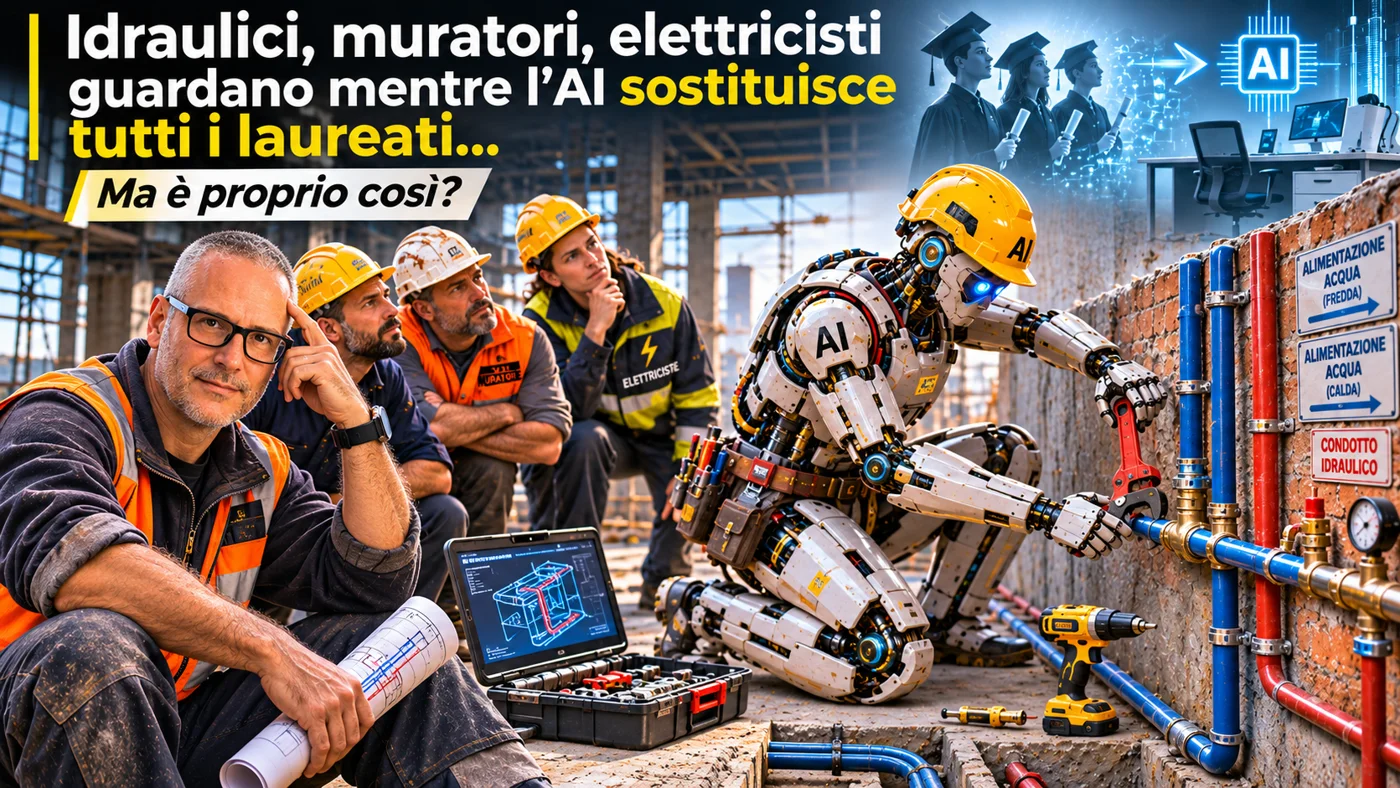
Perhaps the question is not whether artificial intelligence will replace college graduates. It's whether, in order to work tomorrow, we will all have to understand technology the way a computer scientist understands it today.
A post I read tells a curious paradox: computers can write code, analyze documents and solve complex problems, but a robot still struggles to do some things that a child learns almost without thinking about it, such as moving around an environment or grasping an object.
And then it comes naturally to smile: while the AI questions the work of those who have studied, the plumber, the bricklayer and the electrician continue to be called when something breaks.
But stopping at this joke risks making us miss the point.
It is not a competition between graduates and manual trades
Artificial intelligence is already changing many activities that take place in front of a screen: writing, searching for information, summarizing, programming, analyzing data, preparing projects. For this reason, some skills that until recently distinguished those with an IT background are becoming accessible to many more people.
But AI is not just a chat window. It's already inside the services, companies and tools we use every day. And, as software, sensors and robots integrate, it will also reach activities related to physical spaces: maintenance, logistics, construction, plants and production.
This does not mean that tomorrow a robot will replace every electrician or that every profession will disappear. It means that even practical jobs will change: intelligent tools will be able to help diagnose a fault, read a project, control a system or plan an intervention. The professional will have to know how to collaborate with tools that collect data, suggest solutions and, in some cases, take action.
The division between those who work with their hands and those who work with their head will no longer describe the world of work well.
IT culture as a new basic skill
The thesis is provocative, but it is worth taking it seriously: to enter the world of work of tomorrow, we may all need an IT preparation comparable, at least in basic terms, to that which we now associate with a graduate in IT.
It doesn't mean that everyone will have to get that degree. Nor that every person will have to write professional software. It means that computer culture could become a common language, like reading, writing and arithmetic.
We will need to understand how to break down a problem, precisely describe the outcome we want, provide context to a system, control what it produces, and recognize when it gets it wrong. We will need to have an idea of how data flows, what information is prudent to share and who is responsible for automated decisions.
Not to get all technical. So as not to be forced to delegate to others every choice regarding tools that are increasingly present in our work.
From taking each step to directing the outcome
When a machine can perform part of the task, the human contribution shifts. It doesn't disappear: it changes shape.
Instead of performing each step by hand, we could define the goal, choose the constraints, guide the tools, evaluate the alternatives, and take responsibility for the outcome. An electrician could use AI to analyze the documentation of a system, but he will have to understand if the suggestion is applicable to that place and work safely. A person in the office will be able to have a first draft prepared, but will have to check that it is correct and suitable for the person receiving it.
This is a paradigm shift: less work dedicated to producing each individual step, more work dedicated to understanding what is needed, directing the process and verifying what the machine does.
It is possible that in the future we will work less and that the value produced by machines will allow higher wages. But it is not an automatic outcome. Technology can increase productivity; it does not decide how to distribute the benefits. Whether the time saved will become free time, better wages or just higher goals will depend on social, economic and political choices.
The question is not just who will be replaced
When we discuss AI and jobs, we often ask, “Which job will disappear?” It's an understandable question, but an incomplete one.
We should also ask ourselves:
- what skills will become necessary in almost all jobs?
- who will have access to training to acquire them?
- who will monitor the systems and establish what they must do?
- who will be responsible when an automated decision causes harm?
- who will receive the value produced by the machines?
If computer culture becomes indispensable, we cannot leave it as a privilege for those who have had the opportunity to attend a university or a specialist course. Schools, businesses and institutions will have to help people understand technology, not just press buttons on an app.
And learning to use it won't be enough. We will also have to learn to govern it: decide where it can act, what limits to respect and how to maintain human responsibility.
The future doesn't require everyone to do the same job
Plumbers, bricklayers, electricians, teachers, doctors, office workers and programmers will not become the same profession. Practical skills, knowledge of places, relationships with people and judgment will continue to have value. But every profession can be transformed by tools that today seem far from everyday life.
Perhaps, then, the provocative title should be read in reverse. It's not just manual trades that are watching AI change the jobs of graduates. We are all facing the same change: technology that was once a specialization is becoming the environment in which we work.
The real challenge will be to give everyone the tools to understand it, without pretending that the machine is neutral or that progress distributes its advantages on its own.
To work tomorrow we won't necessarily all have to be computer science graduates. But we may have to understand the digital world with a depth that today we imagine reserved for those who have studied it. And we will have to decide together who controls the machines and who owns the value they produce.