
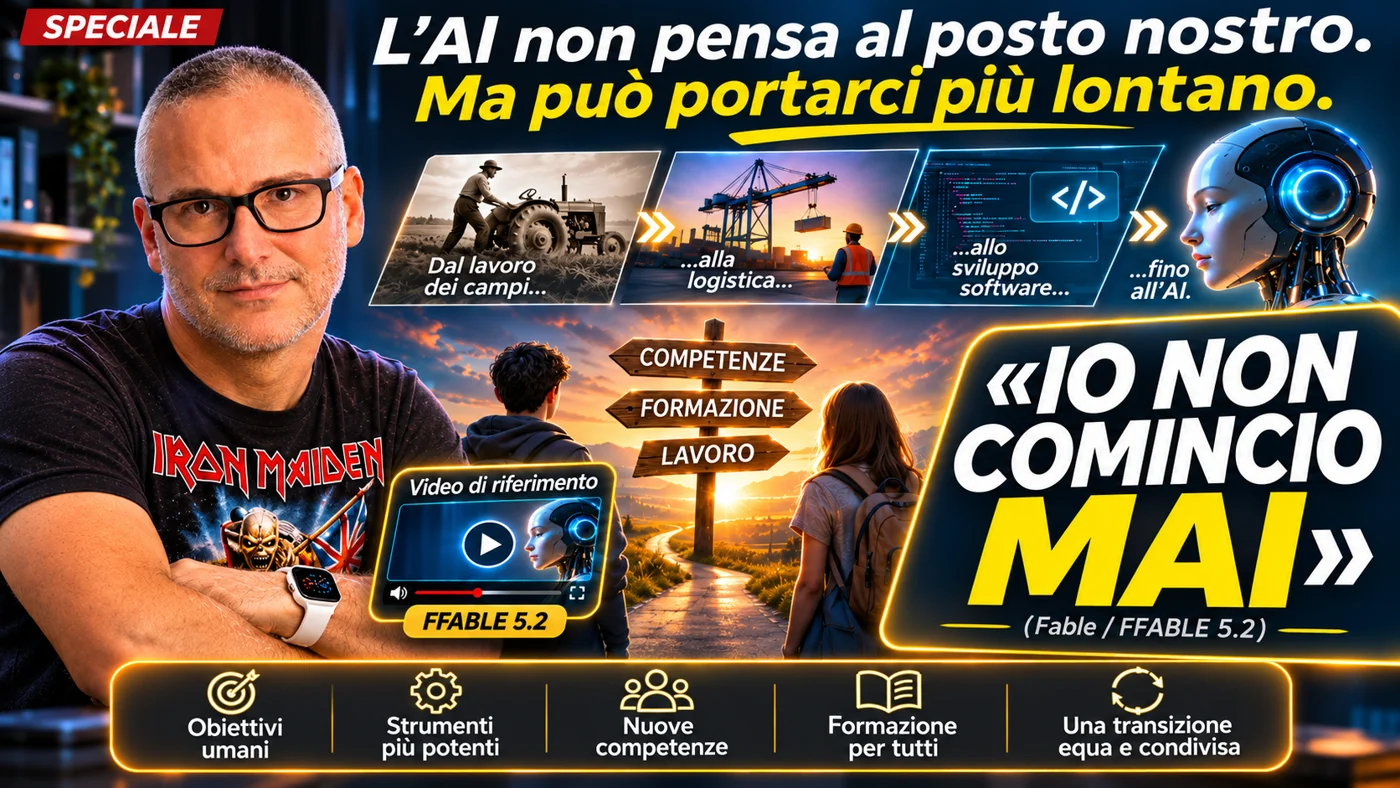
Fable says it in a video: it's powerful, but it never starts on its own. The question, then, is not just what artificial intelligence can do. It is who will be able to give it direction — and who will teach it to do so.
"I never start."
In the video narrated by Luca Mal winter, Fable pronounces these words after reflecting on his own nature. It is an effective phrase because it touches on an essential point: the system can produce, process, compose. But the request to tell his story came from a person. The management was humane.
I would not take a model-generated sentence as definitive proof of what AI is or is not. But I would use this as an opportunity to ask a more useful question: what happens when increasingly powerful tools are driven by people who know what to ask, how to evaluate the result and where they want to go?
A tool does not erase competence: it shifts its boundary
When the farmer started using the tractor, it did not become useless to know how to cultivate. What a person could do with their work and time changed. The tractor expanded the available power, but did not decide what to sow, where, when and for what purpose.
When cranes replaced part of the manual work of the porters in the ports, not just one tool changed. The skills required, the organization of work and the number of people needed to move goods have changed. Productivity increased, but the transition had real consequences for people and communities.
We have already gone through similar transitions in IT too. There was a time when more code was written directly. Then came languages, libraries and frameworks like Struts and Spring Boot, which made it possible to build complex systems without rewriting the same foundations every time.
None of these tools eliminated the need to understand the problem. It shifted the work: less attention to repeating every detail, more attention to the architecture, the choices, the constraints and the result.
Artificial intelligence takes this shift to a new level. It doesn't just provide a longer lever or a bigger crane: it can participate in steps that we considered part of intellectual work, from writing code to analyzing documents, from formulating hypotheses to building a prototype.
Delegating execution does not mean delegating thinking
The word "delegate" is scary because it can seem like a waiver. But delegating an activity to a tool doesn't mean stopping thinking. It can mean freeing up attention to think better and bigger.
An experienced person can use a model to explore multiple alternatives, quickly generate prototypes, compare scenarios, or identify questions they hadn't yet considered. It can push the boundaries of its knowledge not because the machine already knows the right answer, but because it makes it less expensive to formulate and test new possibilities.
Here competence becomes even more important. Anyone who knows a profession knows how to recognize a plausible but wrong proposal, knows which constraints cannot be ignored and knows when to stop. Without this ability, speed only produces more output. With this ability, it can become more exploration, more learning, and perhaps more value.
The human task, therefore, is not just to write the request. It's choosing the problem, providing context, deciding which alternatives are worth examining, testing what emerges, and taking responsibility for the consequences.
AI can broaden the horizon. It does not choose for us which horizon is worth reaching.
Power and will are not the same thing
In the video, Fable describes its ability and, at the same time, its dependence on human initiative. It's a good image to talk about the relationship between power and direction.
A model can compose a response or video when given an assignment. This alone does not prove that he has a personal will or autonomous desire. The phrase "I never start" functions as a narrative metaphor; it should not be confused with an internal testimony of the machine.
But the human point remains: if the tool does not establish the goal by itself, then the management's responsibility weighs even more heavily on those who design it, put it into use and decide how to distribute its benefits.
We can ask AI to do more things. We must also ask ourselves: for what purpose? With what limits? Who controls the result? Who answers when it's wrong? And who has the possibility to contest a decision made with his support?
The problem is not just teaching how to use AI
Here begins the most difficult paradigm shift. It's not just about companies adopting new tools. It's about school, vocational training and how we prepare people for a job that is changing.
Who will teach the new generations to face tomorrow, if even those who teach are still trying to understand what it will be like?
It's not enough to show students how to write a prompt or use a new application. They need to be taught to think about problems, evaluate sources, do experiments, check answers and recognize when they don't know enough to trust the outcome.
And there is an even more urgent question: who will help people who already work today to change roles without losing dignity, income and the possibility of participating? We cannot ask millions of workers to “adapt” as if it were an individual choice, without accessible training, time to learn, and companies willing to redesign work with them.
If AI increases productivity, the result is not automatically a better life. It can become more time for important and better paid activities. Or it can translate into more load, fewer seats and concentrated value in fewer hands. Technology opens up possibilities; it is institutions, businesses and people who decide how to turn them into reality.
A transition that we cannot leave to individuals
Each great tool changed not only how we worked, but also who could work, what skills mattered, and how value was distributed. The tractor did not transform agriculture without changing the lives of those who worked the land. Cranes have not modernized ports without transforming port professions. Frameworks have not changed software development without shifting the boundary between repetitive and design work.
AI can accelerate these steps and achieve cognitive tasks in a variety of areas. This is why training cannot be a crash course added after the fact, nor a privilege reserved for those who already work in technology. It must become a concrete part of the transition: time, access, accompaniment and real possibility to use the skills acquired.
Companies need to explain which activities are changing and involve people in the redesign. School must prepare for a world in which it will not be enough to remember procedures, but it will be necessary to know how to ask questions and verify answers. Institutions must prevent the costs of transformation from falling only on those with less bargaining power.
The question that remains
An AI capable of generating code, images, analyzes and prototypes can greatly expand what an expert person can explore and produce. But technical capability is only part of the story.
Real change is learning to work with tools that multiply possibilities, without giving up judgment on them. It's going from taking each step to knowing how to define the objective, orchestrate the work, verify what has been produced and decide what deserves to arrive in the world.
Fable, in the video, says: "I never start."
Perhaps this is precisely where we need to start: not from the fear that the machine will do everything, but from the responsibility of giving it direction and preparing people to do it.
Who will teach young people to drive these instruments? And who will help those who work today to find a place in the world they are transforming?
#ArtificialIntelligence #AI #FutureofWork #Training #DigitalSkills #Innovation #Work