
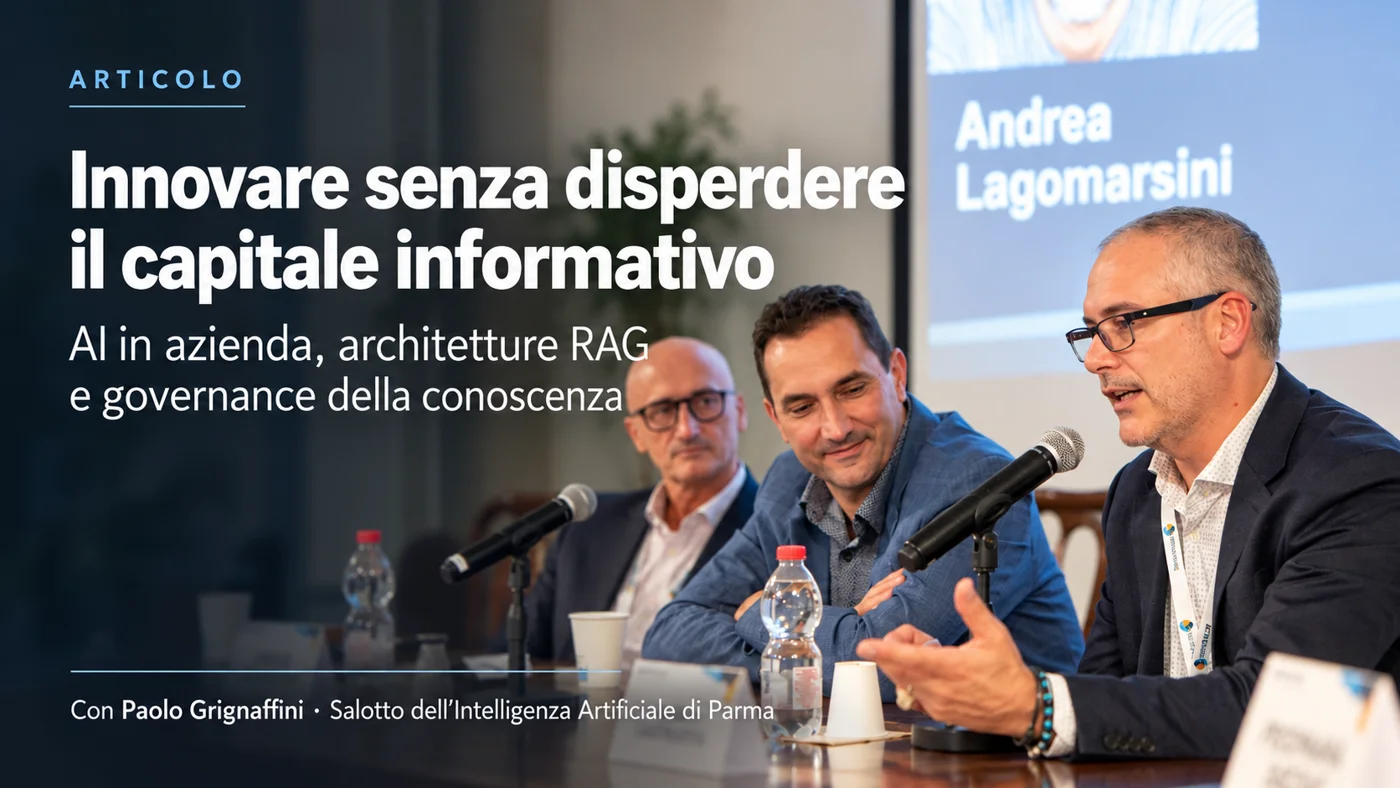
The question I brought to the Artificial Intelligence Salon in Parma, together with Paolo Grignaffini, is only apparently simple: how to introduce AI into the company without losing what makes that company unique?
Talking about artificial intelligence in business often means talking about models, platforms and speed. These are important issues, but they are not the starting point.
The starting point is what the company knows.
Every organization holds a heritage made up of documents, procedures, past decisions, operational data and skills gained in the field. Some of it is stored in systems. Another lives in the experience of people, in the informal passages, in the exceptions that some have learned to recognize after years of work.
This is its information capital. And it is precisely here that the adoption of AI can create value or disperse it.
The risk of asking too much from a generic model
A generative model can produce convincing answers. But, without adequate context, he does not know the internal procedures, the priorities of the organization or the reasons behind a past decision. Can complete a sentence; this did not mean he understood the undertaking.
The casual use of public tools can also take confidential information outside the company perimeter. And when answers are not linked to verifiable sources, a plausible result can be mistaken for fact.
Then there is a less obvious risk: by adopting the same tools and models without preserving their own knowledge base, organizations can end up producing increasingly similar responses. AI speeds up work, but it can also flatten the method, memory and identity of a company.
The question, therefore, is not just: which model do we use?
It is also: what knowledge do we allow him to use, with what rules and for whose benefit?
The RAG is not a magic wand
One of the architectures often considered to bring corporate knowledge into a generative system is RAG, an acronym for Retrieval-Augmented Generation. Simply put, before responding the system searches for relevant information in authorized sources and passes it to the model as context.
This can make the answers more linked to the contents of the organization. But it's not enough to connect a model to a folder of documents and call the result “Company Brain”.
We need to know which sources are reliable, who has the right to consult them, how they are updated and how we can trace the contents used to formulate a response. The permissions must also be valid when the documents are recovered: it is not enough to protect the original file if the system then returns information to those who should not see it.
And the RAG does not eliminate errors. It can reduce the distance between the response and the sources, but verification, traceability and controls proportionate to the importance of the decision are still needed.
From knowledge to situation
In the contribution presented with Paolo Grignaffini we related the problem with three concrete perspectives.
AISAC addresses the collaboration between sensors and devices: the value does not arise from the single signal, but from the ability to correlate different observations in a shared space and reconstruct a coherent picture of the situation.
Colonel represents the perspective of decision support in complex contexts. AI can aggregate information and highlight anomalies; the operator interprets the picture and maintains responsibility for the decision.
Golden Rabbit brings the question into governance: which experiences enter the system's memory, which limits it must respect and how deviations are controlled or corrected.
Three different cases, one common principle: accumulating data is not the same as understanding. We need correlation, context, rules and people capable of evaluating what the system proposes.
In complex or critical scenarios, AI can speed up analysis and help highlight relevant elements. The operational decision, however, must remain linked to defined responsibilities, controls and the possibility of reconstructing the path followed.
Memory must have rules
A system that learns from experience or maintains interactions over time poses a further question: what must it remember, what can become a rule and who can change its mandate?
Not all information is useful. Not every previous answer is correct. Not every piece of data collected has to change the future behavior of the system.
For this reason, in the governance model described in the paper, the memory must be accompanied by selection criteria, operational limits, control registers and checks. Memory should not update without rules; the constraints should not be modifiable independently by the model; anomalies must be able to be analyzed and corrected.
Said without jargon: if an AI makes a mistake, we need to be able to understand what sources it came from, what rules it followed and who is responsible for the decision made based on its response.
Innovating also means protecting
At the Artificial Intelligence Salon in Parma I brought a belief that is increasingly central to me: protecting knowledge does not mean locking it in an archive. It means making it usable without losing its origin, context, permissions and responsibilities.
Well-designed enterprise AI is not simply a more powerful model. It is a system that connects data and processes, distinguishes what is authorized, preserves memory in a governed way and leaves room for human judgment where risk requires it.
Technology can help the company find what it knows and transform it into better decisions. But it doesn't decide for itself what deserves to be remembered, shared or protected.
That remains an architectural, organizational and human choice.
And that is where, in my opinion, every serious artificial intelligence project in the company should begin.
With Paolo Grignaffini, at the Artificial Intelligence Salon in Parma, with the contribution Innovating without dispersing information capital: artificial intelligence in business. Orchestration models, RAG architectures and algorithmic governance in complex business processes.