
Tools do not demonstrate competence. Understanding yes.
Special article
There's an idea that keeps coming back every time a new technology enters the workplace: if you use a tool, then you're not really competent.
It is a reasoning that seems to defend human value. It actually confuses the medium with the ability to use it.
In an email exchange attributed to Linus Torvalds, the Linux founder responds to a discussion about the use of artificial intelligence in kernel work. The point, in short, is clear: it makes no sense to impose absolute bans on instruments. What matters is that people do their best and understand what they are doing.
The example he uses is deliberately provocative: banning compilers to demonstrate that they know how to write code would be an absurd rule. And so would it be to demand that every commit message be written without an editor, to prove that you know how to compose a sentence.
Provocation works because it shifts the question.
Not: did you use a tool?
But: do you know what you're delivering?
The instrument test is a bad test
When a person uses a compiler, no one thinks that the compiler wrote the program for him. It is an essential tool: it translates source code into executable instructions. But it doesn't decide which problem is worth solving, which requirements matter, which trade-offs are acceptable, or whether the result is useful.
An editor helps with writing. A debugger helps you observe behavior. A search engine helps you find information. None of these tools, by themselves, transfer responsibility for the result to the user.
With artificial intelligence the conversation changes. The machine produces text, code, images, analyzes and proposals that seem already finished. The fluidity of the output can make us imagine that behind it there is understanding, intention and reliability similar to that of a person.
But generative AI is not a compiler, nor is it a human colleague. Produces results based on available data, models and context; it can be surprisingly useful and, at the same time, make mistakes with apparent certainty.
This is why Torvalds' comparison is useful, but should not be taken too far. It reminds us that banning the instrument does not prove competence. However, it does not demonstrate that every AI-assisted outcome is correct, safe or fit for purpose.
The tool is not proof of competence. And not even proof of his absence.
The question is not “did you use AI?”
The important question is what happened between the initial intention and the final result.
- What problem did you want to solve?
- What did you ask the AI and what information did you provide it?
- Which parts of the answer did you check?
- How did you verify that the solution works in your context?
- What errors or limitations have you found?
- Who is responsible for decisions made based on that result?
These questions do not serve to construct an interrogation on the use of technology. They serve to understand whether the AI was used consciously or whether the output was accepted only because it appeared convincing.
A programmer can use an assistant to explore a solution, but he or she must be able to read the code, test it, and understand the effects of changes. A professional can use AI to summarize documents, but must be able to check the sources and distinguish what was said from what the system inferred. A designer can generate variations, but remains responsible for the choice, context and consequences of the published image.
It doesn't mean that everyone has to know every technical detail of the models. It would be an impossible and, above all, useless threshold. It means having enough expertise in your work to judge whether the machine's contribution is sensible, verifiable and usable.
Understanding AI does not mean knowing how it is made
Saying that we need to understand artificial intelligence may seem like a huge ask. Should we know about neural networks, training data, parameters, architectures, evaluation methods?
For some roles, yes: deep technical understanding is essential. For most users, however, the necessary expertise is more concrete.
Understanding AI in your work means knowing at least:
- What kind of task are we giving you. Generating options, reformulating, classifying or synthesizing are not equivalent activities.
- What information can influence the answer. The context provided, the quality of the data, and the formulation of the problem change the outcome.
- Where the system is fragile. It may make up details, miss exceptions, reproduce distortions, or fail to recognize that it doesn't know.
- How to check the output. A plausible answer is not a verified answer. The verification must be proportionate to the risk.
- Which decisions remain ours. Using AI does not transfer professional, legal or human responsibility to the machine.
You don't need to know how to build a language model to understand that a quote needs to be checked. You don't need to design a computer vision system to know that you can't identify a person based on an unverified result. And you don't need to be a security researcher to understand that confidential information should not be pasted into a tool without checking the rules.
Useful understanding is situated: deep enough to allow conscious decision making in the work we are doing.
The riskiest commodity is output without judgment
Today many companies introduce AI starting from the availability of the tool: a license, an integrated function, a chatbot, a programming assistant. Then they look for use cases.
It's understandable. Access is bought quickly; changing processes, responsibilities and skills takes time.
But if we consider AI a commodity, we risk treating its result as a commodity too: ready text, ready code, ready decision. And so we measure productivity by counting how quickly something is produced, without asking whether that something is correct, necessary, useful or sustainable.
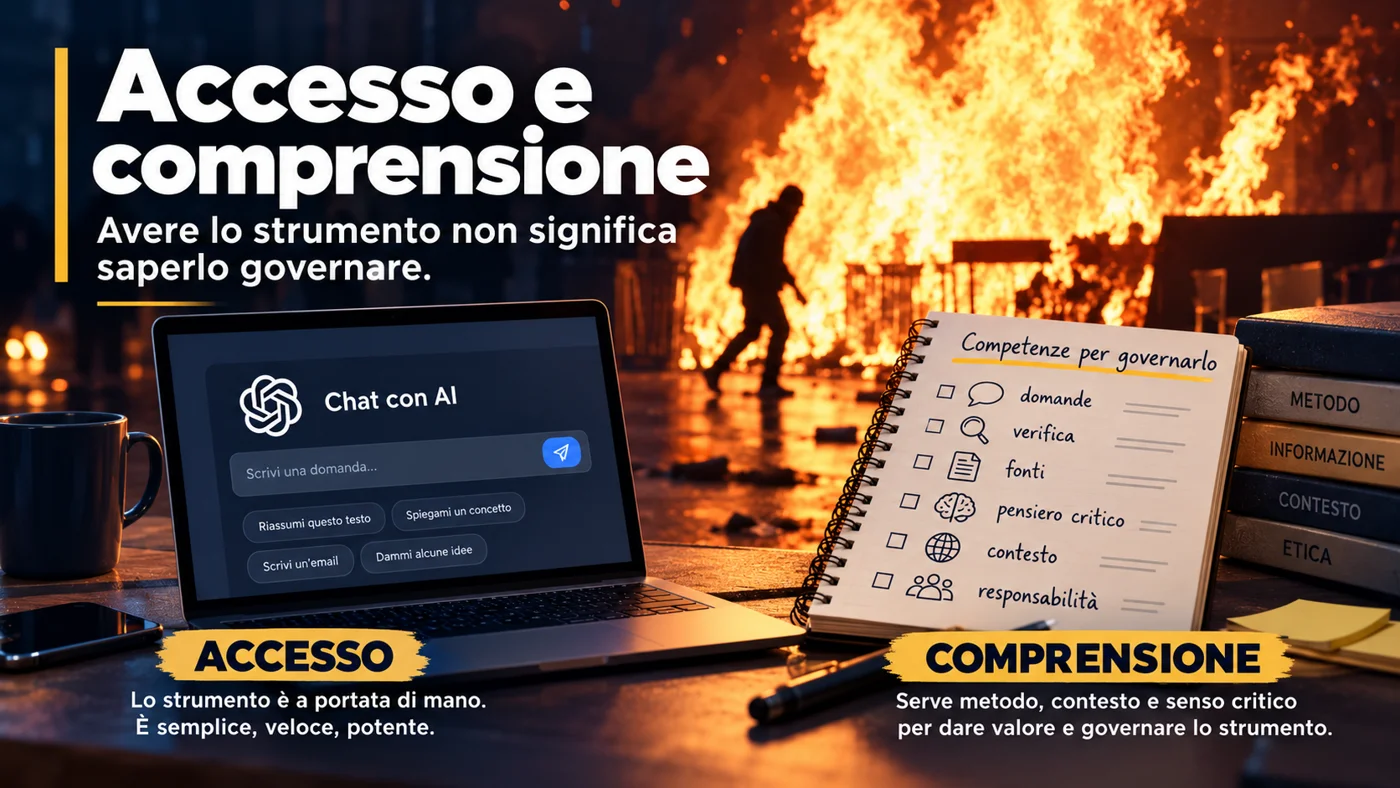
Adoption is not the same as transformation. Having access to a system does not mean knowing how to govern it. Automating an activity does not mean you have improved the work: sometimes you have just moved the control further forward, where errors cost more.
A good introduction to AI instead starts from real work:
- what is the problem and who is responsible for it;
- which activities are repetitive and which require judgment;
- what the system can do and with what limits;
- what checks are necessary before using the result;
- what to do when the AI makes mistakes or the service is not available;
- how the role of people changes and what training is needed.
This is the difference between deploying a tool and designing a better way of working.
Responsibility is not delegated together with the task
A system can prepare a draft, suggest a diagnosis to verify, detect anomalies, or automate a part of the flow. But when a person or organization uses that result to take action, the responsibility does not disappear within the technology.
This applies differently depending on the context. An error in an internal draft does not carry the same weight as an error in a medical evaluation, a credit decision or a security update. The level of verification must grow with the possible impact.
It's a simple, but often overlooked rule: the more important the consequence, the less we can settle for a plausible output.
And there is another responsibility, often left in the shade: that of those who decide to introduce the system. It is not enough to tell employees to “use common sense” if permitted data, control procedures, usage limits and channels for reporting problems have not been defined. It's not enough to ask people to verify everything, without giving them time, expertise or access to sources.
Individual awareness matters. But it cannot become an alibi for an organization that passes on the risks of a technology introduced without governance to users.
Training must go beyond prompts
To learn to use AI, a list of effective prompts is not enough. Request techniques can be useful, but they get old quickly and don't solve the main problem: understanding whether the answer is necessary.
Training should start from concrete activities and teach:
- break down a problem before asking for a solution;
- provide the necessary context without exposing improper data;
- compare the output with independent sources and criteria;
- recognize when the system is filling a gap with a plausible response;
- use iterations and corrections without exchanging fluidity for accuracy;
- decide when not to use AI;
- document and take responsibility for the final result.
Every person doesn't need to become a machine learning expert. Everyone needs to understand where the machine's help ends and where their own judgment begins.
This is why I do training: not to teach how to press a button or memorize formulas, but to help people understand what AI does for them, what it doesn't do and what changes in their work.
The training question is not just: How do I use this tool?
It's also: what part of the job am I trying to improve, how will I recognize a good result and who is accountable for it?
A simple criterion for the next result
The discussion on AI is often divided between two opposite positions: those who would ban it to defend competence and those who would adopt it without reservations so as not to be left behind.
Both risk avoiding the most difficult question.
We don't have to prove we're capable by pretending not to use tools. And we don't have to prove we're innovative by accepting whatever a tool produces.
We can use AI, even intensively, and remain responsible. But to do this we need to be able to explain what we asked, what we checked, what we changed and why we consider the result fit for purpose.
The criterion is not the purity of the process.
It is the quality of the work, together with the understanding and responsibility of those who deliver it.
Let's not just ask ourselves if a person has used artificial intelligence. Let's ask ourselves if she understood what AI did for her.
That's where competent use begins.