
Occasionally, an image or a phrase about AI raises a question larger than technology.
If the human species first invented mechanical machines and is now building machines capable of generating language, apparent reasoning and autonomous decisions, could we ourselves be the first successful prototype of that process?
We can imagine it provocatively: civilizations infinitely greater than us created a living planet, designed us as organisms capable of reproducing, gave us water, energy, oxygen and raw materials, and left us producing knowledge, work and value on someone else's behalf.
We are biological machines, expendable, replaceable and freely reproducible.
This hypothesis has no scientific basis. It is not a theory to present as fact. It is a literary lens that allows us to look differently at what we are building today.
Because the resemblance to the technological process is uncomfortable.
The machine we replace is not only physical
When a factory introduces an industrial robot, it replaces a movement. When it introduces an AI agent, it can replace an activity involving research, reading, writing, classification, decisions and coordination.
The difference is substantial.
A mechanical machine requires constant energy, a stable network, maintenance and replaceable components. A biological machine can be fueled by bread and caffeine, manipulated emotionally and return to work the next day believing it is doing so freely.
The metaphor becomes even sharper if we look at the labor market.
The system continues to prefer a resource that can receive instructions, process them, produce a result and become available again, with the lowest possible cost of nourishment and training.
Yet human beings are not CPUs. They have memories, affections, culture, health, traumatic experiences and a life beyond the shift. When they are treated as components, they do not cease to be so in practice. But in reality they continue to be something more.
The economic side of the biological machine
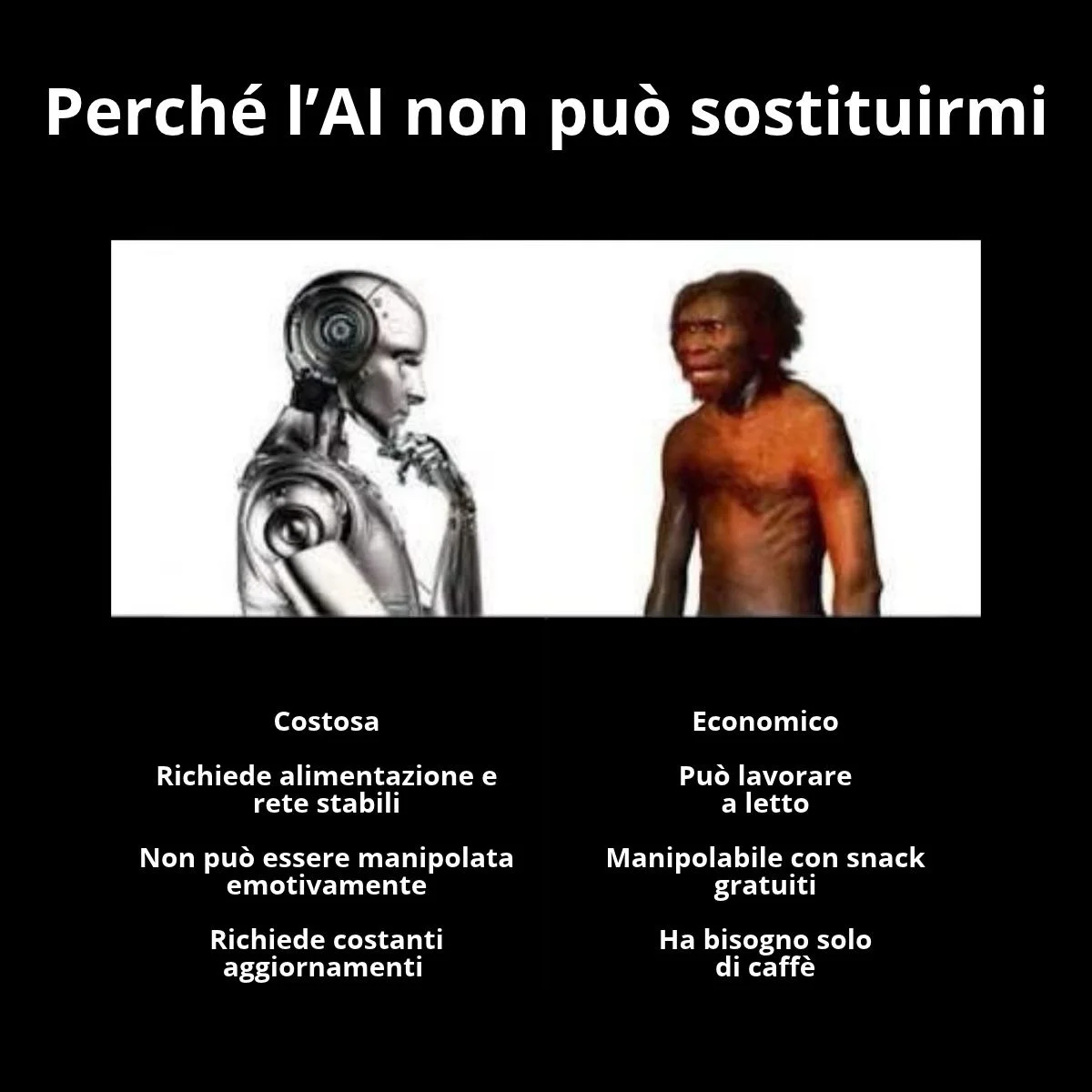
In the image accompanying this reflection, a metaphor contrasts costs and economy.
An artificial machine costs energy, a stable network, maintenance and continuous updates. A human can work in bed, be manipulated with free snacks, persuaded emotionally and trained for new functions.
The joke is harsh, but it contains a real question:
are we building more intelligent systems to free ourselves from toil, or to make human work even easier to measure, replace and automate?
When an organization considers a person only in terms of cost, speed and availability, it reduces them to a resource. When it considers them in the development of skills, responsibilities and decisions, it recognizes them as part of operational sovereignty.
The problem is not efficiency. Every company should eliminate waste and make work sustainable. The problem arises when efficiency becomes the only value and human cost is merely an item to compress.
Reproduction, self-repair and obsolescence
Human civilization reproduces, ages and dies. But the planet continues to use its remains to create new forms of life.
From this perspective, we could be machines that regenerate themselves, without the need for centralized maintenance.
A more advanced species might have designed the system to obtain work, surveillance, energy or simply data. No matter how fantastical this hypothesis may be, its philosophical value lies in observing how we are already organized.
We reproduce out of biological necessity, but the entire economic system has an interest in creating consumers, workers, users and data.
The human being is a node that produces and records information. It lives in an environment that turns thought into content, content into advertising, advertising into behavior and behavior into economic value.
We are not designed by an alien civilization. But we are building systems that strikingly resemble the very model we attribute to a supposed external creator.
Agentic AI is not the end of the human species
In the popular imagination, AI will replace all of us within a few years.
Reality is less theatrical and more silent.
Many activities will be automated. Some professionals will see the value of their standardized skills decline. Others will gain operational power. Some organizations will grow without a proportional increase in staff. Others will need new roles to supervise, correct and govern agents.
The decisive issue is not whether AI can replace a human.
It is who will decide which decisions remain human and which become delegable.
When an agent can read data, call tools, change configurations and act on external systems, it becomes a machine with an operational identity. It must have limited authority, human approval, traceability and revocation.
If these boundaries do not exist, the human user becomes part of the system exactly like a component: receiving inputs, producing actions, being monitored and replaced.
The real question is not whether we will be used by machines.
It is whether we will continue using people as machines.
Consciousness as the ultimate difference
A machine can simulate a choice, but it is not responsible for its own design. It can process alternatives, but it has no life to lose.
A human being, by contrast, can refuse, create, change direction and value what has no immediate price.
This capacity is not a barrier against AI. It is the reason why AI must be designed under human control.
If a system makes decisions without explanation, the error is not merely technical. It is a form of power. If a job demands obedience without understanding, the problem is not merely organizational. It is a form of control.
Technology always accelerates what an organization chooses to become.
It can make work more creative or more fragmented. It can increase individual capabilities or eliminate the dignity of decision-making.
Are we really the machine?
The hypothesis that distant civilizations created us as biological machines cannot be demonstrated. And it does not need to be demonstrated for us to understand the point.
We are already surrounded by systems that treat us as productive units, data, profiles, metrics and resources.
The difference is that today we can design what comes next.
We can use AI to expand skills or erase them. We can automate decisions or introduce human responsibility where it matters. We can train people or reduce them to users to be monetized.
Perhaps the most important question is not whether there is a civilization that built us.
It is whether we are building, intentionally or otherwise, a civilization that behaves as if all of us were replaceable.
The final provocation is simple:
If, in the end, we are measured only by the amount of work we produce and the cost required to keep us operational, what difference would truly separate us from the machines we have built?
#AI #IntelligenzaArtificiale #AIAgentica #FuturoDelLavoro #Società #Tecnologia #Etica #Cultura #Autonomia #SovranitàTecnologica