
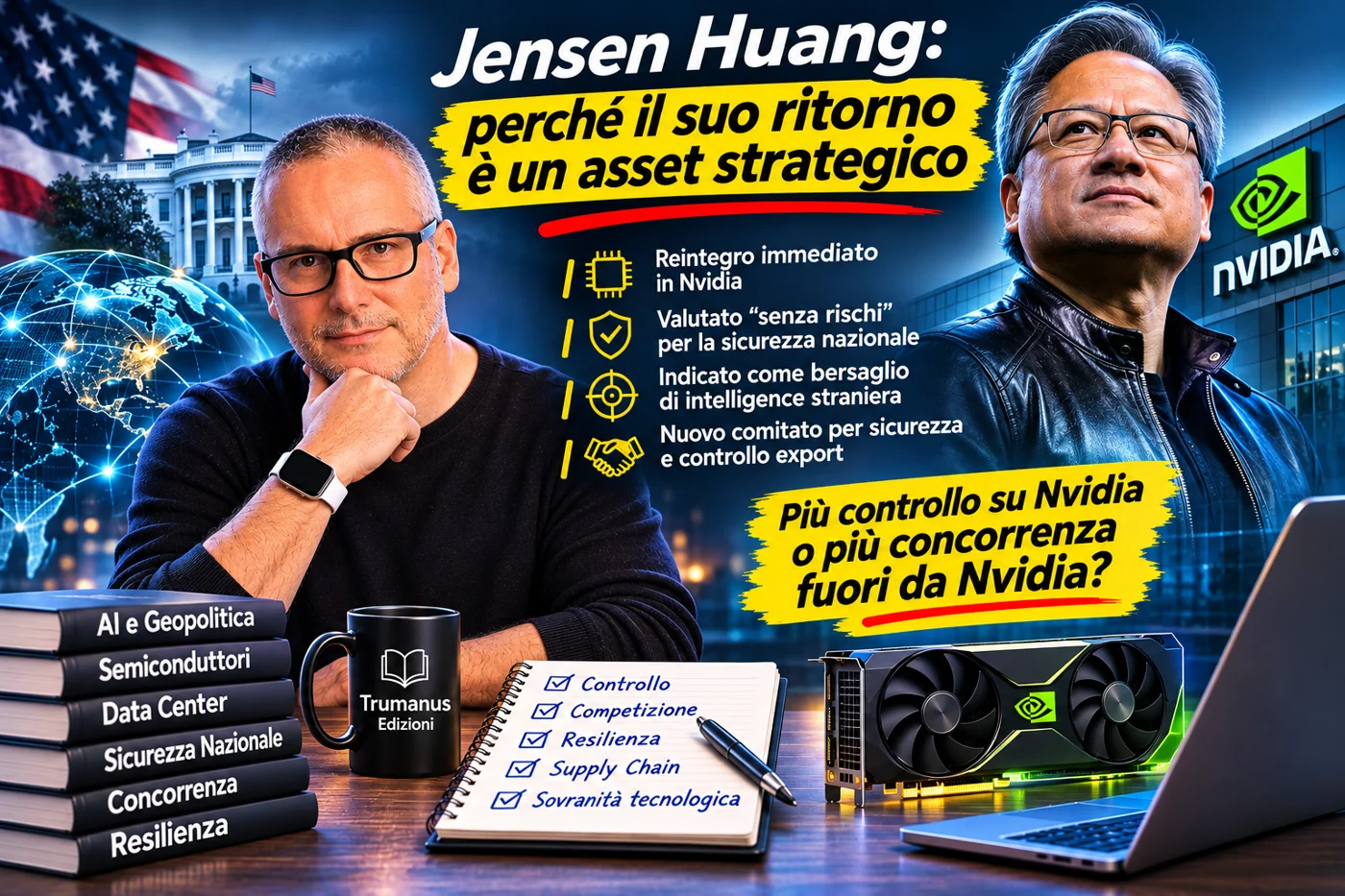
On November 23, 2026, Nvidia announced that Jensen Huang had been reinstated, effective immediately, as CEO, president and board member.
The news is important. But the most interesting point is not Huang's return. It is the reasoning reported by the board: senior US officials were consulted and, based on their advice, the reinstatement was deemed to pose no national security risks.
Nvidia added two elements that broaden the picture: Huang was identified as a target of foreign intelligence activity, and the company established an independent committee for national security and export controls.
None of this demonstrates that Donald Trump personally decided Huang's return or privately explained to him that the American industrial system would face “serious geopolitical security problems”.
That is, rather, a provocative reading of the facts: if Nvidia represents the operational center of the GPU ecosystem, losing Huang or losing political control over its direction can be perceived as far more than an ordinary change in corporate leadership.
The CEO who built a platform
Jensen Huang did not simply lead Nvidia to success. He built an ecosystem encompassing chips, data centers, interconnections, developer tools, software, production models and relationships with governments and cloud providers.
His role matters because the market does not merely buy Nvidia components. It buys a system. In software, that system is called CUDA; in infrastructure, a platform; in diplomacy, industrial leverage.
That is why Huang's strategic value does not coincide with his popularity or the stock price. It coincides with the continuity of a network of relationships, skills and decisions that are difficult to transfer elsewhere.
If Nvidia were merely a semiconductor company, the board could replace a CEO almost routinely. But in a world where computing power determines economic competitiveness, surveillance, scientific research and military capabilities, the process takes on another meaning.
The question Trump — or anyone with authority over the United States — might have asked
This is a hypothetical reconstruction, not a quotation:
what does it really cost the United States for the key to the AI ecosystem to remain in Nvidia's hands, but outside American political control?
Corporate independence is a good thing. That does not mean, however, that the company operates in a neutral space. The ability to influence exports, delivery times, partnerships, data centers and access to advanced models can become a national security issue.
From this perspective, Huang's reinstatement might have seemed preferable to a period of instability at the top. Not because the government should elect CEOs, but because suddenly removing the leading industrial reference figure could create a vacuum at a time when the United States and its allies are trying to control the flow of computing power toward other countries.
The point is even more blunt: an Nvidia without Huang could become a less coordinated Nvidia, more exposed to internal conflicts, less effective in responding to political pressure and more vulnerable to the temptations of foreign markets.
My provocative interpretation is therefore this: a government can tolerate private power as long as that power can be understood, influenced and coordinated. It can become dangerous when it appears misaligned, unpredictable or managed by leadership that moves beyond American control.
This hypothesis connects to our earlier reflection
A few weeks ago, I wrote that I hoped a credible competitor to Nvidia would emerge. Not an alternative monopolist, but a market with more alternatives, more available capacity and less dependence on a single supplier's software, networks and relationships.
Huang's return makes that issue even more urgent.
If concentrating AI power in Nvidia's leadership is considered a security guarantee today, tomorrow it could become the main point of vulnerability. A system dominated by a single CEO, a single ecosystem and a single country is very effective while everything works. It is fragile when geopolitics changes, a supply chain fails or a conflict emerges between corporate and national interests.
Competition is therefore not merely an economic issue. It is a form of resilience.
The real provocation
Perhaps America did not reinstate Huang because it needs Nvidia.
Perhaps it reinstated Huang because it understood that, in the absence of strong alternatives, keeping Nvidia under its direct influence is a strategic priority.
This sentence is not evidence. It is a question.
Who really controls the AI ecosystem? The market, the board of directors, the US government or a few executives who simultaneously understand technology, industrial policy and diplomacy?
And who would govern the same market if Huang left the company to found a competitor?
As I hypothesized in the previous article, a new company led by one of the main architects of AI infrastructure could break Nvidia's absolute centrality. But it could also move a new kind of concentration elsewhere: knowledge, relationships, intellectual property and control of the supply chain.
That is why the final question is not only “who will lead Nvidia?”.
It is whether the United States wants more control over Nvidia or more competition outside Nvidia.
Because these two objectives are compatible only up to a point. The first protects the existing system. The second could make it less vulnerable over the long term.
Sources
- Swissinfo — “Nvidia: Huang reinstated as CEO”
- Previous special — “Competition in GPUs is needed to make AI accessible”
#AI #Nvidia #JensenHuang #Trump #Semiconduttori #Geopolitica #SicurezzaNazionale #GPU #DataCenter #Concorrenza