
Category: AI, work and society Tags: artificial intelligence, AI economics, productivity, AI agents, future of work
Why AI costs should be measured against verified outcomes, without ignoring quality, security and human value.
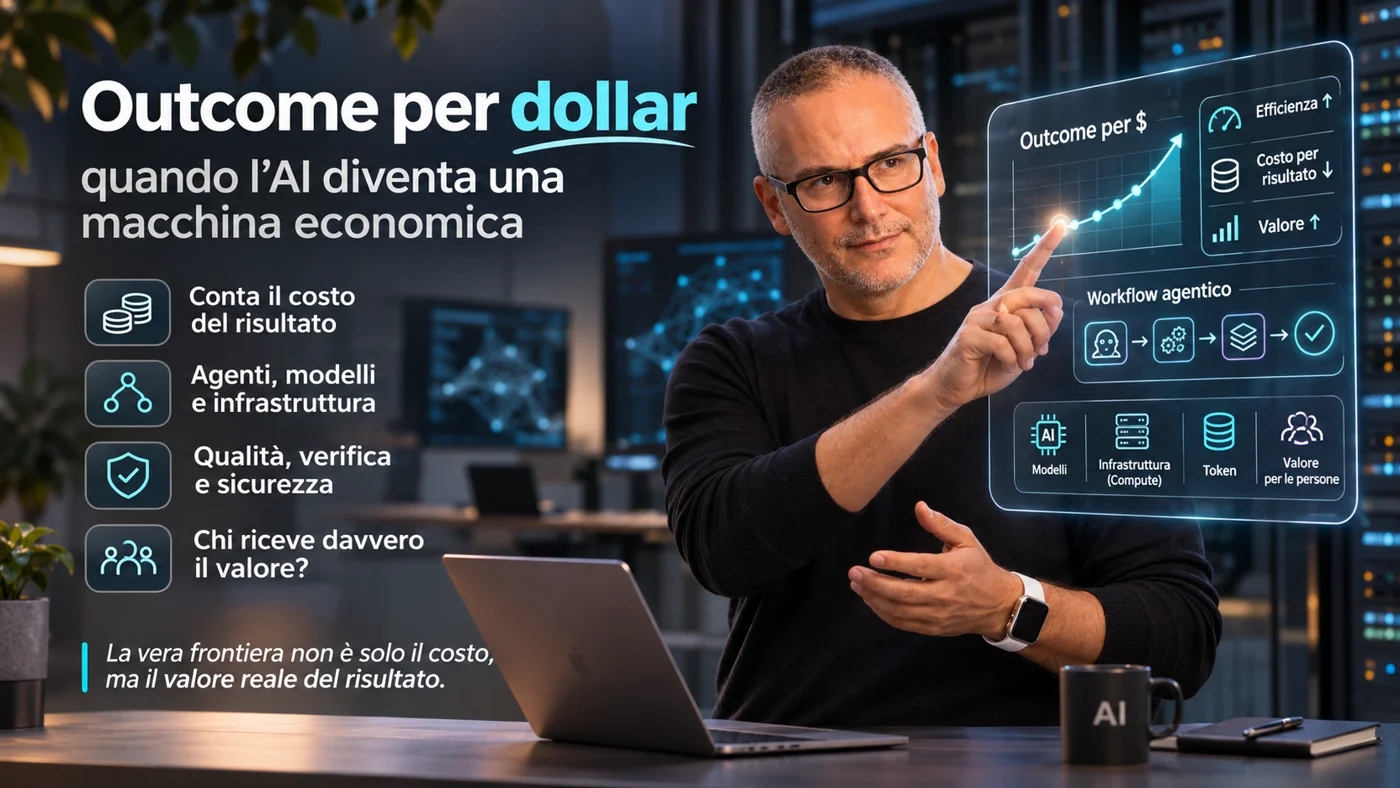
“Outcome per dollar is the frontier”.
With this phrase, Satya Nadella summarizes the direction set by Microsoft AI: building larger models or achieving better benchmark scores is not enough. The challenge is to produce useful outcomes at an ever lower cost.
It is an important shift in perspective. The question is no longer simply “how intelligent is the model?”, but:
how much does it cost to obtain an outcome, and how often is that outcome actually correct and usable?
From intelligence to the cost of an outcome
In the post, Nadella connects efficiency at three levels: pre-training, reinforcement learning and more token-efficient models. He also states that models and products are developed together, so that economic improvements can be passed on to customers, while remaining open to frontier models from other providers as well.
This is a precise industrial strategy: optimizing not a single neural network, but the entire chain leading from computation to outcome.
Microsoft AI describes Rocket, its reinforcement learning infrastructure, as a system capable of sustaining long training cycles distributed across thousands of GPUs. For agentic tasks, such as software engineering, some attempts can last hours: the agent performs a sequence of actions, uses tools, receives responses and continues until the task is completed or a limit is reached.
The promise is to make this kind of work economically sustainable at scale.
There is a point here that often disappears behind demos: an agent that reasons for longer is not necessarily more efficient. It can consume more tokens, computation and time. Value is therefore not measured by counting generated responses, but by checking how many tasks are completed correctly and at what total cost.
The outcome is not the token
Cost per token is a useful metric, but it is not enough. A cheap model that often makes mistakes may require more attempts, human review and corrections. An agent that completes an activity with apparent autonomy may still need checks, permissions, infrastructure and error management.
To truly assess the cost of an outcome, we should include at least:
- quality and correctness of the outcome;
- number of attempts and rework;
- latency and service availability;
- computing and energy consumption;
- necessary human intervention;
- integration, security and governance costs;
- impact of an error or an unauthorized action.
A less expensive model does not automatically mean a less expensive process. And a lower cost does not automatically mean more value for those using it.
The most meaningful metric might be the independently verified cost per completed task, including failures and the work needed to correct them.
When the model becomes a platform
Microsoft states that it wants to control the entire pipeline: models, training infrastructure and inference systems. The stated advantage is being able to optimize the different components together, rather than considering them separately.
The logic is understandable. If the model is designed for the infrastructure it runs on, it can make better use of the available computation. If tools and products are developed together, features can reach users faster.
But integration also brings a strategic consequence: the more layers of the same supply chain are controlled by the same provider, the harder it becomes to distinguish the product from the system that makes it possible.
The customer no longer chooses merely a model. They choose an ecosystem: infrastructure, interfaces, data, tools, costs and access conditions.
It is an advantage as long as it improves reliability and reduces costs without removing freedom of choice. It becomes dependence when migrating to another system is too costly or when fundamental decisions are no longer transparent.
From machine efficiency to human efficiency
Here the discussion also touches human work.
If the goal is to obtain more outcomes for every dollar invested, AI will increasingly be assessed as a productive resource. But the same logic can be applied to people: output per hour, activities per employee, cost per case, performance per team.
This is the less neutral side of efficiency.
There is nothing wrong with reducing waste, automating repetitive activities or freeing people from pointless tasks. The problem arises when economic results become the only criterion and human work is treated as a component to optimize, replace or keep constantly available.
A machine can be assessed through throughput, latency and cost. A person, however, is not merely what they produce within a period of time. They bring experience, judgment, responsibility and the ability to recognize when a formally correct objective is wrong in context.
If AI makes work more productive, the question is not only how much the company saves. It is also who receives that value: the customer, the company, the worker or the owner of the infrastructure?
The autonomous agent remains a system to govern
The post discusses efficiency, but agent autonomy makes a discussion of control inevitable too.
When an agent can operate for minutes or hours, interact with tools and change its behavior based on results, cost is not the only parameter. Authority limits, distinct identities, traceable actions, approvals for sensitive operations and the ability to interrupt or revoke access are needed.
An agent that completes more activities while spending less, but has excessive privileges or leaves no verifiable traces, is not efficient: it transfers the cost into a risk that may emerge later.
That is why outcome per dollar should mean not simply “more output at the lowest price”, but more correct, verifiable and secure outcomes for every dollar invested.
The real frontier
Nadella's message captures a real transformation: AI is entering the phase in which the economics of execution matter as much as the model's capabilities. Training, inference, agents, hardware and products are being optimized as a single system.
But every metric also reveals what we have chosen to value.
If we measure only cost, we will tend to ignore quality. If we measure only speed, we will overlook consequences. If we measure only outcomes per dollar, we may fail to ask who bears the hidden costs and who benefits from the gains.
The frontier, then, is not merely obtaining more intelligence for each unit of computation.
It is building systems that deliver useful outcomes without reducing people, organizations and choices to a simple cost equation.
The question we should ask is not merely “how much does an outcome cost?”, but “what are we calling an outcome, who verifies it and who receives its value?”.
Sources
- Satya Nadella — LinkedIn post
- Microsoft AI — Frontier Pre-training at Microsoft AI
- Microsoft AI — RL infrastructure at Microsoft AI
#AI #IntelligenzaArtificiale #AIAgentica #MicrosoftAI #FuturoDelLavoro #Efficienza #EconomiaDigitale #Governance #Etica #Innovazione