
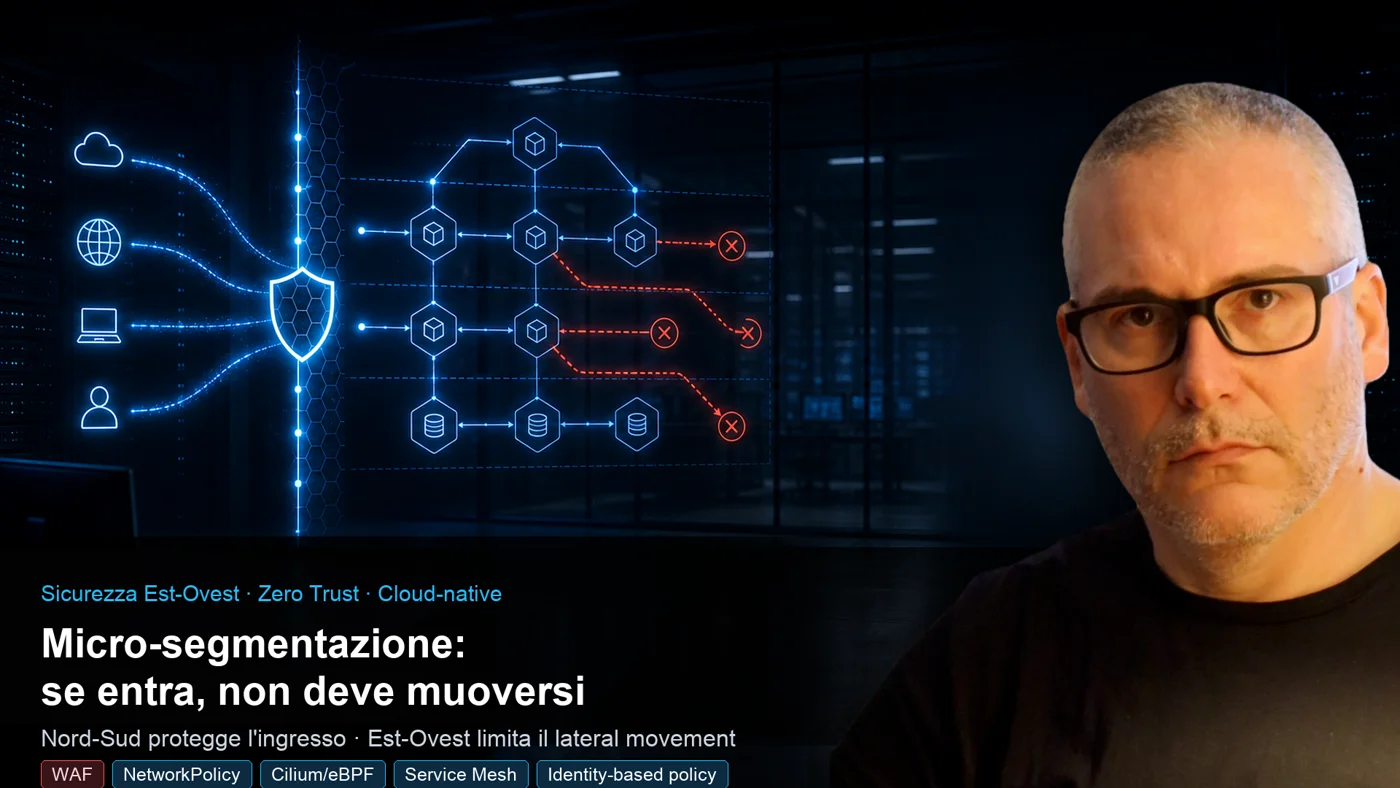
For years we've thought about security as if the problem was just keeping attackers out.
Firewalls. WAF. VPN. Proxies. Checks at the entrance.
Everything correct.
But incomplete.
Because today many compromises don't end when the attacker enters. They start there.
The real point becomes another:
once inside, how far can it move?
North-South and East-West
In network security parlance, North-South traffic is traffic that enters or exits the perimeter.
Examples:
Internet -> WAF -> Applicazione
Utente esterno -> API pubblica
Client -> Load Balancer -> Servizio
It is the traffic that we are used to protecting.
East-West traffic, however, is internal traffic.
Examples:
Frontend -> Backend
Backend -> Database
Microservizio A -> Microservizio B
Container -> API interna
VM -> File server
Applicazione -> Sistema di backup
And this is often where the problem lies.
Because many networks are still built with implicit logic:
if you're in, you're pretty trustworthy.
This assumption is dangerous today.
The problem isn't just getting in
Let's imagine a compromised web server.
Without micro-segmentation, this can happen:
Server Web compromesso
        |
        v
Database
File server
API interne
Backup
Pannelli amministrativi
Altri server
The attacker no longer has to force the main door.
He's already in.
Now look for credentials, tokens, network shares, exposed databases, outdated internal services, reachable backups, administrative ports left open.
This is called lateral movement.
Lateral movement.
And that's one of the reasons why a small accident can become a big accident.
What is micro-segmentation for?
East-West micro-segmentation serves to limit and control internal traffic between systems, services, workloads, containers, VMs and microservices.
The principle is simple:
each component must be able to speak only with what they really need.
Not:
Tutto parla con tuttoBut:
Frontend -> solo Backend
Backend -> solo Database
Database -> non avvia connessioni verso altri servizi
Servizio X -> non parla con Servizio Y
With micro-segmentation, the scenario changes:
Server Web compromesso
        |
        v
può parlare solo con API Gateway sulla porta consentita
        |
        v
non raggiunge Database
non raggiunge Backup
non raggiunge Admin Panel
non raggiunge altri server
The attacker is still in.
But the range is much smaller.
This is the important technical point: micro-segmentation does not promise that no one will ever enter. It is used to reduce the blast radius when something goes wrong.
In the cloud and Kubernetes
In the cloud-native world the problem is even more evident.
Workloads change. Containers are born and die. IPs are not stable. Services scale automatically. Internal APIs increase.
In Kubernetes, for example, without proper policies many pods can communicate with each other more than they should.
A correct policy should express rules such as:
Il frontend può chiamare solo il backend sulla porta 8080.
Il backend può chiamare solo il database sulla porta 5432.
Il database accetta traffico solo dal backend.
Nessun altro pod può raggiungere il database.
This is not technical bureaucracy.
It's damage control.
The tools
Micro-segmentation can be implemented with different tools:
- internal firewalls
- security group cloud
- Kubernetes Network Policy
- service mesh like Istio
- Cilium and eBPF
- Zero Trust Network Access
- policies based on workload identity
The choice depends on the architecture.
But the principle remains the same:
Don't trust a connection just because it's internal.
IP to identity
In the past many rules were IP based.
10.0.1.20 può parlare con 10.0.2.15 sulla porta 443In static environments it can work.
In modern environments it becomes fragile.
Better to think by identity:
Il servizio frontend può parlare con il servizio backend.
Il servizio backend può parlare con il database.
Il servizio payment può parlare solo con ledger e fraud-check.
This model is closer to how clouds, containers, and microservices really work.
The summary
North-South security remains fundamental.
The WAF is needed. The firewall is needed. Perimeter control is needed.
But it's not enough.
Because a modern infrastructure should not only be protected at the entrance.
It must also be protected inside.
The question is no longer just:
who can enter?
But also:
Who can talk to whom once inside?
Put bluntly:
the WAF protects the front door.
Micro-segmentation prevents the thief, once he has entered the kitchen, from roaming freely throughout the house.