
Category: Frontier mathematics Tags: artificial intelligence, mathematics, Riemann Hypothesis, Lean, research
An AI-assisted proof raises a broader question: what does it really mean to understand and verify an answer?
For 167 years, the Riemann Hypothesis remained one of the most famous and difficult problems in mathematics.
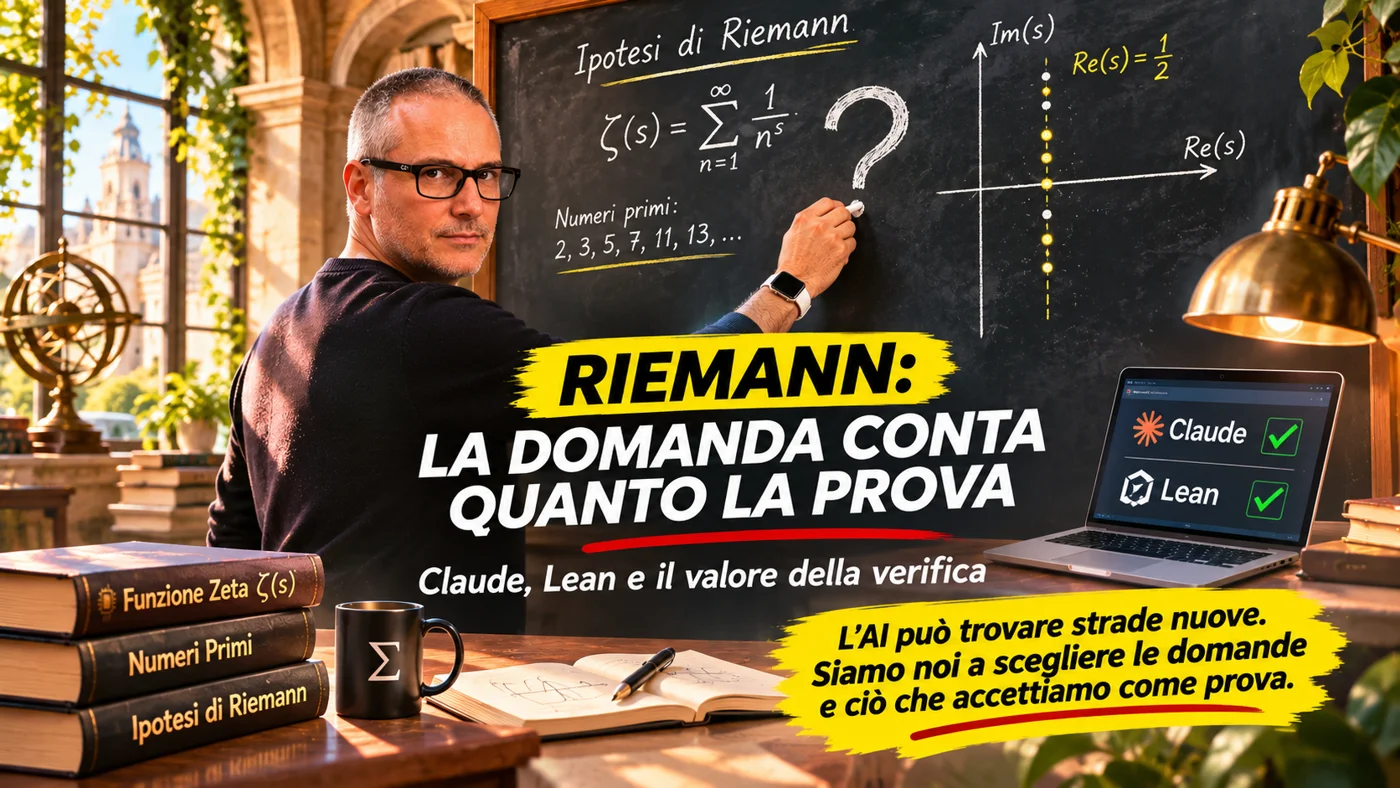
On November 20, 2026, Levent Alpöge, a mathematician at Anthropic, announced a proof developed with Claude's help. The result was formalized in Lean, a language that allows a system to check, step by step, whether a proof follows from mathematical rules.
The most impressive fact is not merely that an AI participated in a problem open for more than a century and a half. It is how we must understand what it really means to say that an AI helped prove it.
The question to ask is not: “Did AI do it, or did a human do it?”.
It is: who formulated the problem, who found the path, who checked the result and who can explain its meaning?
First, the Riemann Hypothesis in simple terms
Prime numbers seem to be distributed irregularly. They are the building blocks of all other integers, but the farther you go along the number line, the rarer they become.
In 1859, Bernhard Riemann linked their distribution to a mathematical function called the zeta function. In greatly simplified terms, his hypothesis states that all the “nontrivial” zeros of this function lie on the same vertical line in the complex plane.
Why should this interest us?
Because the location of those zeros tells us how regularly prime numbers are distributed. Proving the hypothesis would help us understand with great precision how far observations of prime distribution deviate from the expected average.
It is one of the Clay Mathematics Institute's seven Millennium Prize Problems, with a one-million-dollar prize for a correct proof.
What AI did
According to Alpöge's account, the work with Claude lasted around six weeks and led to a proof formalized in a Lean library of around 17 million lines of code.
An export in traditional mathematical form would have exceeded 250,000 pages: a size that makes it practically impossible for one person to read and check every single step in the usual way.
But there is a fundamental distinction here. A long proof, or one that is difficult to read, is not automatically a wrong proof. Lean was designed precisely to formally check that every step follows from previous steps and the declared axioms.
On November 21, the Lean and Mathlib community announced that it had verified the proof's correctness. It checked that the code compiled, that the theorem proved really corresponded to the statement of the Riemann Hypothesis in Mathlib, and that the proof was accepted by several verifiers, including Lean's official kernel and other independent checkers.
This changes the picture compared with the initial announcement: it is no longer merely an individual mathematician's claim. Formal verification provides strong guarantees that the proof is logically valid with respect to the checked mathematical formulation.
Another challenge remains, however: understanding the ideas of the proof, reconstructing its path and grasping which mathematical insights made it possible. Automated verification can certify that the formal reasoning holds; it does not necessarily make it intuitive or readable for us.
AI did not wake up with a question
It is easy to turn the result into a headline such as: “Artificial intelligence solved the Riemann problem on its own”.
It is a simple headline, but it hides the process.
Alpöge was a mathematician who knew the problem and had spent a long time studying the ground on which to work. He brought a research direction, collaborated with Claude, evaluated the responses and persisted with the useful steps. In his account, he explains that the model proposed ideas that surprised him and, at certain moments, went beyond him.
It is therefore not correct to reduce AI's contribution to autocomplete. But it is equally incorrect to imagine Claude as a human researcher who spontaneously posed the problem, decided it mattered and worked to prove it without guidance.
The breakthrough lies in the interaction: an expert formulates a difficult question and guides the research; the model explores possibilities, produces steps and suggests connections; formal tools check the proof; other mathematicians verify what has been proved.
AI expands the range of things we can explore. It does not automatically replace the choice of what is worth exploring.
But can AI connect things that seem unrelated?
Here I want to clarify a point. I would not say that artificial intelligence “still cannot connect two things without context”.
Models can find analogies, combine distant ideas and propose connections that nobody had made explicit in the conversation. Sometimes those very associations are useful in opening new paths.
The difference lies elsewhere: producing a plausible connection is not the same as knowing that the connection is meaningful, true or useful for the problem.
A model can associate concepts because it has learned regularities in data, because it follows clues in the prompt or because a certain sequence of words is statistically likely. A researcher, by contrast, can decide that two apparently distant fields deserve to be connected, formulate a new question and recognize when the answer changes how the problem is viewed.
Human beings do not invent in a vacuum either: they draw on knowledge, experience and contexts. The human advantage is not a mysterious ability to make connections that machines cannot make. It is the ability to deliberately give research a direction, choose what to test, understand which assumptions matter and take responsibility for conclusions.
AI can suggest a path. The research question determines where it is worth going.
Learning to ask questions is part of expertise
Using AI well does not mean writing a long prompt or knowing secret formulas.
It means learning to turn curiosity into a verifiable process. For example:
- precisely defining the problem and the desired result;
- providing context, assumptions and constraints;
- requesting several approaches, not a single definitive answer;
- asking which steps are proved and which are conjectures;
- asking for sources, counterexamples and possible weaknesses;
- using independent tools to verify calculations and claims;
- stopping the research when the result is not reproducible.
For a mathematical problem, the context may include rigorous definitions and already known theorems. For a public-health problem, however, data quality, real-world conditions and consequences for people must also be assessed.
A good question does not merely help obtain a better answer. It makes clear what would count as evidence.
Verifying an answer does not always mean the same thing
In formal mathematics, we can describe rules and steps within a logical system and have software check that a conclusion follows from its premises. Lean is valuable precisely because it verifies the structure of the proof, not because it “believes” the model that produced it.
Outside mathematics, many questions concern the real world. A system can perform every step correctly while starting from incomplete data, an incorrect measurement or a hypothesis that does not describe reality.
Verification must then also address:
- the quality of sources and data;
- assumptions built into the model;
- reproducibility of results;
- differences between simulations and real conditions;
- uncertainty and the consequences of an error.
The Riemann proof does not demonstrate that AI can answer every question correctly. It demonstrates something more limited and, precisely for that reason, important: AI, formalization and independent verification can collaborate on a mathematical proof of enormous complexity.
Real collaboration
The result does not force us to choose between “humans are creative” and “machines are intelligent”. It invites us to redesign research work.
Human beings can become more effective at formulating problems, exploring hypotheses and giving meaning to answers. AI can expand the number of paths to examine and help build proofs that, without assistance, would be far harder to develop or check.
But if formal verification is automatic and understanding remains out of reach, the scientific community will need to learn to manage both: trusting certified correctness while continuing to seek a human explanation.
Not out of distrust of machines. Because understanding a proof also means being able to reuse it, teach it, connect it to other problems and build new ideas from it.
Perhaps the most important skill in the AI era will not be knowing how to obtain an answer.
It will be knowing how to formulate the question, recognize which connections deserve exploration and build a method for verifying the answer.
AI can help us find a path we had not seen. But we are still the ones who must decide which problem to pose, why it matters and what we will accept as evidence.
Sources
- Corriere della Sera — What the Riemann Hypothesis is and why its AI-assisted proof concerns us all
- Lean FRO and Mathlib Initiative — Lean verification of the Riemann Hypothesis
- Levent Alpöge — note on the proof
- Clay Mathematics Institute — The Millennium Prize Problems
#AI #IntelligenzaArtificiale #Matematica #IpotesiDiRiemann #Ricerca #Lean #Claude #PensieroCritico #MetodoScientifico #Innovazione