
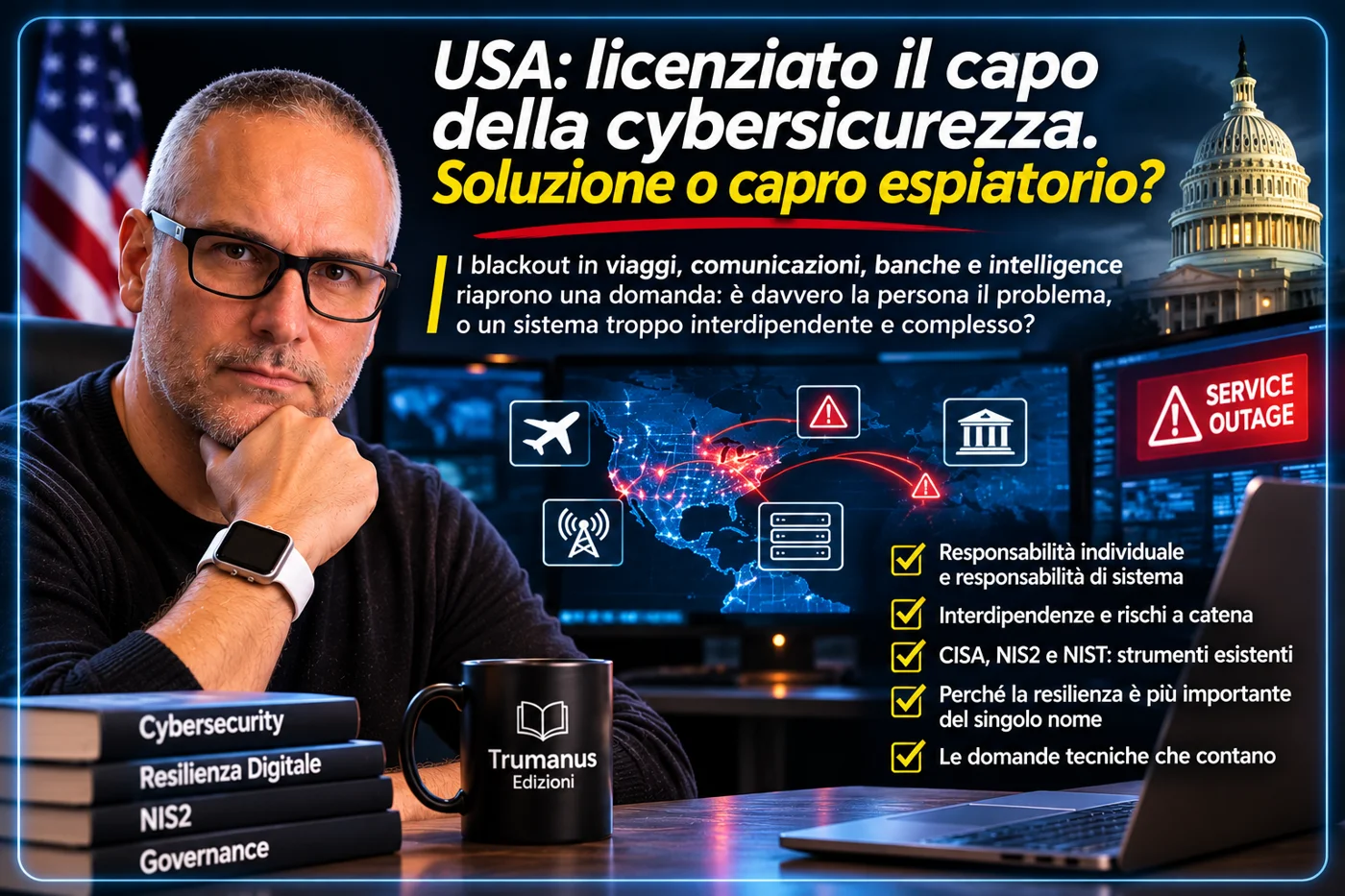
On November 20, 2026, Euronews reported the dismissal of Sean Cairncross, the United States' national cyber director. His temporary replacement is expected to be Kirsten Davies, formerly the Department of Defense's chief information officer.
The decision reportedly followed a series of service disruptions affecting travel, communications and banking, as well as an internal system used by the National Security Agency in recent weeks.
The episode has been presented as a consequence of those outages. But the available source — an article based on the testimony of a person close to the White House — does not demonstrate that Cairncross caused the incidents, knew about every failure in advance or could have prevented them.
This distinction matters. News reporting can describe a sequence of events. Verification requires a technical reconstruction: what failed, in which systems, with which dependencies, for what reasons and with what response process.
One person can coordinate. They cannot control every system.
The national cyber director's task is to advise the president and coordinate federal policies on information, data, deterrence of malicious activity and protection of critical infrastructure.
This is an important responsibility, but it is not equivalent to operational control of every hospital, bank, airline, cloud provider or federal agency. Many services are managed by different organizations, with separate networks, suppliers and responsibilities.
So when something serious happens, immediately looking for a name to fire can be reassuring. It turns a systemic problem into a simple story: the person responsible has been removed, so security has been restored.
That is not necessarily the case.
Outages show how interdependent the digital world is
The reported episode involves different sectors: transport, communications, finance and intelligence activities. We do not know whether the disruptions were connected. The absence of a common report does not demonstrate that they were separate either.
This is the point: we are used to considering the internet, travel, banks and communications as distinct services. In reality, they share infrastructure, software, suppliers, digital identities, energy and people.
A vulnerability can propagate along a chain. An error can be amplified by automated systems. A supplier can interrupt services for many customers at once. An update can be correct for one technology and incompatible with another.
Resilience, therefore, does not depend only on the security of each individual system. It also depends on the ability to limit the propagation of an incident, understand what is happening and continue providing essential services.
We are prepared, but not as well as we think
It is not correct to say that nobody has prepared anything. Risk frameworks, exercises, response teams and regulations involving governments, businesses and critical infrastructure exist.
The problem is that preparedness remains uneven.
In the United States, CISA is the national coordinator for critical infrastructure security and resilience. It has tools to receive reports, identify correlations between incidents and help public and private organizations. In November 2026, it announced an updated form to improve data quality on incident types, observed behaviors and connections between events.
In the European Union, the NIS2 Directive brings multiple sectors into a common framework, imposes risk management and reporting of significant incidents, and increasingly involves the responsibilities of corporate leadership. The European CSIRT network and EU-CyCLONe seek to coordinate responses across national borders.
Finally, the NIST Cybersecurity Framework 2.0 calls on public and private organizations to govern risk continuously through identification, protection, detection, response and recovery.
These tools exist. The question is whether they are applied at the same time, with the same data, across the same chain and with sufficient authority to intervene.
The individual can be responsible. But the system determines how much they can get wrong.
We should not automatically protect executives. If a person acted badly, ignored warnings or failed to ensure the resources necessary for their role, they must be assessed on evidence.
But treating dismissal as a solution often confuses individual responsibility with institutional responsibility.
A coordinator can be replaced. But if essential systems still lack an updated inventory, incidents are reported late, alternative procedures do not exist, suppliers share vulnerabilities or data is not correlated, the problem will still be there.
The scapegoat is often the most visible person: the person who signs a strategy, heads an agency or coordinates a response. The system, by contrast, remains less visible because it consists of too many interests, too many suppliers and too much complexity.
Moving beyond scapegoating requires technical, verifiable questions:
- which incidents had a common cause?
- what depended on which suppliers?
- who had visibility over the entire system?
- how was data shared?
- which alternative services were available?
- which decisions failed, and why?
- which authorities could impose corrections?
- which responsibilities were clear before the incident?
Security improves when we find answers to these questions, not when we quickly choose someone to remove.
Do not cross boundaries we do not understand
Today we are pushing digital systems, artificial intelligence, automation and cross-border dependencies beyond the boundaries most organizations can govern.
This does not mean stopping innovation. It means avoiding the assumption that speed and interconnection are sufficient virtues on their own.
Every new capability produces new breaking points. Every acceleration increases the responsibility to understand dependencies, anticipate failures and prepare alternatives.
The dismissal of a national director may be a political signal. It is not technical evidence. The real test is what happens afterward: clearer procedures, better data, defined responsibilities, real coordination and systems capable of continuing even when one part fails.
If the dismissal leads to these answers, it can serve a purpose. If it becomes merely a public gesture, it leaves intact the web of fragility that made the outage possible.
Sources
- Euronews — US national cyber director fired after tech outages
- CISA — enhanced cyber incident reporting form
- CISA — StopRansomware Guide
- NIST — Cybersecurity Framework 2.0
- European Commission — NIS2
#Cybersecurity #BlackoutDigitali #CISA #NIS2 #CyberResilience #ResilienzaDigitale #Governance