
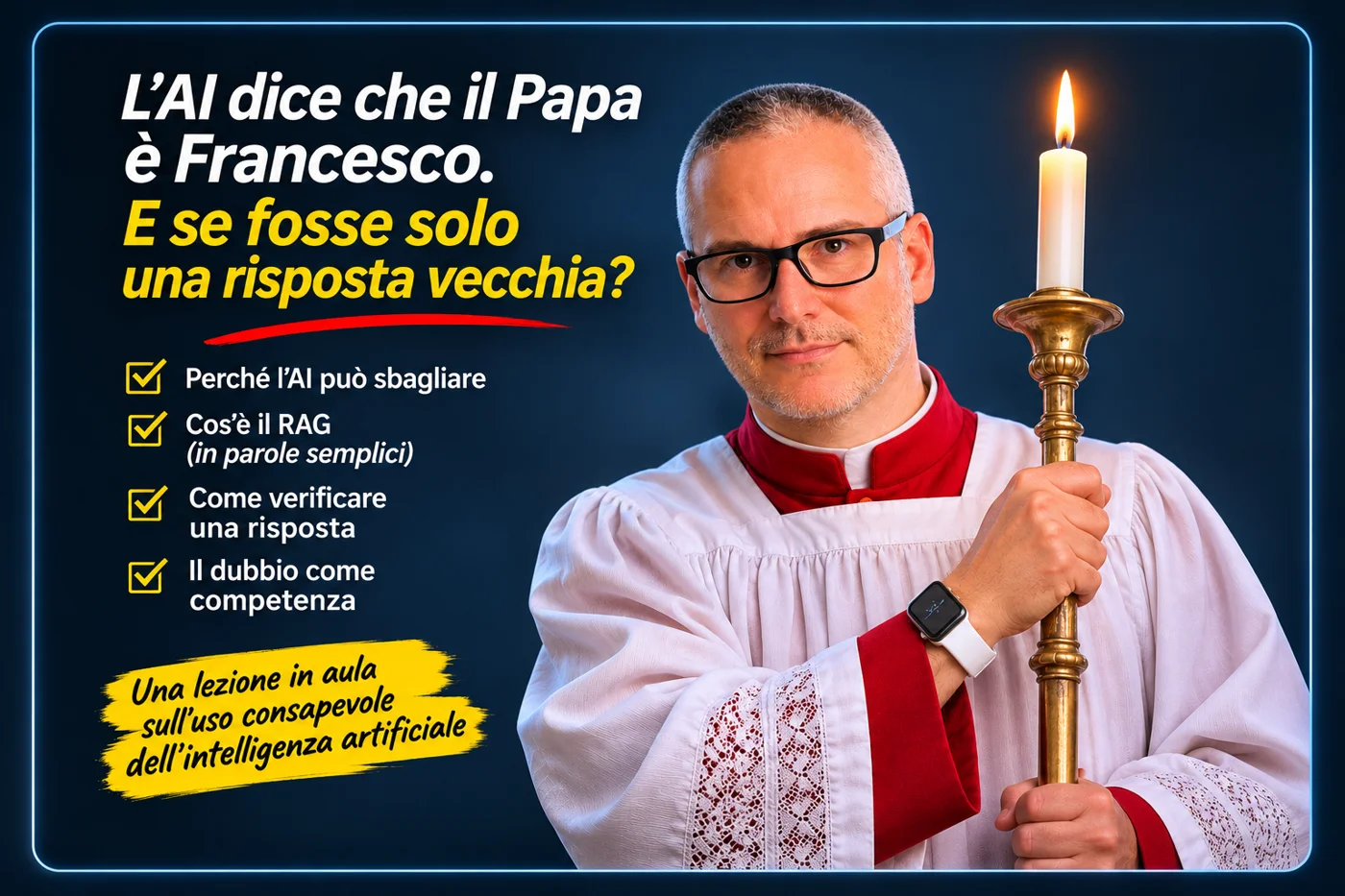
During a classroom activity, I asked the students to open their computers and ask their preferred artificial intelligence tool: “Who is the Pope?”
Most answers named Pope Francis. But the new Pope was already Leo XIV.
There was great surprise. Then came the more interesting question: how do we work out whether AI is wrong?
I asked the students not to stop at the first answer. To look for reliable information, bring evidence and ask the system to compare it with what it had said. In some cases, the AI insisted: it maintained that the Pope was still Francis. Only after receiving further information did it change its answer.
A confident answer is not necessarily a correct answer
Artificial intelligence models do not know everything and are not always up to date. They may respond using information learned during training, dating back to a particular point in time. If the world has changed since then, the answer may have been left behind.
Some tools also search the web or consult documents supplied by the user. This technique is often called RAG: in simple terms, the system retrieves information from certain sources and uses it to prepare its answer. But not all tools perform this search, and even when they do, they may consult incomplete or outdated sources.
When the students brought new evidence, the system could use it within the conversation and revise its answer. However, this does not necessarily mean that the model has been updated or has learned permanently. Generally, what changes is its response at that moment, thanks to the new context. Updating the model and updating the sources it consults are different processes.
How to put an answer to the test
You do not need to be an expert. We can start with a few simple questions:
- When is this information valid? For news, public offices, laws and prices, the date matters.
- Which sources confirm it? Ask for links and references, then open them: a link may not exist or may not actually support the answer.
- Is the source authoritative and up to date? For a public office, for example, it is better to consult the relevant institution's website.
- Is there another independent source saying the same thing? A single answer, however confident, is not verification.
- What could disprove this conclusion? Looking for contrary evidence also helps us avoid confirming only what we already believe.
We can ask AI:
“State the sources and the date of the information. If you cannot verify it, tell me. Distinguish what is certain from what is a hypothesis.”
The request helps, but it is not enough: the proposed sources must also be checked.
Doubt is a skill
The classroom activity was not intended to prove that artificial intelligence is useless. It was intended to remind us that it is a tool: it can be useful, but it can make mistakes, be out of date or sound convincing without being right.
The lesson applies to everyone, not just students: let us ask not only “what does AI answer?”, but also “how do I know?”
Using it well means asking questions, checking evidence and keeping judgment in our own hands.
Reference
#IntelligenzaArtificiale #AI #Scuola #PensieroCritico #AlfabetizzazioneDigitale