
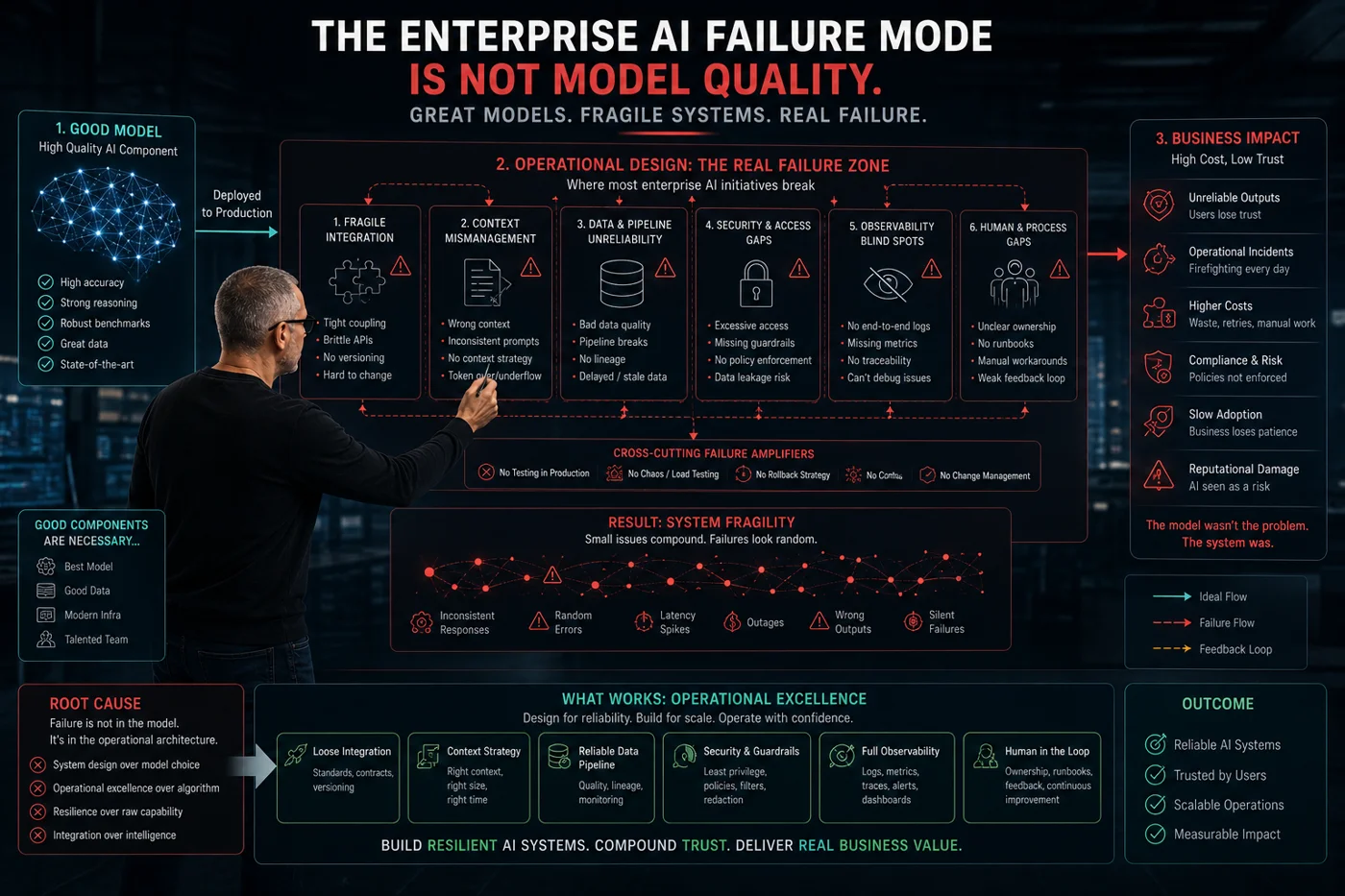
One of the most surprising things about enterprise AI is that most problems do not originate in a “poor” model.
They originate in weak operational design.
The model can be excellent.
The system can be fragile.
And that fragility operates at the point where AI meets the real world.
The model can be good and the system can still fail
A model can:
- respond well
- classify correctly
- pass benchmarks and tests
- perform very well in a controlled environment
And still fail in production because:
- external APIs are unavailable
- input data is incomplete or incorrect
- the requested action requires human approval, but there is no mechanism
- the flow has no fallback
- the process has no observability
- there is no rollback
- the system generates decision-making outputs without quality control
The problem is not, in Gaussian terms, “model quality”. It is the design of the execution system.
Operational failure modes of enterprise AI
1. Input quality degradation
AI performs poorly when input data is inadequate.
In real companies, data changes constantly: different formats, incomplete data, inconsistent processes, old versions, duplication.
If the AI system does not assess input data quality, its output will be treated as reliable when it is not.
2. Tool misalignment
The problem with tool calling is often one of design: the model calls the right tool with the wrong context, or calls a tool with overly broad access.
The resulting action is correct in itself but inappropriate for the context.
This creates both operational and accountability risks.
3. Lack of human escalation
Many AI decisions are considered “good” simply because the model generated them.
But some cases require human decisions: anomalies, edge cases, sensitive data, critical impacts.
If the system does not define the escalation point, it is delegating too much responsibility to a probabilistic system.
4. No rollback strategy
When AI performs an action, the company must be able to go back.
If a system sends a message, changes a document or launches a workflow that cannot be undone, it must be treated as a high-risk system.
And if it is not designed for rollback, it is not ready.
Operational design reduces system errors
Enterprise architectures that work well differ from fragile ones through a few principles:
- input validation
- guardrails
- fallbacks
- explicit state transitions
- bounded autonomy
- decision logs
- escalation paths
- clear failure boundaries
These are not secondary details. They are the building blocks of a reliable system.
The real pillar of AI production: execution resilience
If we want AI to work in companies, it is not enough for it to be efficient in an ideal situation.
It must be designed to:
- withstand real-world conditions
- contain errors without propagating them
- distinguish a supported decision from an authorized decision
- separate recommendation from action
- define ownership for every workflow stage
This is where AI moves closer to the architecture of critical systems.
The strong message
We are no longer building an intelligent chatbot.
We are building systems that can make decisions, invoke services and change business conditions.
The reliability of these systems does not depend only on the model. It depends on how the system is built to provide:
- supervision
- context
- controls
- traceability
- resilience
Anyone who neglects this is building “AI in theory”.
🔥 Your experience
Have you ever seen an AI system that seemed reliable in testing and extremely fragile in production?
Write a one-line comment.
In the next episode we will discuss the last fundamental part: AI must be observable to be controllable.