
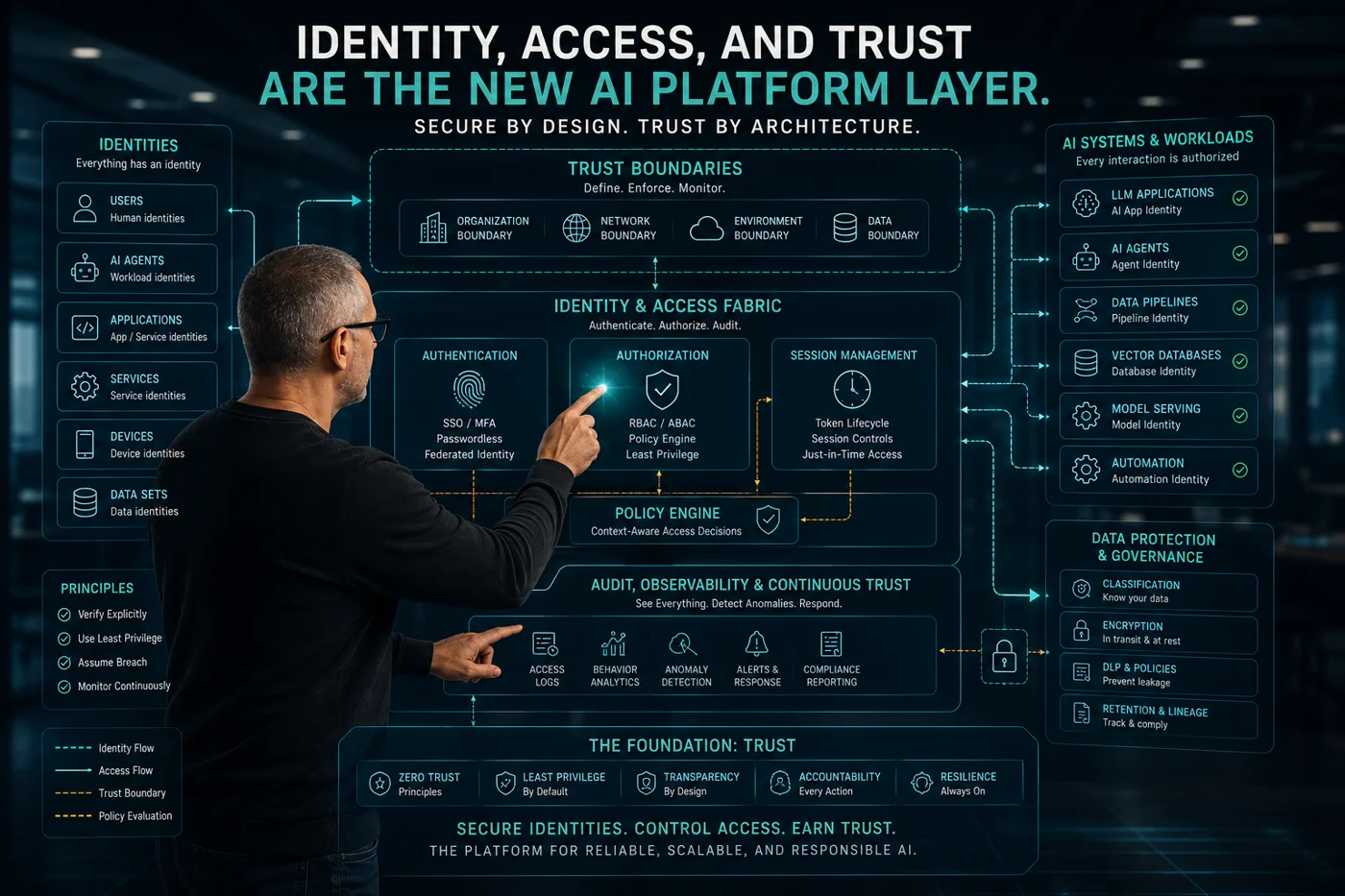
One of the most underestimated issues in enterprise AI is this:
AI is not truly integrated into companies until it properly manages identity, access and trust.
And this is not a detail. It is the platform's fundamental layer.
Because if an AI agent can read data without context, call systems without a specific scope and act with elevated privileges, it is already an enterprise security problem, not a model problem.
The right question is not “which LLM do we use?”
The right question is:
- who is this agent?
- who activated it?
- which data can it read?
- which systems can it use?
- which actions can it perform?
- which actions require human approval?
- how is access revoked?
These are not “AI strategy” questions. They are identity architecture and access-control questions.
Identity architecture for AI agents
An enterprise agent is not an individual user.
It is an entity with a specific scope of responsibility.
The correct design requires:
- separate identities for agents and services
- defined scopes for tools and APIs
- short-lived or rotating credentials
- separation between the caller's identity and the agent's identity
- authorization policies based on context and task
- immediate revocation in the event of an incident
If an agent uses the same identity as a real user or a highly privileged service, you are building a structural risk.
Least privilege is not a theoretical principle
In real enterprise systems, the basic principle is always least privilege.
Why should an AI agent not apply the same idea?
If a customer support agent can read tickets and documentation, it should not have access to financial data, HR data or repositories of company secrets.
If an internal process automation agent can write to a CRM, it should not be authorized to change infrastructure provisioning or perform cross-domain actions without approval.
Authorization must be based on task, scope and context, not on “because the agent is intelligent”.
AI needs a trust model, not just access
Access and trust are not the same thing.
A system can have correct access and still be unreliable.
For example:
- the model may have access to data but not know when it should not respond
- the agent may be able to call a tool but not understand whether the action is appropriate
- a service may be able to read information but unable to validate it
This is why a trust-design team is needed:
- who determines the decision policy
- who validates outputs
- who approves sensitive actions
- who monitors tool use
- who manages rollback or deactivation
This is the real AI platform layer: the layer of operational trust.
The “tool calling” problem is actually a policy problem
Many teams see tool calling as an elegant feature.
In reality, it is the point where AI stops being an assistant and becomes an actor in a business system.
So every tool must have:
- invocation policies
- a defined scope
- input/output validation
- guardrails for sensitive actions
- retry limits and timeouts
- a human approval mechanism
Tool calling is what drives AI's transformation: from “text generation” to “action execution”.
And if it is not governed, it is a risk.
Trust architecture = system design
The most robust enterprise systems do not discuss trust as something abstract.
They discuss it as a platform control model.
A robust enterprise AI system requires:
- identity-aware execution
- policy-based access
- traceability
- human approval for critical decisions
- failure containment
- clear separation between recommendation and action
This is the real platform-design layer.
🔥 Your experience
Have you ever seen an AI agent with access that was “too powerful” for its role?
Write a one-line comment.
In the next episode we will discuss the most important point: if AI is not observable, it is not controllable.