
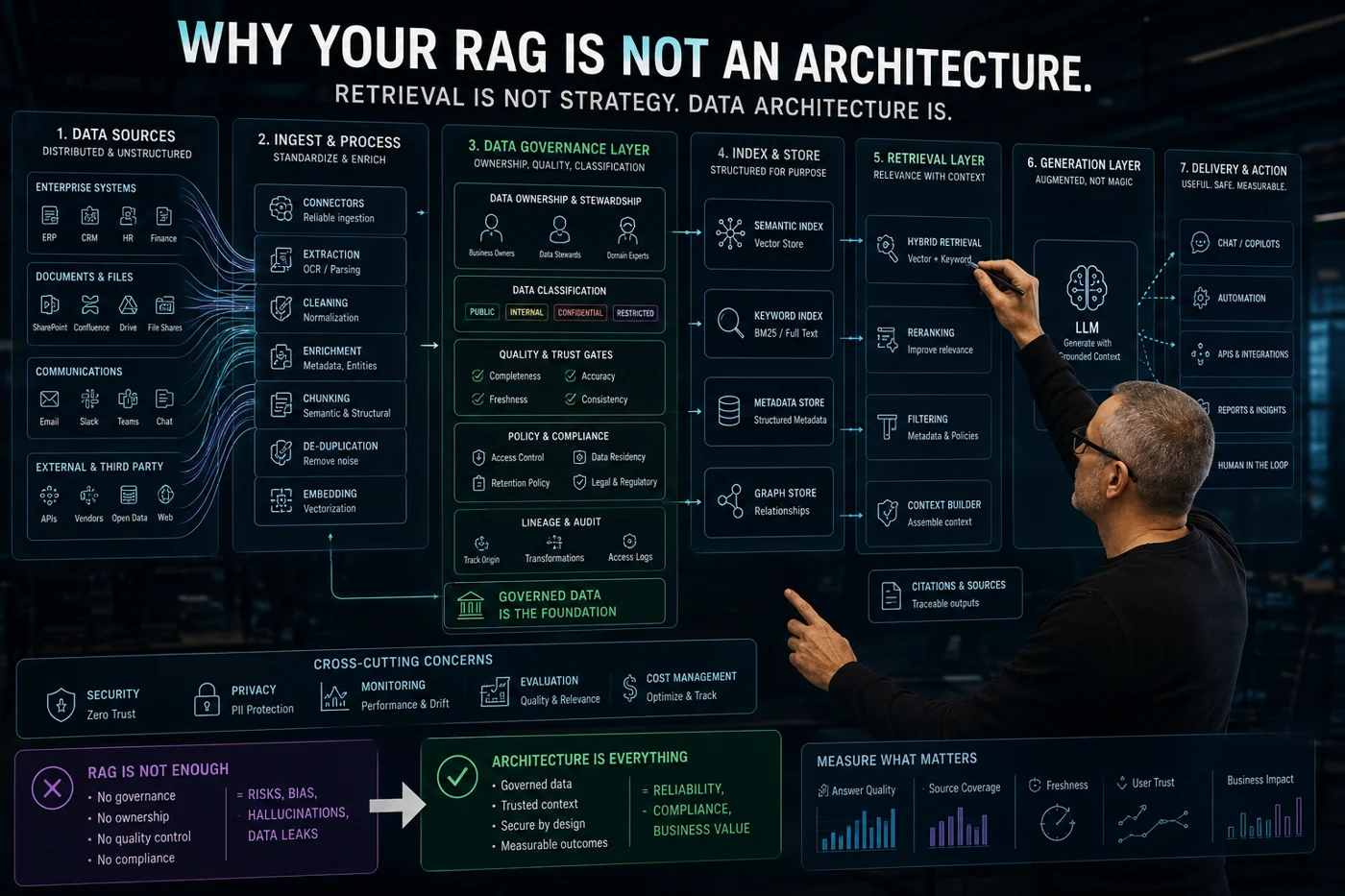
Many companies talk about RAG as though it were enough to build a credible AI system.
In reality, retrieval is only one part of the problem.
More precisely: RAG is a data access pattern, not an enterprise AI architecture.
Because the real complexity is not “how to retrieve a document”.
The real complexity is:
- who can access the data
- which data is up to date
- who is responsible for it
- how sources are validated
- how permissions and confidentiality are managed
- how to avoid building a system that answers confidently while using incorrect data
Retrieval is easy. Enterprise data is difficult.
The problem with many RAG systems is that they try to solve retrieval before solving the data problem.
They usually find themselves in one of these situations:
- data distributed across multiple systems, without clear ownership
- documents not classified by sensitivity
- outdated or inconsistent information
- overly permissive access
- an index that does not reflect the actual state of the data
- no refresh and invalidation process
This means that a RAG system with well-designed retrieval can still be dangerous.
Because answer quality depends on the quality, origin and accessibility of the data, not only on the model.
Three problems that cause real RAG systems to fail
1. Data ownership
Who decides which data AI is authorized to use?
If the data lives in documents, CRM, legacy systems, repositories, internal shares or cloud storage, an ownership model is needed.
Without ownership, the system retrieves everything and responds as if everything were equally reliable.
2. Data freshness and provenance
Retrieval must know:
- which version of the document is in use
- when it was updated
- who modified it
- whether it is still valid
- whether it is the official source or a secondary copy
When data lacks provenance, the model can “speak confidently” based on an unreliable source.
3. Access control and confidentiality
This is the most underestimated problem: an AI system can retrieve documents that a user should not see.
If the retrieval architecture does not integrate access-control principles, the problem is not the model. It is the data-level access policy.
The real problem: the answer is not neutral
When a model responds using company data, it is making an implicit business decision.
Organizations often fail to realize that AI is not merely “an information parser”. It is a consumer of data and sources.
If the wrong document was selected, if a source is incomplete, if the data is old, the output can be convincing and still harmful.
This is not a prompt-engineering problem. It is a problem of information integrity and system trust.
Enterprise RAG must be built as an evidence system
A good enterprise AI system must not merely “retrieve answers”. It must build a chain of evidence:
- source selection
- document trust
- access validation
- context assembly
- output verification
- traceability of the response
In practice, less “AI as a black box”, more “AI as an evidence-based system”.
The real architecture is data governance
When a team asks me, “Can I use RAG for our use case?”, the first question is not “which model do we choose?”
The first question is:
“What is our data trust architecture?”
This includes:
- data classification
- the data owner
- lifecycle
- access control
- freshness
- validation
- monitoring
Without this foundation, RAG is just an elegant way of generating answers from poor or uncontrolled data.
🔥 Your experience
Have you ever seen a RAG system with a brilliant answer but poor-quality or unauthorized source data?
Write a one-line comment.
In the next episode we will discuss the invisible foundation of every enterprise AI platform: identity, access and trust.
Because without this layer, AI cannot truly be a business system.