
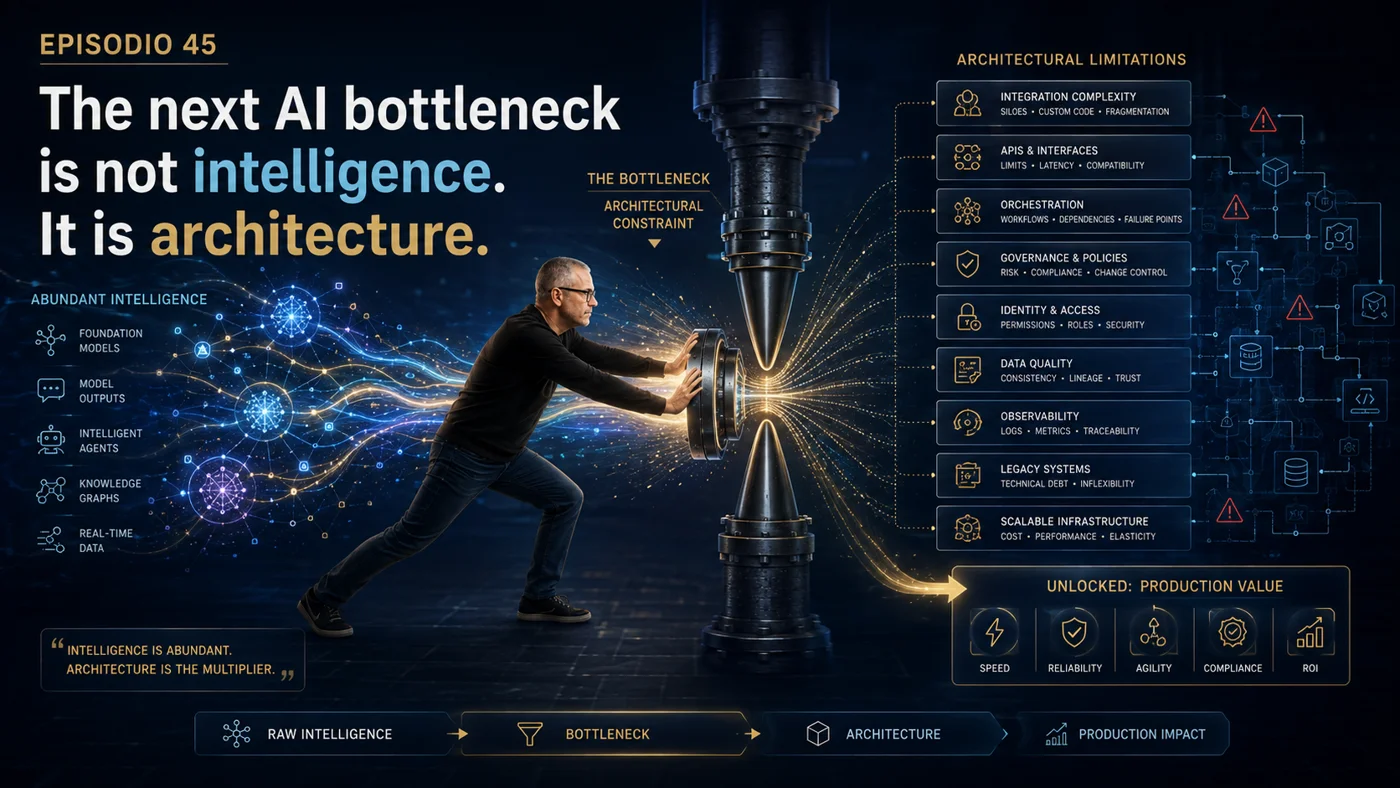
The most interesting part of the AI transformation is no longer whether models are becoming “more intelligent”.
It is that their practical usefulness increasingly depends on how they are integrated into real systems.
And this is a lesson system architects have already learned with cloud, distributed systems, microservices, IoT and enterprise platforms.
The model can become a commodity. The competitive difference will no longer be the model. It will be the system surrounding it.
When the model stops being the barrier
For years, in many organizations, the main problem was “which model to use”.
Now the question is more interesting:
- how you integrate the model into business processes
- how you manage data
- how you protect access
- how you provide observability and evidence
- how you decide when an action requires human approval
- how you enforce policy at runtime
These are architecture and governance problems.
Not intelligence problems.
The real competitive lever is not the model. It is the ecosystem
The difference between a company that uses AI well and one that uses it poorly will not be determined by the best LLM on the market.
It will be determined by:
- data quality
- workflow structure
- authorization design
- system resilience
- integration quality
- the presence of observability
- the ability to control and roll back
In the enterprise world, competitive advantage comes from infrastructure that makes AI practical, secure and consistent over time.
The problem is not “having AI”. It is “having an AI system”
Many organizations are building AI marketplaces: lots of models, lots of tools, lots of projects, few architectures.
This situation creates a range of problems:
- duplicated systems
- inconsistent access
- data in multiple places
- unmonitored outputs
- redundant tools
- no business-flow owner
- no operational standards
In enterprise architecture, the key phrase is controlled standardization.
That is exactly where the difference between innovation and chaos lies.
The 5 elements that will make the difference
1. Data architecture
AI lives on data. If the data is incomplete, unclassified or ungoverned, the model produces inconsistent value.
2. Identity architecture
AI must be designed as a system with identities, scopes and policies. No global access. No spurious authorization.
3. Workflow architecture
AI is not a chat app. It is part of an operational process. The decision-making and execution flow must be designed.
4. Observability architecture
If you cannot trace it, you cannot govern it. Enterprise AI requires logs, metrics, tracing, auditing and decision quality.
5. Operational architecture
This is where the truly difficult work comes in: error handling, fallbacks, escalation, rollback, security and business continuity.
The most important point: the platform becomes the advantage
The model is the component. The platform is the advantage.
Companies that understand this are not merely “using AI”. They are building:
- a data access layer
- an identity and policy layer
- an orchestration and workflow layer
- an observability layer
- a control and accountability layer
This is what makes AI enterprise-ready.
The same lesson as cloud and microservices
I have seen this pattern before with other technology trends:
- cloud: systems became more scalable, but required governance architectures
- microservices: more speed, but more coordination complexity and a desire for standards
- IoT: more edge, more data, more critical infrastructure, more need for control and security
AI is doing the same:
we are focusing too much attention on the model and too little on the architecture that makes it useful, secure and sustainable.
The real question is not “how good is the model?”, but “how well does the system support it?”
The difference between a powerful model and one that is useful in a company depends not only on its ability to generate text, but on its ability to:
- integrate
- respect boundaries
- work with reliable data
- produce controlled decisions
- be observed
- be shut down and restarted on command
This is the real bottleneck for the coming year.
🔥 Your experience
Do you think AI's competitive advantage will lie in the model or in the architecture surrounding it?
Write a one-line comment.
In the next episode we will discuss how AI changes the relationship between data, authorization and trust.
Because the real starting point of enterprise AI is not the prompt. It is trust.