
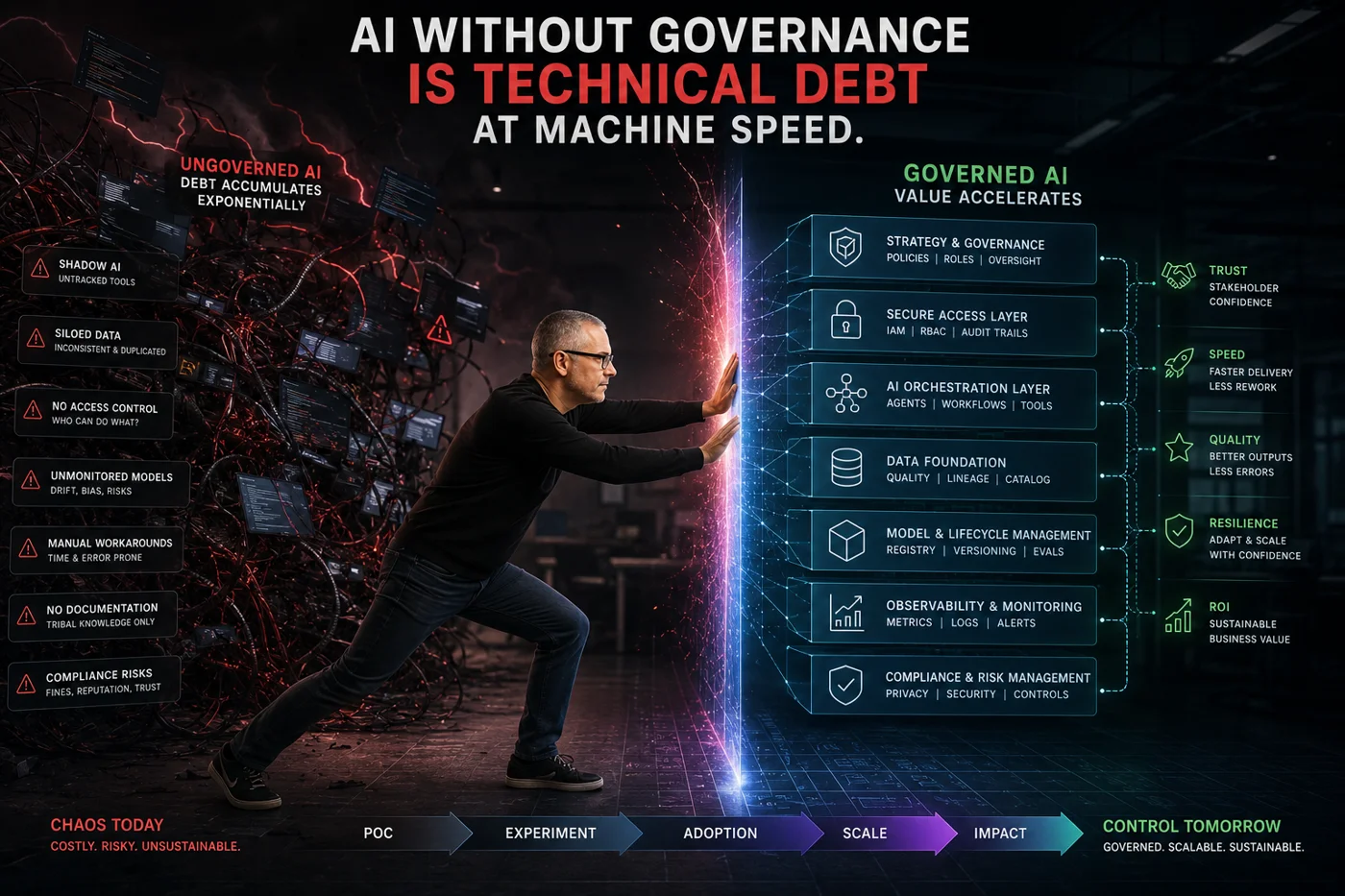
AI is becoming a business asset.
But sometimes its adoption resembles a typical case of accelerated technical debt:
- the PoC works
- AI enters production
- teams start using it intensively
- authorization becomes inconsistent
- data is not classified correctly
- outputs are not monitored
- decisions are delegated without ownership
Then the problem arrives, and it is not a model bug. It is a governance problem.
What AI technical debt is
Technical debt is not just poorly written code. It also includes:
- undefined processes
- unassigned roles
- unenforced policies
- data accessible without control
- unsupervised automation
- systems without audit trails
With AI, all of this multiplies because development moves fast, but the complexity of control does not grow in the same way.
The result is a system that works well at one stage but cannot be governed sustainably.
The problem is not using AI. It is controlling its impact.
AI is not merely a tool. It is a capacity for action.
If an inference function can:
- read sensitive data
- send messages autonomously
- call internal systems
- make decisions that affect customers, processes or compliance
then control is not optional. It is the prerequisite.
In enterprise architecture, critical systems have always had a governance model: identity, authorization, traceability, testing, approval, rollback. AI cannot stand outside this logic.
What organizations often lack
1. Clear ownership
Who is responsible for the AI system?
Not the “AI team”, not the “digital department”, but a specific person with responsibility.
If nobody is the owner, everyone owns the risk and nobody manages it.
2. An inventory of AI systems
This is often the simplest and most neglected point.
Organizations focus on official AI systems but overlook:
- shadow AI
- AI tools in vendor software
- unregistered internal agents
- automation with data access
- peripheral office AI workflows
Without an inventory, there is no governance.
3. Policies that are enforced, not merely written
An AI policy that is not checked by the system is almost useless.
You need:
- approval for tool use
- least privilege
- access scopes
- output validation
- structured logs
- controlled deactivation
4. Observability and auditing
If you cannot reconstruct a decision, you cannot explain an error. If you cannot explain an error, you cannot manage the risk.
Every critical AI system must have:
- call logging
- context tracking
- decision recording
- model and prompt versioning
- alerting and escalation
Governance does not hold back innovation
The tendency is to say: “Governance slows us down”.
In many cases, however, the opposite is the problem: the speed of AI development without governance is creating enormous organizational debt.
The cost of fixing an uncontrolled AI system arrives much sooner than the cost of building it correctly.
Governance serves two purposes:
- reducing the risk of errors and exposure
- allowing the system to grow sustainably
This is an architectural issue, not a bureaucratic one.
In practice, an AI governance model must include
- an inventory of AI systems
- a human owner for every solution
- classification of data and access
- scopes for tools and automation
- critical approvals
- logging, auditing and observability
- rollback and deactivation procedures
- risk assessment and business continuity
This is not “paperwork”. It is the foundation for using AI in production.
AI forces us to make the system accountable
One of the most important things AI has brought us is this:
we can no longer think of software as something isolated from the business.
Every AI tool involves:
- how data is used
- who can trigger actions
- which decisions are delegated
- how errors are handled
- how accountability is assigned
This is enterprise architecture in the strict sense.
It is not just technology. It is operational governance.
🔥 Your experience
In your company, is there anyone who truly owns AI risk?
Tell us in a one-line comment.
In the next episode we will discuss the real competitive bottleneck: it is not intelligence, it is architecture.