
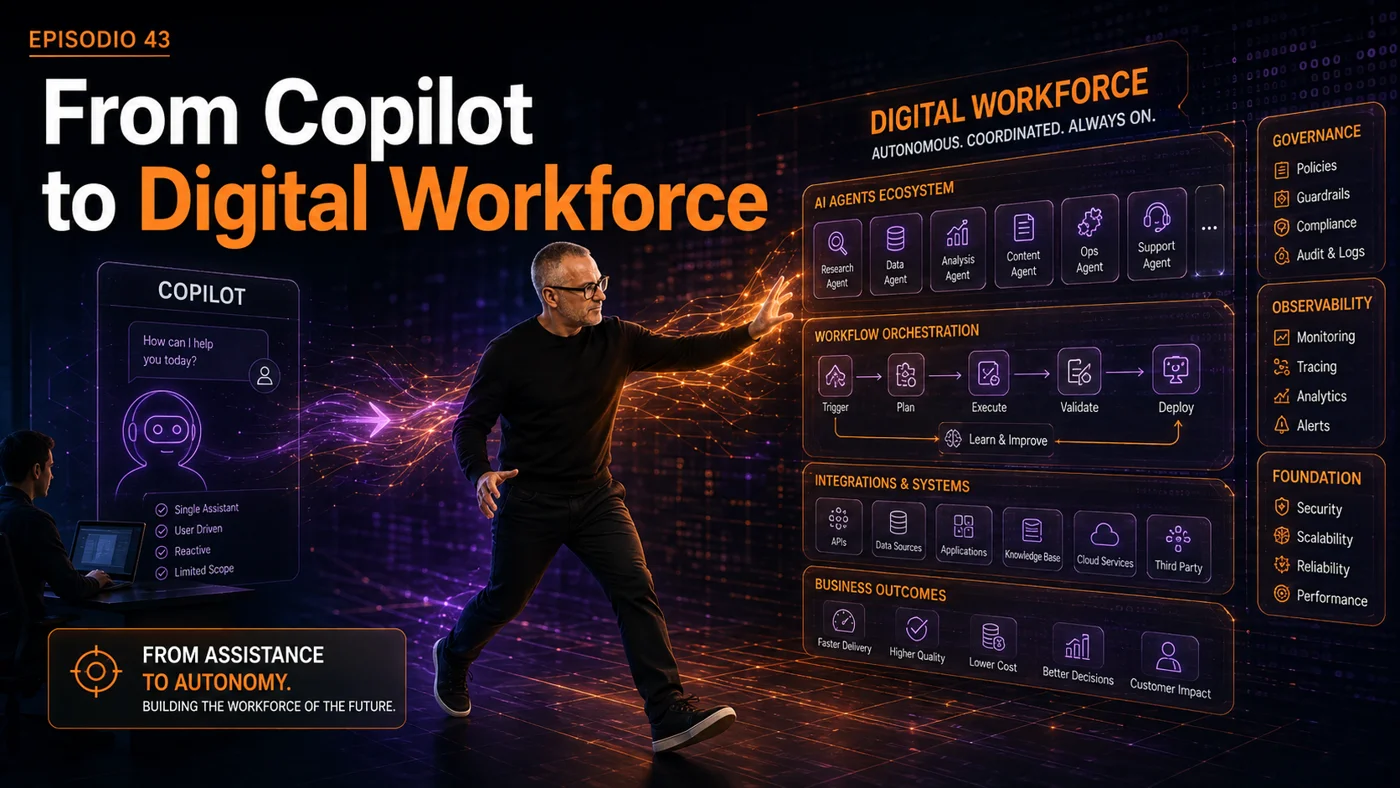
In 2023 and 2024, many people described Copilot as a paradigm shift.
In 2025 and 2026, the real transformation is something else:
software no longer merely responds.
It starts taking action.
And when a system takes action, enterprise architecture changes profoundly.
From chat to action
The first stage of enterprise AI was chat: the model reads a prompt, interprets the question and generates a response.
Then came retrieval: the model consults documents and data to give better answers.
Then Copilot: it helps the user in an operational workflow, producing outputs, suggestions and support.
Now we are entering the next stage:
- agents
- tool calling
- orchestration
- workflow automation
- multi-agent systems
- decision support with action
The difference between a Copilot and an agent is not only “how intelligent it is”.
The difference is this:
a Copilot supports the user; an agent participates in executing the process.
And this changes everything.
Enterprise architecture does not change because of the UI. It changes because of the execution model.
In a traditional system, application code is often explicit, deterministic and controllable.
In an agentic architecture, a significant part of behavior is delivered through:
- orchestration logic
- tool access
- the policy layer
- data retrieval
- decision criteria
- probabilistic outputs
- escalation and approval paths
As a result, system boundaries are no longer merely application boundaries. They become:
- identity
- permissions
- integration points
- data access domains
- human oversight
- operational governance
This is an architectural transformation, not a UX transformation.
From “AI as feature” to “AI as operating layer”
The way many companies have integrated AI has been superficial: a chatbot in the CRM, an assistant in ticketing, a model for classifying emails.
But the real evolution is this:
AI can become an operational layer of the enterprise platform.
Not merely a front-end component.
A layer that:
- gathers information
- evaluates conditions
- proposes choices
- invokes systems\
- starts processes
- requests approval
- manages escalation
When AI behaves this way, the architecture must be designed as a multilayered system, with clear responsibilities.
What really changes
1. Services that are no longer merely “stateless”, but context-aware
Traditional applications often have a static execution model. AI, by contrast, requires context, task memory, domain data and opportunities to connect events, user types and policies.
2. Workflows that become heterogeneous orchestrations
A request no longer passes through a single app. It passes through:
- retrieval
- policy checks
- model reasoning
- tool execution
- validation
- human approval
- state updates
This is orchestration architecture, not simple API composition.
3. Trust becomes a platform requirement
When software acts, trust cannot be left to the model's goodwill.
You must have:
- logging and traceability
- output validation
- guardrails
- human approval for critical decisions
- indistinguishable operational accountability
4. Integration becomes encrypted in the business model
You are not building an AI app. You are building a new way of running business processes.
To do so, you need:
- robust APIs
- event systems
- transparent data pipelines
- architecture and integration standards
The multi-agent architecture problem
The idea of multiple agents collaborating is interesting, but it must be managed with discipline.
The problem is that collaboration between agents increases the complexity of:
- coordination
- workflow state
- conflicts of responsibility
- auditing and traceability
- managing critical decisions
In a multi-agent team, simply “getting two agents to talk” is not enough. You need:
- a supervisor layer
- bounded autonomy
- task decomposition
- clear ownership
- escalation standards
Otherwise, you get faster execution and less security control.
The new architectural question
The question in 2026 is not:
“Which model best serves our use case?”
The question is:
“How do I build a system that can act in a controlled, governable and sustainable way?”
For AI, this is the equivalent of what we must do with cloud, microservices and distributed systems: take innovation from the prototype level to the level of the company's operating system.
🔥 Your experience
Have you already seen AI move from being an assistant to being an actor in a process?
Write a one-line comment.
In the next episode we will address a central issue: AI without governance generates technical debt at machine speed.