
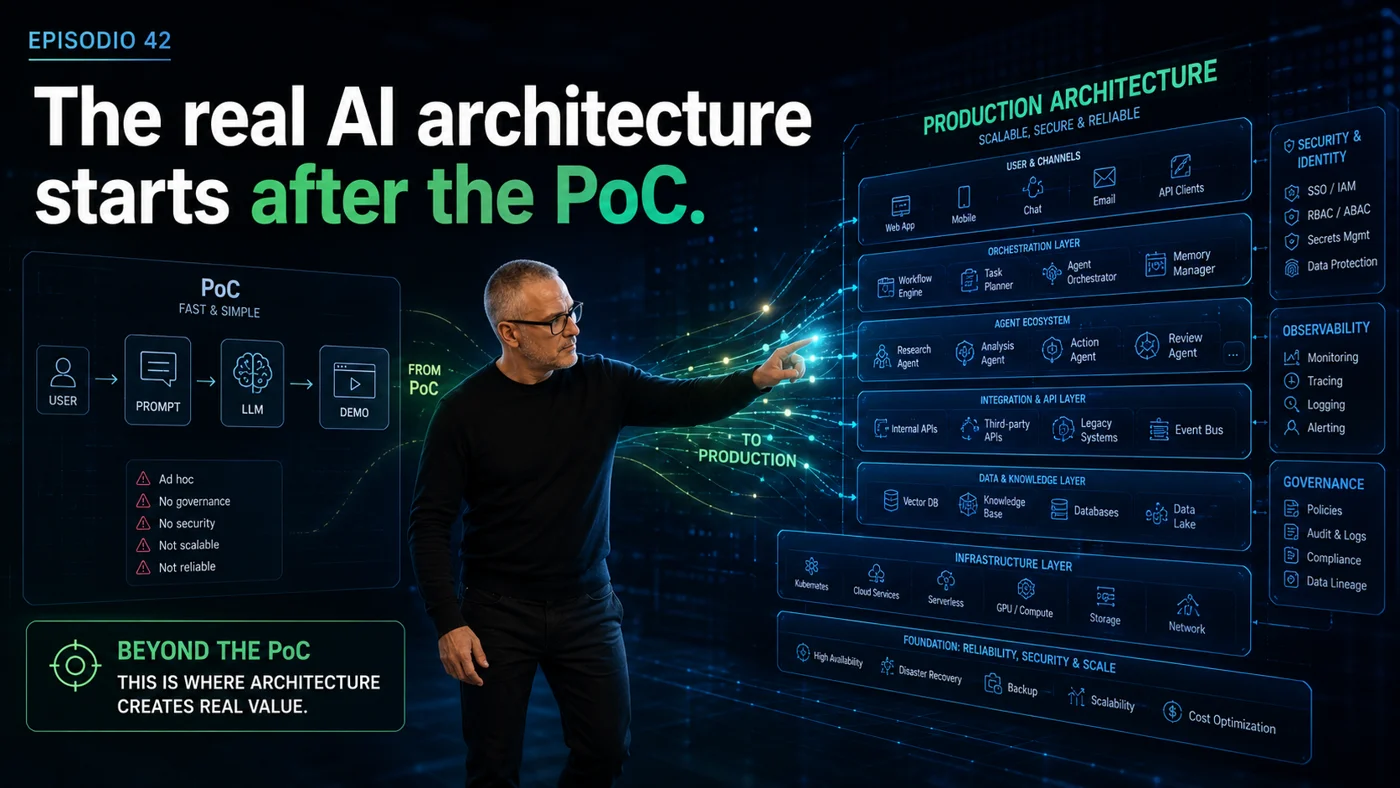
After more than twenty years building distributed systems, I have often seen the same pattern repeat itself with AI.
The team arrives, builds a convincing PoC, demonstrates better answer quality, some smart retrieval and a few working tool calls.
And everyone says: “Good, it's ready”.
Then production arrives.
And that is where you discover that the real architecture is not in a notebook. It is in the details of:
- data
- authorization
- latency
- fallbacks
- governance
- resilience
- operational control
The problem is not making AI work. The problem is making AI work in a real system.
The PoC is an experiment. Production is a system
The PoC demonstrates that the model has some usefulness.
Production demonstrates that the system is controllable, reliable and sustainable.
This is the most common breaking point:
- effective prompts
- working retrieval
- tool calls that work locally
- APIs that respond in demos
- “good” outputs in a controlled environment
All these details are not enough when the system has to work with:
- real users
- real data
- real authorization
- real SLAs
- real responsibilities
At that point, we are no longer talking about “AI”. We are talking about a platform.
Scaling AI is not only about models. It is about architecture.
Enterprise systems break down because of architectural problems, not model problems.
The right question is not:
“Is the model good enough?”
The right question is:
“Is the system hosting it designed to support decision-making, control, operations and security?”
Because if it is not, a “good” model becomes a source of various problems:
- incomplete or outdated data
- excessive access
- slow or inconsistent responses
- fragile pipelines
- unvalidated outputs
- orchestration bugs
- chains of errors across tools, data, workflows and decisions
In other words: model quality is not enough if the ecosystem is not built to manage it.
The critical transition: from demo to operational system
When an AI project enters production, five design domains are needed.
1. Data architecture
My experience with distributed systems has taught me that data is the real nervous system of architecture.
For an AI system, having a vector store is not enough. You need:
- data classification
- provenance
- freshness
- access policies
- data lineage
- retention
- governability
If the data is not governed, AI cannot be governed.
2. Identity and authorization
An enterprise agent must have a clear access model.
Look at real enterprise systems: APIs cannot be called by just anyone, services do not have global access, and control is based on scope and role.
AI is no exception.
3. Workflow orchestration
AI is often only one part of the workflow. Overall execution must be designed as an orchestration of services and decisions.
Without orchestration, you will have:
- tools invoked without context
- inconsistent responses
- duplicated or missing approvals
- cascading errors
4. Observability
In enterprise architecture, if you cannot see the traffic, you cannot see the system.
With AI, you must observe:
- tool calls
- latency
- token consumption
- the prompts and context used
- outputs and quality
- human or automatic decisions
Without observability, AI is a black box.
5. Recovery and control
An architecture that does not know how to recover from an error is not a platform. It is a risk.
The design must include:
- manual fallbacks
- action rollback
- escalation policies
- kill switches
- alerting and incident response
The real challenge is the enterprise, not the demo
Companies that do AI well are not creating “more bots”.
They are building systems to:
- integrate complex data
- manage real authorization
- control execution
- ensure traceability
- maintain quality over time
- protect the business when AI makes mistakes
This is architecture.
It is not “model magic”.
After the PoC comes the architecture of reliability
If you want to build a real AI platform, you must move from a “working demo” mindset to a “reliable system” mindset.
And five things often make the difference:
- a clear data model
- correct identity and authorization
- observable workflows
- defined human escalation
- integrated operational control
If any one of these is missing, you are building software that works only until it has to face the real world.
🔥 Your experience
How often have you seen an AI project that was convincing in a demo but fragile in production?
Write a one-line comment.
In the next episode we will discuss how enterprise architecture changes when software no longer merely responds, but starts taking coordinated actions.