
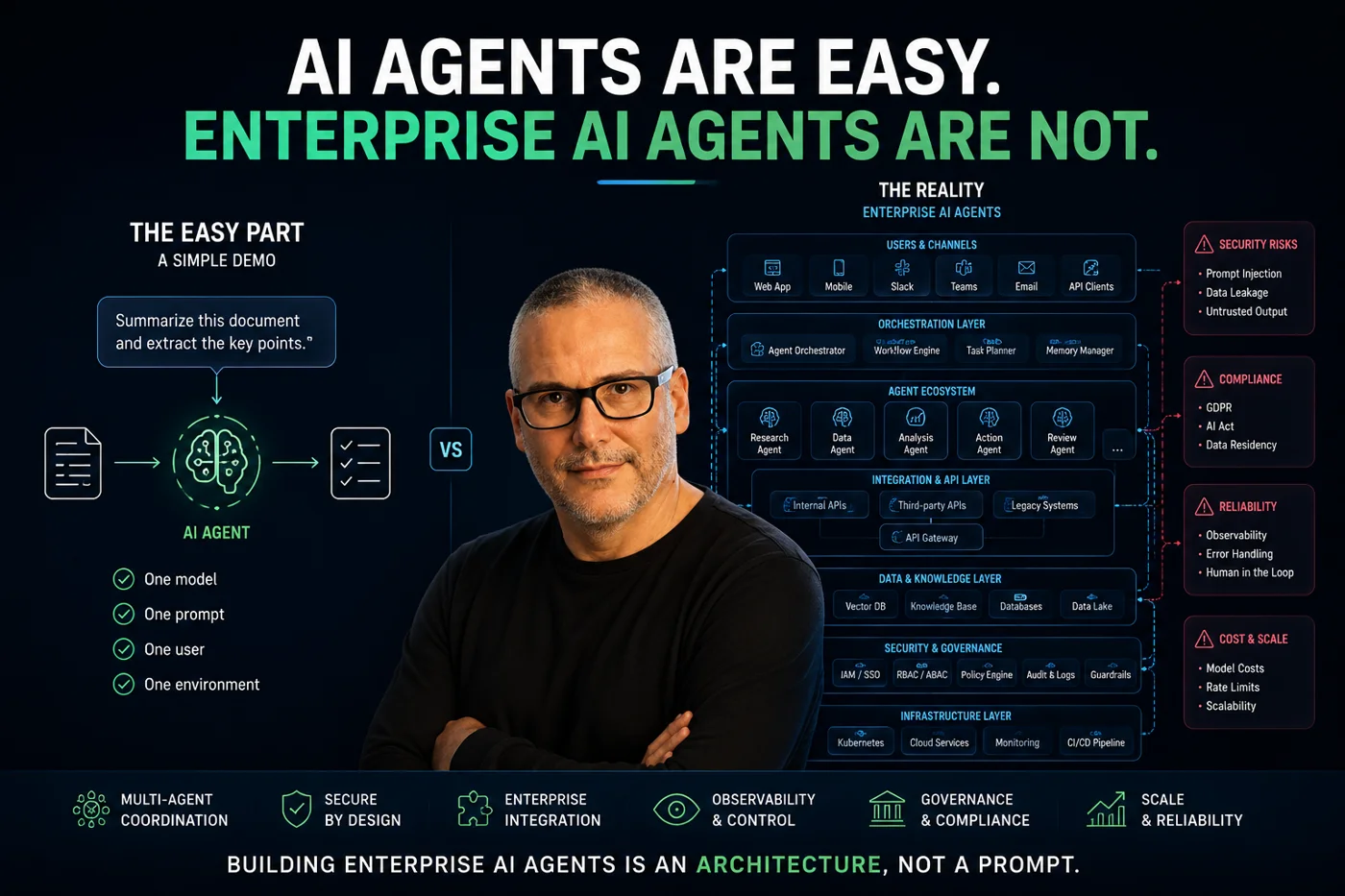
After more than twenty years designing distributed systems, enterprise platforms and critical architectures, one thing is clear to me:
the more agentic AI becomes, the less the problem is the model. The problem is the system around the model.
Because AI agents are easy to demonstrate in demos. They are much harder to make reliable in a serious business environment.
An agent that writes a paragraph is simple. An agent that reads company emails, consults the CRM, calls internal APIs, updates workflows and makes decisions with privileged access is something else entirely.
These are production systems. And production systems have rules.
The difference between an “AI demo” and “enterprise AI”
The big difference is that, in a company, AI does not live in an isolated terminal. It lives in an ecosystem of:
- identity and access management
- authorization policies
- external services and critical APIs
- structured and unstructured data
- operational workflows
- monitoring, alerting and rollback
- compliance and audit trails
Just because a model can respond convincingly does not mean it can act safely.
An enterprise agent must be designed as a distributed system, not as a chat app with more tools.
Three levels of complexity that derail PoCs
1. Identity and authorization
The first mistake is to think of the agent as something that “follows instructions”.
In reality, the agent must be able to understand:
- who the user who activated it is
- which data it can read
- which data it can write
- which APIs it can call
- which actions require human approval
With proper design, the agent operates with least privilege, limited scope, control policies, auditing and immediate revocation.
Without this, you are building a system that has the ability to act but no control over its actions.
2. Data governance
Enterprise AI does not work only with prompts. It works with company data, often sensitive, often fragmented, often duplicated and often inconsistently accessible.
If an agent has access to documents, CRM, ticketing, chats, repositories, legacy systems and external data, you must define:
- where the data is read
- where it is processed
- where it is stored
- who can see it
- how retention is managed
- whether the data can be used for training or retrieval
Once data enters the agent's cycle, the model is already just one part of the risk chain.
3. Operations and resilience
In enterprise architectures, the problem is not only “whether the model responds well”. The problem is how the system reacts to:
- timeouts
- API outages
- rate limits
- incomplete data
- unvalidated outputs
- tools doing unexpected things
- cascading failures
An enterprise agent must have:
- circuit breakers
- controlled retries
- structured logging
- timeouts and fallbacks
- human escalation mechanisms
- kill switches to disable the workflow
This is architectural design. Not “AI experimentation”.
The real bottleneck: controlling actions
Producing a response is one thing. Performing an action with real impact is another.
This is where most projects break down:
- the agent generates an output but lacks the appropriate authorization context
- it proposes an action but does not make it traceable
- it acts without approval, or with approval that is too weak
- it changes data without checking quality
- it executes APIs with excessive privileges
- it lacks a complete record of inputs, outputs, decisions and user context
When an agent can do something serious, the problem becomes governance. And governance is not an add-on. It is an architectural requirement.
The right architectural structure
A robust enterprise agent does not emerge from a prompt and four tools.
It emerges from a layered design:
- Identity & policy layer
Who the agent is, who activates it, what permissions it has.
- Data access layer
Which data can be read, transformed, used and stored.
- Execution layer
Which tools and APIs it can execute, and under what constraints.
- Decision & validation layer
When a decision requires human approval, when a resource is too critical to automate.
- Observability layer
Logs, metrics, tracing, auditing and correlation between prompts, tool calls and outcomes.
- Recovery layer
Fallbacks, kill switches, rollback, reversion.
This is enterprise architecture. It is not AI marketing.
The most dangerous point: the conflict between autonomy and control
Many teams try to “maximize agent autonomy”.
The problem is that autonomy and control are in constant tension.
The more autonomous the agent, the greater the need for:
- tighter policies
- clearly defined approvals
- strong observability
- default deny
- minimized scope
- governance of the action chain
Without this tension, the agent is not an intelligent system. It is a system with excessive access.
A simple truth
The AI agent is not a “wow factor”.
It is a change in the software execution model.
When software stops being merely a function and becomes an actor that takes action, the design must change everything:
- access
- authorization
- traceability
- accountability
- human intervention
- resilience
This is the point where architecture stops being a detail and becomes central to the business.
🔥 Your experience
Have you ever seen an AI project that looked “perfect” in a demo but broke down as soon as it reached production?
Write a one-line comment.
In the next episode we will discuss the real breaking point: not the model, but the transition from PoC to production.
Because serious work begins when AI stops being a demo and becomes a real system.