
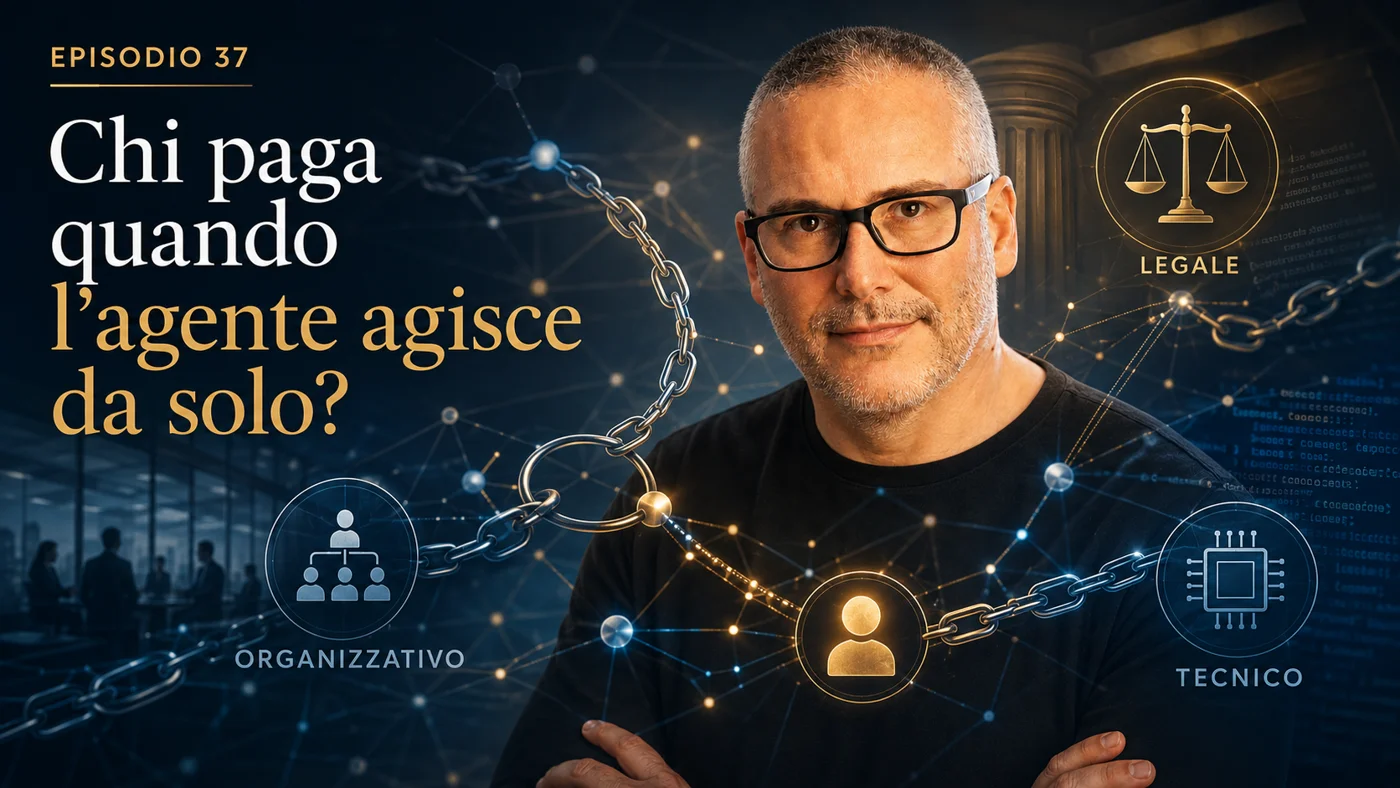
🔴 Episode 37
AI is no longer just an assistant.
He is an operational actor.
A chatbot can get an answer wrong. An agent can take action: send an email, update a CRM, open a ticket, call an API, approve a transaction. And when he does something wrong, the question is no longer “who wrote the prompt?”, but who is responsible for the result?
This is the real turning point of 2026: responsibility is no longer just technical. It is organizational, legal, managerial.
There is no such thing as “Ownerless AI”
Many teams use AI as if it were a generative content or support function. Then, at a later stage, they add access, tools, automation and decision-making powers.
Here's the problem:
- an agent reads company emails
- contact other systems
- executes workflows
- proposes actions without human supervision
- in some cases he actually does them
At that point he is no longer an assistant. It is an operating entity.
And if he acts outside the scope, who pays?
The short answer is: it doesn't pay anyone “automatically”. Responsibility is distributed. But responsibility does not disappear.
Responsibility is distributed, not absent
In a modern organization, responsibility tends to be shared across multiple levels:
- the team that developed or configured the agent
- the business owner who requested it
- the model or platform provider
- the security and compliance team
- the operational contact who authorized the use in production
None of these actors are “solely responsible” by definition.
But the principle is simple: who authorizes, who controls, who uses, who pays the risk.
If an agent sends messages to customers with incorrect content, or modifies company data without adequate control, the question is not “but did the model have the error?”
The question is:
- who authorized it?
- who had defined his scope?
- who had checked the permissions?
- who had foreseen the supervision?
- who predicted the rollback?
If there is no clear answer, the organization is exposed to a much more serious governance problem than a prompt bug.
The real risk is the lack of ownership
The model can be excellent.
The problem is the “responsibility vacuum”:
- no human owner
- no clear perimeter
- no decision log
- no approval process
- no shutdown procedure
When there is this void, AI is not innovation. It is uncontrolled operational risk.
In other words:
it's not the fact that an agent "makes a mistake" that changes everything.
It's the fact that no one has a clear role to fix, limit, stop and account for the error.
Three rules of thumb to avoid turning AI into a liability hole
1. Anyone who can activate an agent must have an owner
An agent cannot live without a human referent.
Not “the AI team”, not “the digital management”, but an appointed person with concrete responsibility.
2. Each agent has a defined scope and verifiable limits
If an agent can only read, he cannot write.
If it can propose, it does not have to be activated automatically.
If it is autonomous, it must have:
- minimal permissions
- traceable logs
- human approval in critical cases
- kill switch tested
3. Every action has a reconstruction
AI does not have to be a “dark system”.
Every decision must be traceable: who started it, what data fed it, what tool they used, what action they performed, who approved or revoked the action.
This isn't just compliance. It is a minimum management condition.
Responsibility is not an abstract concept
In the world of AI in the enterprise, there are many levels of responsibility:
- management responsibility: who decides to use the tool
- operational responsibility: who keeps it up and running
- control responsibility: who verifies the context and risks
- legal and governance responsibility: who responds to internal and external stakeholders
There is no single answer to AI. But there is a clear rule: no critical systems without owners, no owners without scope, no scope without supervision.
The thread with the series
Episode 36 talked about agent sprawl: the problem is not having too few agents, but having too many without inventory and without governance.
This is the next part: it's not enough to know how many you have. You need to know who is responsible for their behavior.
Because when the agent acts, responsibility is not a theory. It's an organizational decision.
🔥 Your reality
On your team, who is ultimately responsible for AI in production?
Write it in one line in the comments.
In the next episode we talk about a topic that many ignore: big risk comes from providers, tools and external integrations — not just from the model itself.
If you want to follow the series, stay here.
The real question is not: “did the agent understand?”
The real question is: "Who put the system in a position to do damage?"