
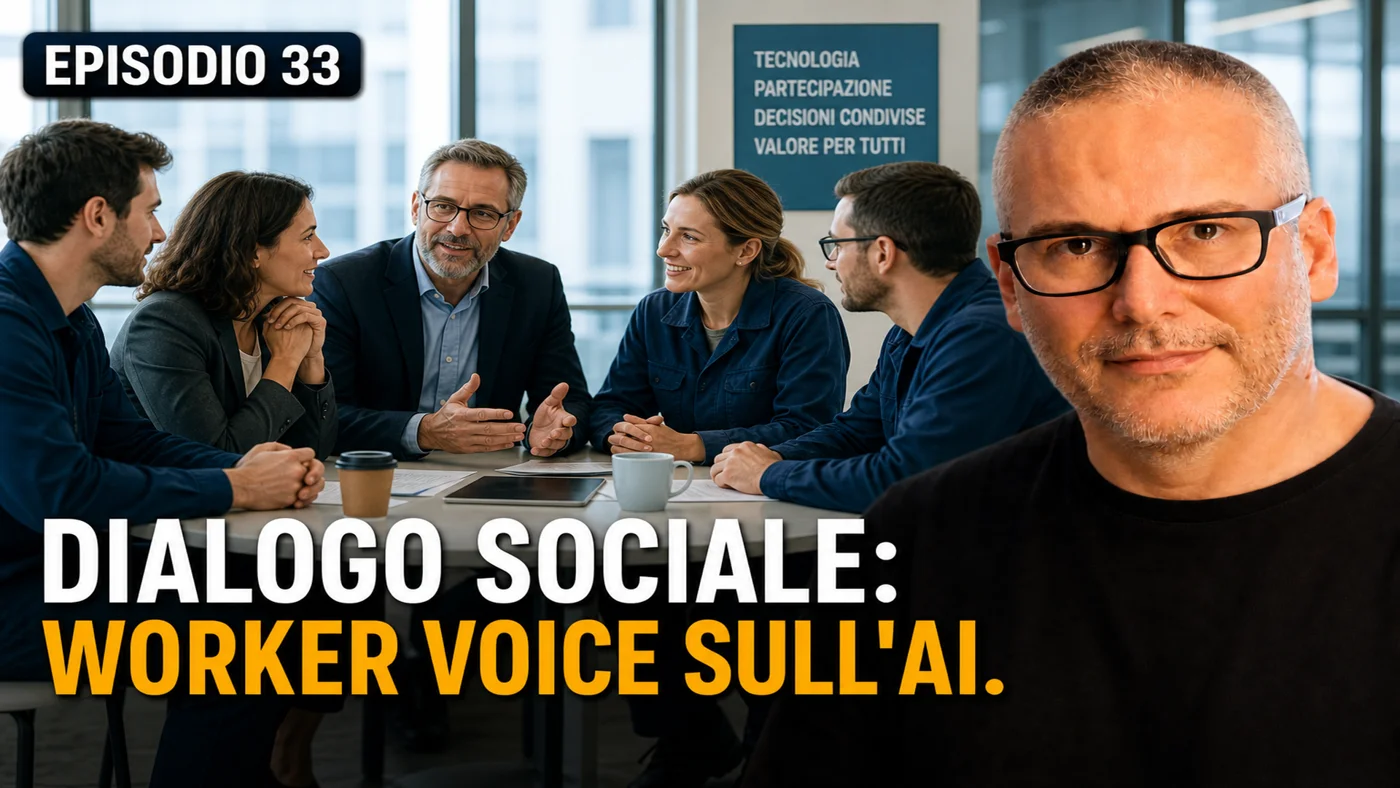
🔴 Episode 33
AI enters the company. Change tasks, roles, workloads. But who decides how? Only the management? Just IT? Do workers — those who experience change every day — have a voice? Do they have the right to be informed, consulted, involved in choices that concern them?
Transforming work without those who do it is a mistake. And social dialogue is the tool to avoid making it.
Because voice matters
Workers see where AI helps — automation of repetitive tasks, decision support — and where it creates stress, surveillance, unbearable burden. They know where data is misused — excessive monitoring, opaque evaluation, metrics that reward speed over quality. They have information that management doesn't have: what works in the field, what blocks, what demotivates. Involving them is not "kindness". It is information and legitimacy. Decisions made without listening risk failing — rejected implementations, passive resistance, turnover — or being imposed without consensus, with social and reputational costs. Examples: in some logistics companies, workers have reported rhythms dictated by algorithms incompatible with health; dialogue could have avoided conflicts.
What social dialogue can do
Information: How AI is used, what data is collected, what decisions are automated. Workers have the right to know. Consultation: Before introducing high-impact systems — performance evaluation, shift allocation, monitoring — listen to worker representatives. Negotiation: on workloads, schedules, evaluation criteria, training. If AI changes the pace, contracts must adapt. Co-decision: where possible, participation in choices on tools and criteria. In Germany, Mitbestimmung (co-determination) gives works councils a say in technical and organizational matters. Unions, RSUs, works councils can be interlocutors - not obstacles - if the legal and contractual framework provides for it and the company practices it.
Obstacles and resistance
"It's technical, it doesn't affect the unions." False: AI affects tasks, loads, evaluation, privacy. “It's strategic, not questionable.” False: the choices on how to introduce AI are choices on work, on dignity, on health. These are excuses. AI affects work, health, dignity. It's a trade union and labor law issue. Those who don't want dialogue usually don't want limits or transparency. He prefers to implement in a top-down manner, without giving voice to who will suffer the consequences. The result: conflicts, lawsuits, reputational damage, and often worse systems than would have been achieved through involvement.
The management
Rules that oblige information and consultation on the use of AI at work. The EU Directive on transparent and predictable working conditions and the Directives on information and consultation of workers need to be complemented with specific provisions for AI. Contracts that regulate algorithmic evaluation, training, transitions. Worker voice not as "no" to innovation, but as a condition for fair and sustainable innovation. Innovation imposed against workers fails. Co-designed innovation has a better chance of working.
🔥 Your experience
Is there dialogue in your company or sector (union, RSU, worker council) on the introduction of AI and its effects on work? A line in the comments.
In the next episode we will close this third part of the saga: what we have come and what remains to be done. Because the conversation doesn't end here.
If you want to follow the series, stay here.
From now on, transforming work without those who do it is no longer acceptable.