
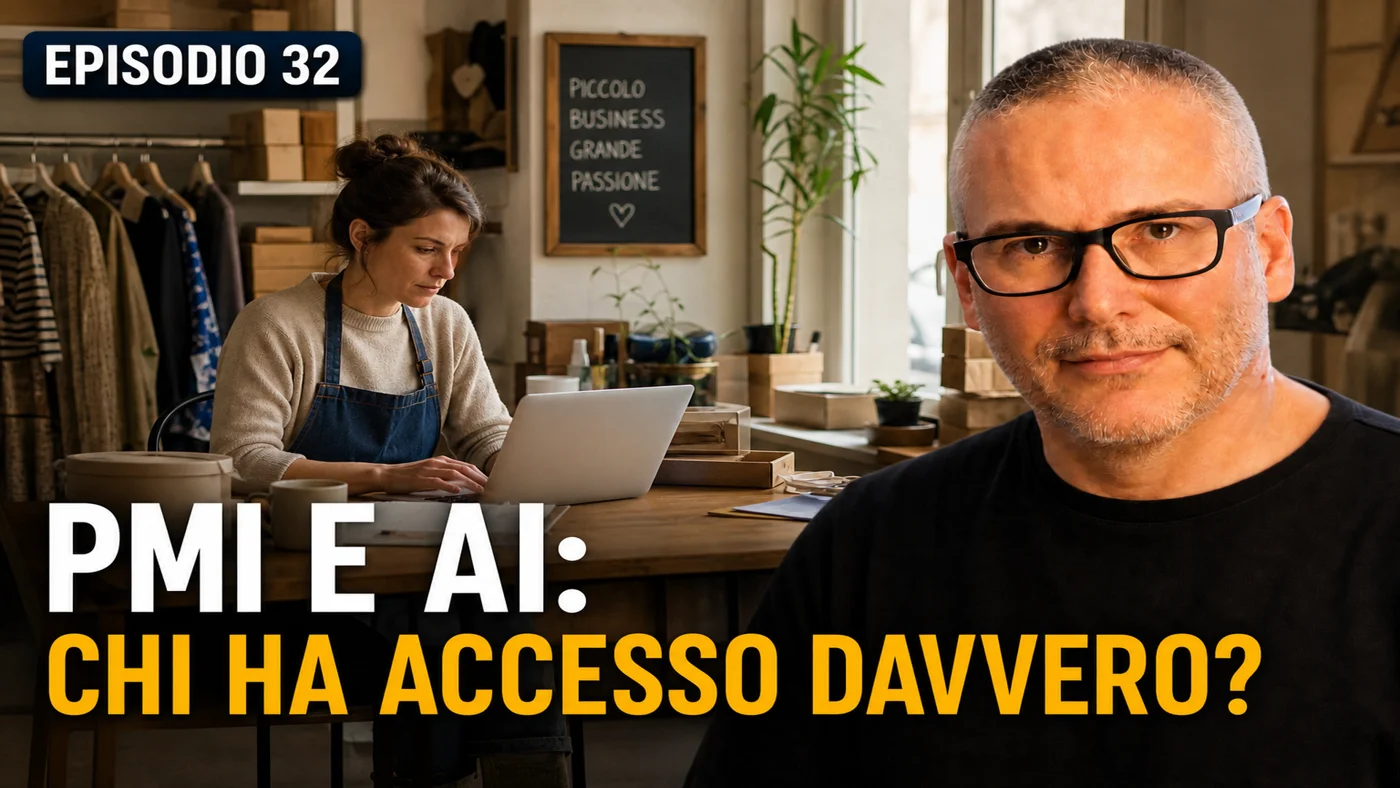
🔴 Episode 32
We talk about AI as if it were for everyone. In reality: large companies, well-funded startups, countries with infrastructure and talent have access. SMEs — small and medium-sized businesses — often don't. Costs, skills, data, time: the gap is real. And AI risks concentrating advantage, not distributing it.
What SMEs are missing
Cost: Proprietary models like GPT-4 or Claude cost hundreds or thousands of euros per month for intensive use; custom integrations require budget. Skills: Who designs, integrates and governs AI? An artisan, a restaurateur, a small wholesaler rarely has a data scientist in their team. Data: Good models require data; SMEs have fewer, more fragmented, less structured ones. A large retailer has millions of transactions; one store has thousands of them. Time and Risk: Experimenting with AI while holding up the day-to-day — invoices, customers, suppliers — is a luxury. If something goes wrong, there is no buffer. Result: Those who are already big become stronger. Those who are small are left behind — or depend on a few suppliers (Google, Microsoft, Amazon) who dictate prices and conditions. AI as a competitive advantage is concentrated in the hands of those who can afford it.
Because it's a problem for everyone
If AI becomes privilege of the few, markets will become concentrated. Big companies automate, scale, acquire. SMEs remain manual, slow, marginal. Innovation and employment are concentrated. But SMEs are the fabric of many economies: in Italy they represent over 99% of businesses and around two-thirds of employment. Leaving them out isn't "just unfair." It is unstable. Less entrepreneurial diversity, less resilience of the production system, more dependence on a few big players. An ecosystem with only large companies and no dynamic SMEs is fragile.
What can help
Open source tools — Llama, Mistral, lightweight templates — that reduce licensing costs. Accessible APIs with free or low-cost tiers. Training and support dedicated to SMEs: not generic courses on "AI", but "how to use AI for your business" — accounting, customer service, inventory. Public policies: tax incentives for digital adoption, targeted tenders, ecosystems that don't just reward the giants. Cooperatives, consortia, hubs that share skills and data: multiple SMEs together can access tools and knowledge that they could not alone. And clarity on what is really needed: not "all AI", but solutions suitable for small and real contexts. Sometimes a simple well-configured chatbot is worth more than a custom machine learning project.
The question to keep alive
Who has access to AI? If the answer is “only those who already have everything” — capital, talent, data, time — it is not sustainable. SME does not mean “backward.” It means diversity, proximity, local work. Giving them real access is a political and market choice. Europe is trying with initiatives such as the AI on Demand platform and funds for the digitalisation of SMEs. But there is still a long way to go.
🔥 Your experience
Do you work in an SME or do you know small businesses that use (or would like to use) AI? What is really missing: money, skills, time? A line in the comments.
In the next episode we will talk about social dialogue: unions, worker voice, co-decision on how AI is introduced. Because transforming work without those who do it is a mistake.
If you want to follow the series, stay here.
From now on, access to AI is not "for everyone" until it is even for SMBs.