
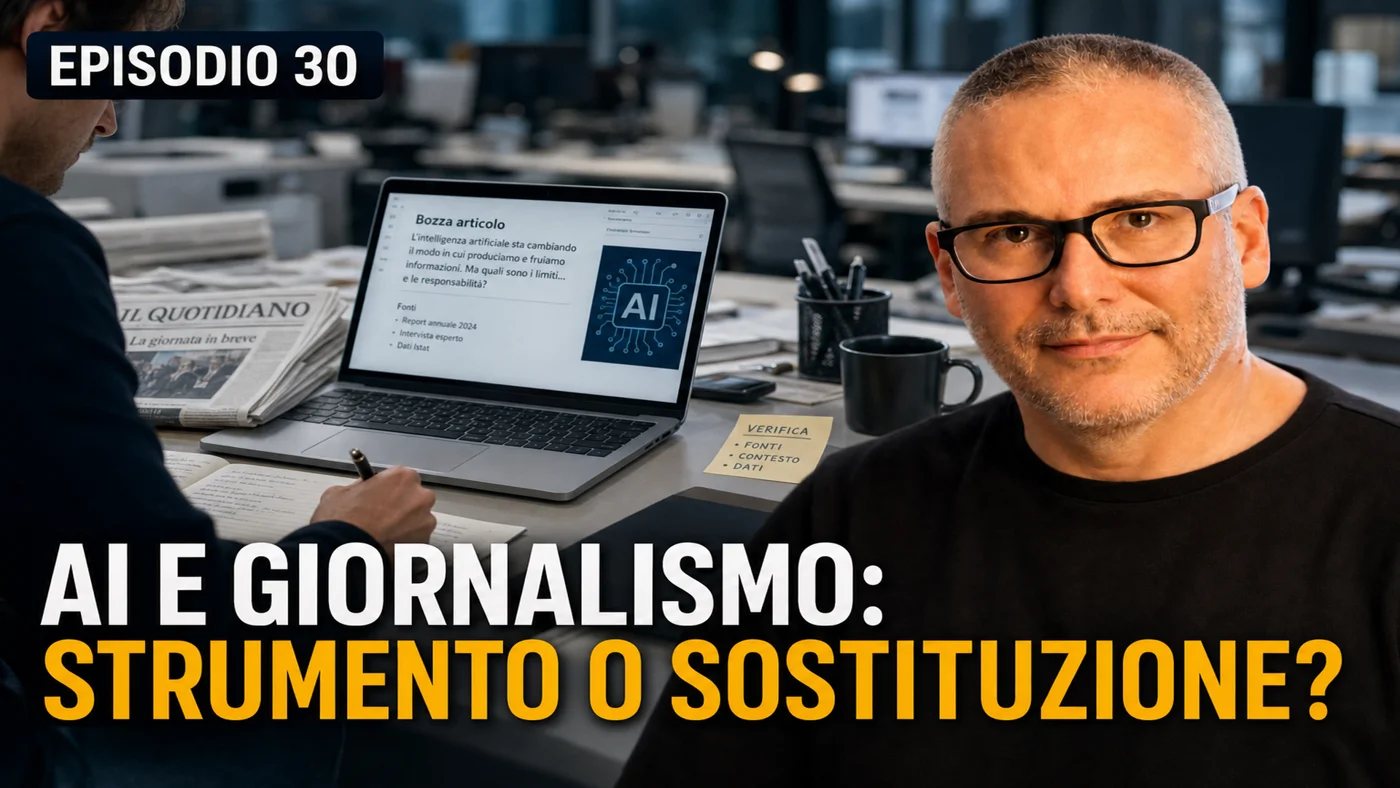
🔴 Episode 30
AI writes articles, summarizes news, generates headlines. Editors use it to speed up, to cover more topics, for fact-checking. The Associated Press uses automation to report on sports scores and corporate financial statements. Reuters has AI tools to generate first drafts. BuzzFeed and others experiment with generated articles. But who tells the story? Who verifies the source? Who takes responsibility for what is published?
Between instrument and substitution lies the difference between information and noise.
Where AI can help
Search for sources: find documents, cross-reference statements, compare versions of the same event. First draft: transforming a press release into an article, a report into a summary. Translation: making sources in other languages accessible. Fact-checking on data and statements: verify numbers, compare statements with databases. In many cases it lightens the journalist's work and leaves more time for investigation, context, the human voice. A reporter who doesn't have to transcribe an interview for hours can focus on analysis. A small editorial team can cover multiple topics without multiplying staff.
Where it should stop
Editorial responsibility cannot be delegated. A misleading title generates clicks but damages trust: think of "clickbait" titles that distort the content. An incorrect summary can spread falsehoods. An unverified source can be manipulation. The damage is real. Misinformation, polarization, loss of trust in the media. AI is not "is" the newspaper. The newspaper is the one who decides what to publish and how. A human editor must have the final say: approve, edit, reject. If the editorial team becomes only "curator of AI output", the pact with the reader breaks down. Cases like CNET, which published buggy AI articles without initial transparency, show the risks.
Trust and transparency
Readers have the right to know when a text has been generated or assisted by AI. Not to demonize — AI can be useful — but for trust. Knowing that an article was produced with AI support allows the reader to weigh in. Transparency and editorial guidelines are the minimum. Some publishers — like the Guardian — have adopted clear policies. And when the AI gets it wrong — and it will get it wrong: hallucinations, invented sources, distorted context — who apologizes? Who corrects? Must be a human, with first and last name. An error without correction and without accountability is a damage to the profession.
The value that remains human
Uncomfortable questions: who has an interest in this story? What isn't being said? Sources that speak: interviews, human relationships, trust built over time. Context: history, culture, nuances that a model does not experience. Interpretation: giving meaning to the facts, connecting, proposing a reading. AI can support. It cannot replace the public role of journalism: reporting, verifying, keeping the powerful under control. That role remains human — or it's not journalism. It's content generation. It's different.
🔥 Your opinion
Should there be mandatory labels (“AI-generated text” or “AI-assisted”) on news articles? Yes or no — and a line — in the comments.
In the next episode we will talk about insurance and algorithmic risk: scoring, policies, who pays when the model is wrong.
If you want to follow the series, stay here.
From now on in the editorial office, AI is a tool. Responsibility remains human.