
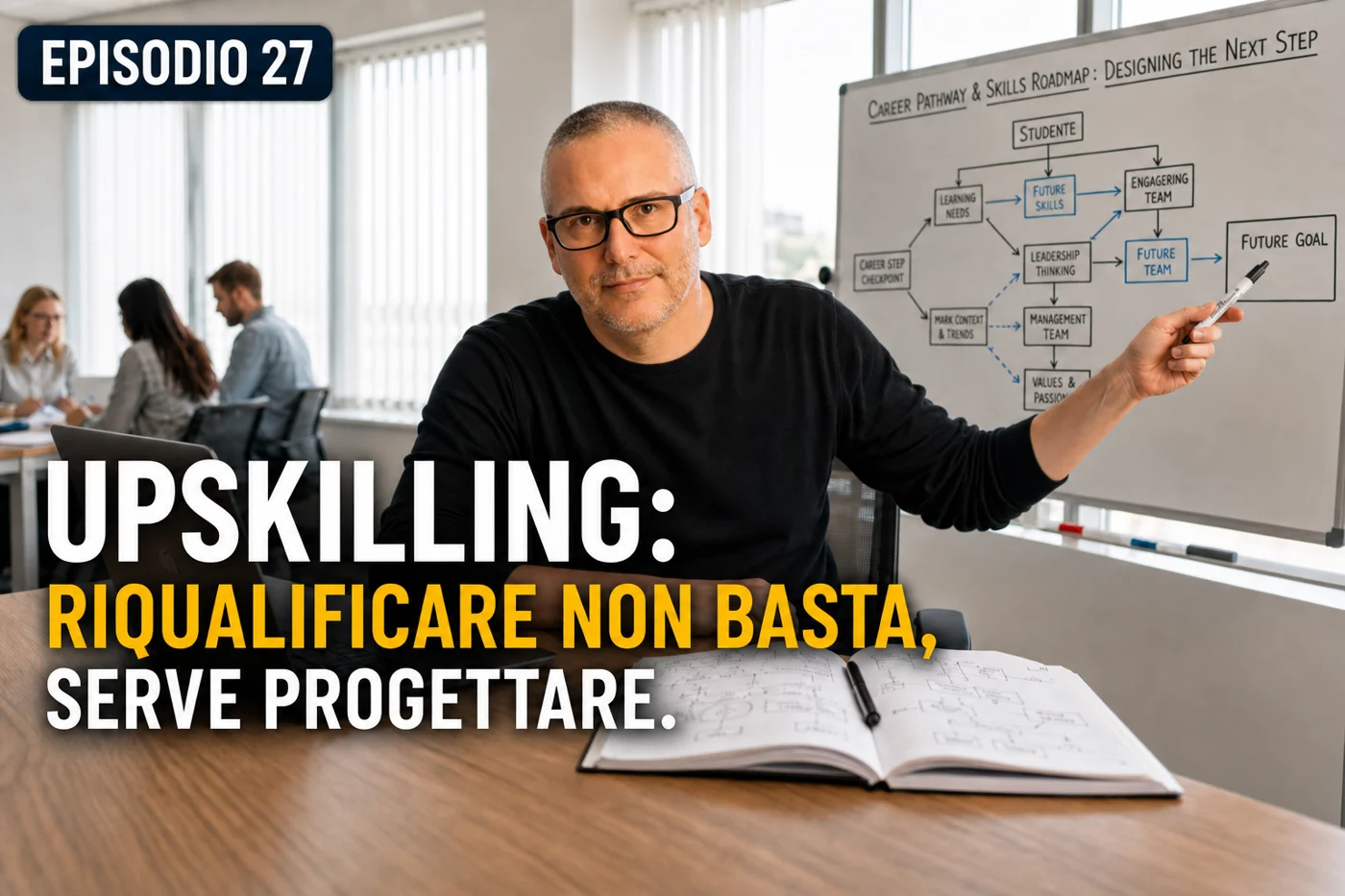
🔴 Episode 27
“We need to train people for the AI era.” It's true. But that's not enough.
Training without new roles, without job redesign, without real opportunities where you can apply what you learn, is half the answer. People take courses — LinkedIn Learning, Coursera, corporate bootcamps — then return to a place that no longer exists or has never been rethought. An employee who learns Python and machine learning but his office has no projects to use it. A worker taking a course on "AI in the factory" but his company has not yet invested in sensors or data. Retraining only makes sense if there is an "after" to plan.
What's missing when you say "upskilling"
Clear paths: not generic “learn AI”, but “this skill for this role we are creating”. Time and resources to study: not "in your free time", but paid hours, permits, support. New roles that enhance human skills + AI: not only "we automate and fire", but "we redesign tasks and people do things with greater value". Salary, contracts, careers that take change into account: if the market demands AI skills but pays the same to those who have them and those who don't, the incentive is weak. Without this, "let's train everyone" sounds good but doesn't hold together job supply and demand. It's training for a market that doesn't absorb.
Who should design
Companies: not just "courses", but skills maps, transitions, new tasks. Understand which roles will be impacted, which new roles will serve, how to take people from A to B. Examples: BMW and Bosch have structured reskilling programs for employees whose roles change with automation. Institutions: active employment policies, income support during training, certifications recognized by the market. Unions and social partners: voice on how work is transformed, not just a defensive reaction. Participate in planning transitions instead of undergoing them.
Designing means: deciding which roles we want, what skills we need, how to go from "old" to "new" without leaving people behind. It's not just an HR exercise: it's corporate strategy and industrial policy.
The risk of "do it yourself"
If upskilling remains only individual responsibility — "make do, learn" — the gap widens. Those who already have resources, time, a network, a favorable context move forward. Those who don't stay behind. A young person in the city with access to bootcamps and tech communities vs a 50-year-old in an industrial area where jobs are shrinking. Training must be a right and a structured opportunity, not a lottery. Investing in public, accessible, targeted upskilling is not a cost: it is the prevention of unemployment, social hardship and polarization.
🔥 Your experience
Have you done (or offered) retraining courses related to AI or digital? What worked and what didn't? A line in the comments.
In the next episode we'll talk about when not to use AI: fallibility, limitations, cases where it does worse. Because saying "no" is also a skill.
If you want to follow the series, stay here.
From now on upskilling is not "taking courses". It's planning for what's next.Upskilling: retraining is not enough, you need to plan
🔴 Episode 27
“We need to train people for the AI era.” It's true. But that's not enough.
Training without new roles, without job redesign, without real opportunities where you can apply what you learn, is half the answer. People take courses — LinkedIn Learning, Coursera, corporate bootcamps — then return to a place that no longer exists or has never been rethought. An employee who learns Python and machine learning but his office has no projects to use it. A worker taking a course on "AI in the factory" but his company has not yet invested in sensors or data. Retraining only makes sense if there is an "after" to plan.
What's missing when you say "upskilling"
Clear paths: not generic “learn AI”, but “this skill for this role we are creating”. Time and resources to study: not "in your free time", but paid hours, permits, support. New roles that enhance human skills + AI: not only "we automate and fire", but "we redesign tasks and people do things with greater value". Salary, contracts, careers that take change into account: if the market demands AI skills but pays the same to those who have them and those who don't, the incentive is weak. Without this, "let's train everyone" sounds good but doesn't hold together job supply and demand. It's training for a market that doesn't absorb.
Who should design
Companies: not just "courses", but skills maps, transitions, new tasks. Understand which roles will be impacted, which new roles will serve, how to take people from A to B. Examples: BMW and Bosch have structured reskilling programs for employees whose roles change with automation. Institutions: active employment policies, income support during training, certifications recognized by the market. Unions and social partners: voice on how work is transformed, not just a defensive reaction. Participate in planning transitions instead of undergoing them.
Designing means: deciding which roles we want, what skills we need, how to go from "old" to "new" without leaving people behind. It's not just an HR exercise: it's corporate strategy and industrial policy.
The risk of "do it yourself"
If upskilling remains only individual responsibility — "make do, learn" — the gap widens. Those who already have resources, time, a network, a favorable context move forward. Those who don't stay behind. A young person in the city with access to bootcamps and tech communities vs a 50-year-old in an industrial area where jobs are shrinking. Training must be a right and a structured opportunity, not a lottery. Investing in public, accessible, targeted upskilling is not a cost: it is the prevention of unemployment, social hardship and polarization.
🔥 Your experience
Have you done (or offered) retraining courses related to AI or digital? What worked and what didn't? A line in the comments.
In the next episode we'll talk about when not to use AI: fallibility, limitations, cases where it does worse. Because saying "no" is also a skill.
If you want to follow the series, stay here.
From now on upskilling is not "taking courses". It's planning for what's next.