
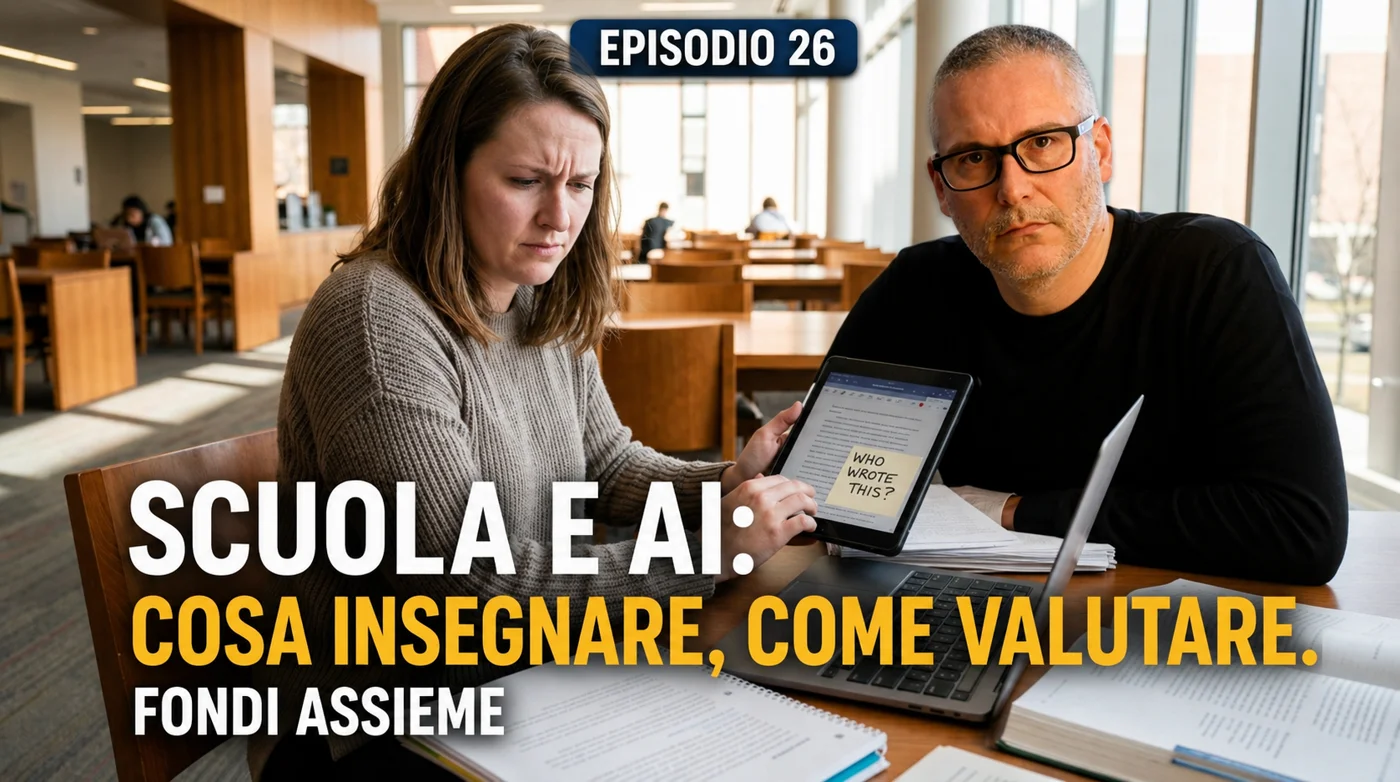
🔴 Episode 26
Students use AI to do homework. Teachers don't know if that essay was written by a human or a model. Assessing “what they know” becomes a puzzle. And the bigger question isn't “to ban or not.” It's what we really want them to learn.
The theme that writes itself
It's banal now: a prompt, a theme. A prompt, a report. The output is smooth, correct, often unsurpassed for those without time or expertise. ChatGPT, Claude, Gemini - students have been using them for months. Banning AI in the classroom is almost impractical — like banning the calculator in the 1990s, but with the problem that the output is not just a number but original-looking text. Using it without rules creates addiction and empties the meaning of the exercise. If the student pastes the prompt and turns it in, they haven't written anything. He didn't think. He was not wrong and correct. He only delegated.
The challenge: using AI as a tool without replacing the learning process. Writing, making mistakes, correcting, understanding — they are part of "learning". If AI does everything, what is left to learn? Some universities — like Sciences Po in Paris — have banned ChatGPT for essays. Others — like Wharton — encourage use with clear rules (state, show process). The answer is not clear, but ignoring the problem is not an option.
What to teach then
Not just "content" that AI summarizes better. But critical thinking, questions, verification of sources, argumentation. If AI can produce an essay on Dante, the value is no longer "knowing the Comedy" - which a model has in memory - but "knowing how to ask questions about Dante", "compare sources", "evaluate whether the AI output is correct or distorted". Know when to use AI and when not to. Know how to check the output: Did it make any mistakes? Did he invent sources? Did it play bias? AI literacy becomes a transversal subject: not "using ChatGPT", but understanding limits, bias, responsibility. Finland, Estonia, some US states are integrating AI literacy into curricula. The goal: citizens who know how to use tools without being used by them.
How to evaluate
Classwork without devices? Projects where AI is allowed but must be declared and discussed? Evaluate the process as well as the product — “show me how you arrived at this conclusion” instead of just “deliver the essay”? No answer is perfect. Traditional classroom assignments remain a way to test skills without AI, but they do not capture the ability to use AI critically. “AI allowed” projects are more realistic for the world students will live in, but require new evaluation criteria. But ignoring the problem — pretending nothing has changed — is the worst. It is training students for a world that no longer exists.
🔥 Your experience
Are you a teacher, student or parent? How are you experiencing the arrival of AI in homework and assessments? A line in the comments.
In the next episode we will talk about upskilling: retraining is not enough, we need to plan. Because "training people" without redesigning jobs and roles is only half the answer.
If you want to follow the series, stay here.
From now on at school the question is not "AI yes or no". It's what we want to keep human.