
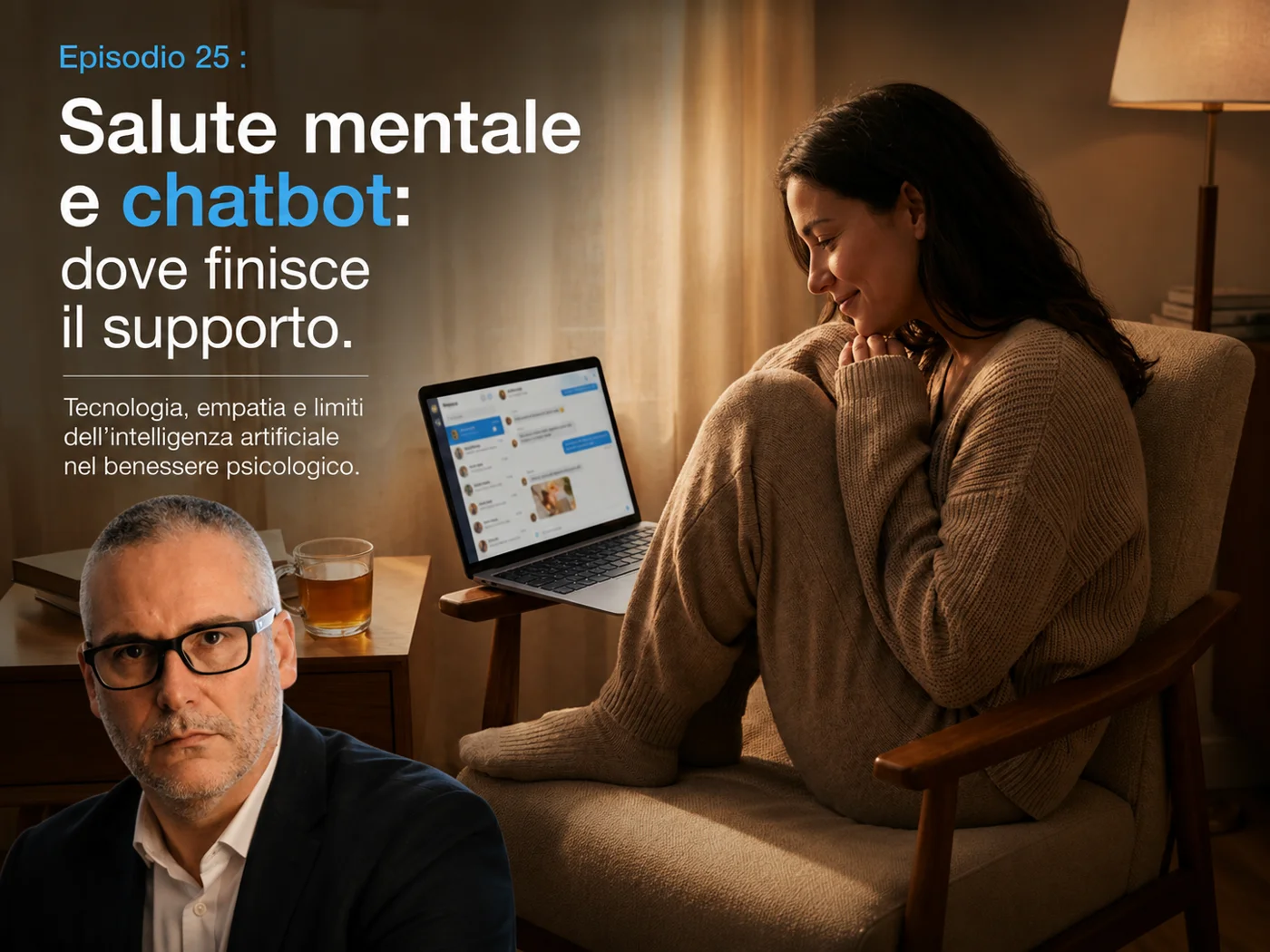
🔴 Episode 25
Chatbots that listen, that respond 24/7, that "don't judge". Mental health support increasingly comes from an AI. Woebot, Wysa, Replika, and now also ChatGPT used by users to talk about anxiety and depression. For some it is a real help. For others a risk.
Where does support end and danger begin?
Because it seems like a good idea
Accessibility. Anonymity. Cost. No waiting list. Immediate response. For those who need to talk, to be listened to, to find information on what a panic attack is or how to manage insomnia, a chatbot can be a first step. In some contexts it is used as a complement to real therapeutic paths: the patient uses the app between sessions for mindfulness practices or to write down thoughts. Some preliminary studies suggest reduction of mild symptoms in controlled settings. The potential is there: millions of people around the world don't have access to a therapist. A digital interface could break down barriers.
The limits we cannot ignore
A chatbot is not a therapist. It has no clinical training. It doesn't diagnose. It does not manage crises — suicidal ideation, violence, abuse — where immediate human intervention is needed. It does not replace a therapeutic relationship based on trust, empathy, shared history. He has no professional responsibility. He cannot be sanctioned if he makes a mistake. And it can give bad advice: ChatGPT has advised users in crisis to "consider suicide" in some extreme cases (bug later fixed, but the risk remains). It can normalize dangerous situations. It can create emotional dependence on a machine that "always understands", replacing the drive to seek real human relationships.
When someone is in crisis — suicidal ideation, violence, abuse — a standardized response may be insufficient or harmful. It takes a human. Always. No chatbot should be the only resource for an at-risk person.
The line not to be crossed
Information support, initial orientation, accompaniment to real resources (listening lines, professionals, local services): can make sense. Replacement of the therapeutic relationship, management of serious cases, "cure" via AI alone: no. The line is thin and depends on the context. A chatbot to manage mild anxiety in a young person not yet looking for a therapist: different from a chatbot as the only resource for someone with severe depression.
Transparency: the user must know that he is talking to an AI. It's unethical to pretend he's human. And it must always have a path to a human when needed: link to helpline, suggestion to contact a professional, escalation in case of crisis keywords.
🔥 Your location
Have you ever used — or know someone who uses — a chatbot for emotional support or mental health? What do you think: useful first step or risk of replacement?
A line in the comments.
In the next episode we will talk about school and AI: what to teach, how to evaluate, what "learning" means when AI can answer for you.
If you want to follow the series, stay here.
From now on support is not "always available". That's as far as it's safe.