
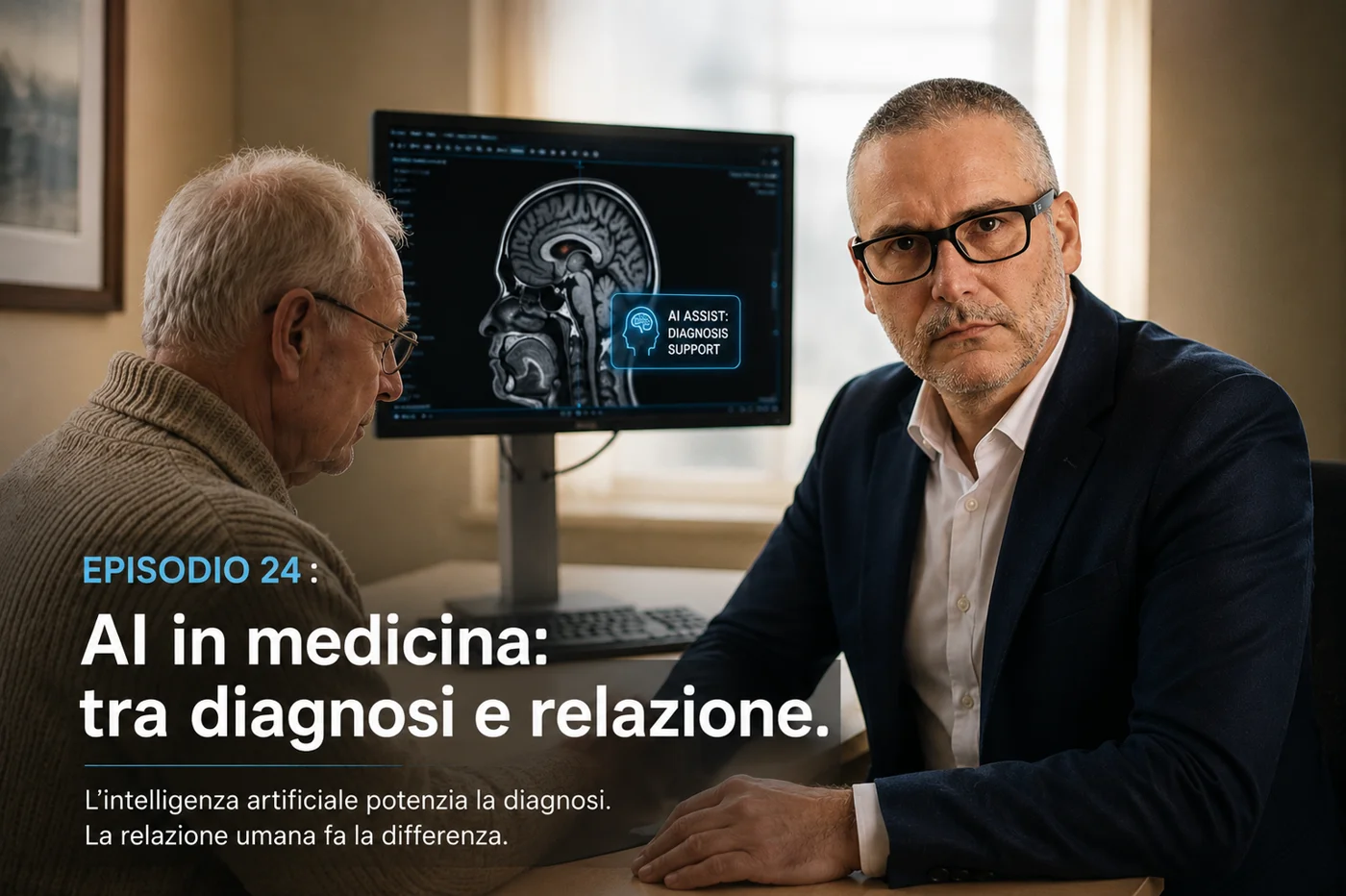
🔴 Episode 24
AI can help read an x-ray, suggest a therapy, predict hospitalization. But the patient is not a data. He is a person. And care is not just accuracy. It's a relationship.
The question is not "will AI replace the doctor?". It's where AI helps and where it needs to stop.
Where AI can help
Image analysis: x-rays, MRIs, CT scans. AI can detect nodules, microcalcifications, patterns that the human eye might miss. Some systems — such as those developed by DeepMind for the retina or by numerous startups for mammography screening — meet or exceed the performance of radiologists on specific tasks. Patterns in large datasets: correlations between genes, symptoms, outcomes that would require years of manual study. Triage: prioritization of cases in the emergency room. Decision support in well-defined contexts: which antibiotics to prescribe, which drug interactions to consider. Speed, consistency, scalability. In many cases AI can reduce human errors and give the doctor more time for what only a human can do: listen, explain, reassure.
Where it should stop
The final diagnosis, the communication of the disease, the choice of a therapy that involves the patient's values and preferences cannot be "just an algorithm". The doctor, the context and informed consent are needed. Telling someone that they have cancer, discussing treatment options with their existential implications, accompanying them at the end of life: these are acts that require presence, empathy, moral responsibility. And when the AI makes mistakes — and it will make mistakes, like any tool — who looks the patient in the eye? A model cannot apologize. He cannot change his approach based on the patient's reaction. He cannot assume professional and ethical responsibility. The doctor yes.
Sensitive data and trust
Health data is among the most sensitive. Each record contains information on medical history, genetics, intimate life. Privacy, security, secondary use, consent: are not details. They are the foundation of trust between patient and healthcare system. A hospital data breach can expose millions of people. Use of data without consent — for example to train models — violates trust. A system that "works well" but that patients don't trust to use fails. Europe with the GDPR and national regulations has stringent rules. AI in medicine must respect them not only for compliance, but to maintain the trust without which medicine does not work.
The doctor remains at the center
AI as a doctor's tool, not a substitute. Mandatory human supervision for critical decisions. Explainability when possible: the doctor must be able to understand why the system suggests something, to validate or contest. Possibility of dispute: the doctor has the final say. Technology serves the care relationship. It does not replace it. The goal is not "machine better than doctor", but "doctor better supported, patient better cared for".
🔥 Your opinion
Should it be mandatory for a human (doctor) to always confirm a diagnosis or treatment suggested by the AI, before it is applied to the patient?
Yes or no — and a line — in the comments.
In the next episode we will talk about mental health and chatbots: where the support ends and the risk begins.
If you want to follow the series, stay here.
From now on in medicine AI is not "more precision". It is precision at the service of the relationship.