
🔴 Episode 15
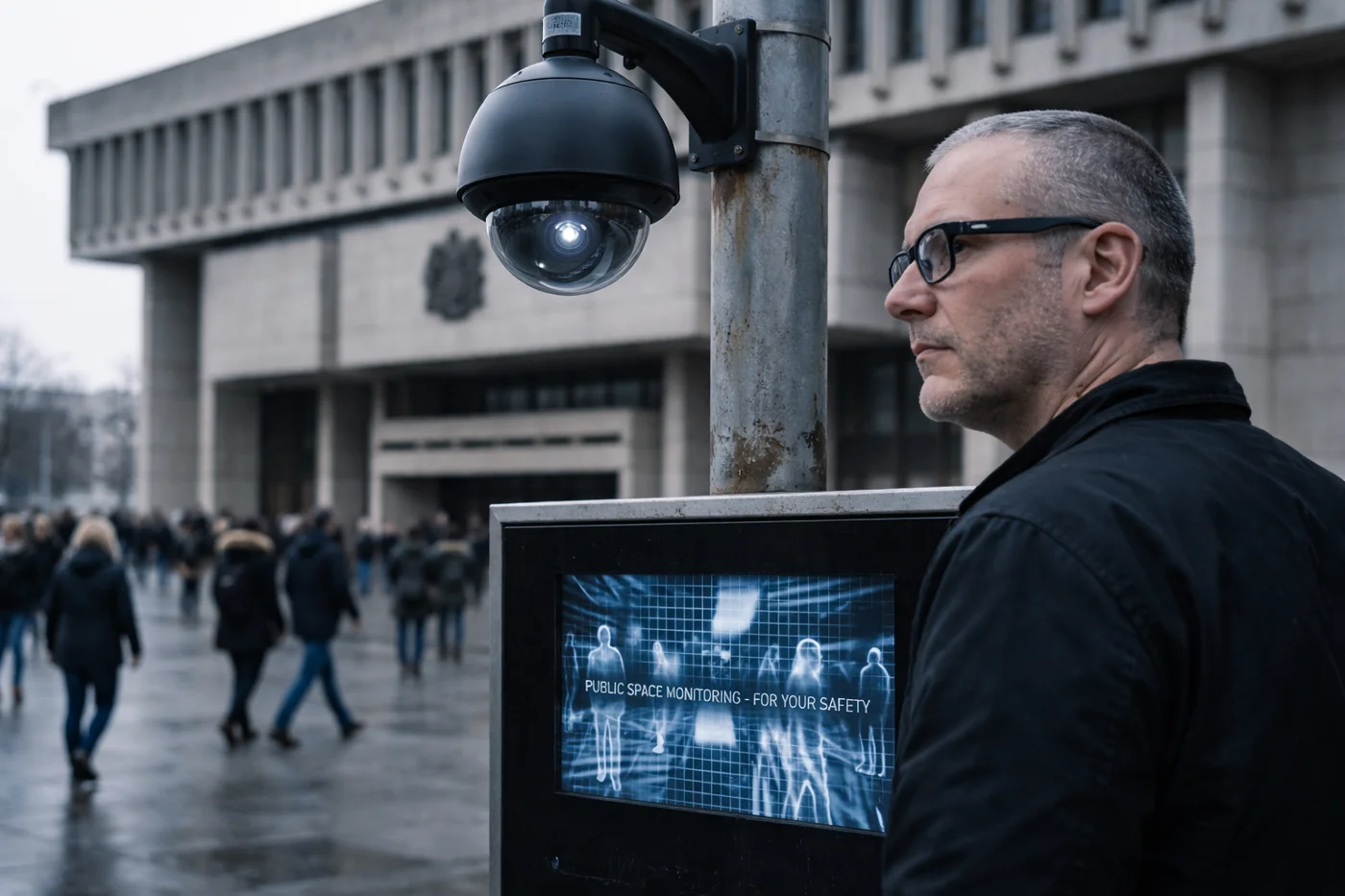
Facial recognition everywhere. Algorithms that assign scores. Systems that know where you are, who you are with, what you do.
I don't look at it just as an observer: I have also worked on these systems personally, up to the US patent US 9,286,791, System of electronic devices for protection and security of places, persons, and goods. Precisely for this reason the question, for me, is not whether technology is powerful. It is. The point is how we choose to use it.
The question is not "does it work?". It's "at what price?".
And in a historical moment in which the language of war returns to occupy the center of public discourse, this question becomes even more urgent. Because when the perception of threat grows, the collective willingness to accept tools previously considered excessive also grows. In other words: the emergency lowers the consensus threshold.
This is the point I would like to argue most forcefully: Surveillance AI is not just a set of useful or dangerous technologies. It is an infrastructure of power. And in times of geopolitical tension, pre-war or hybrid warfare, the risk is not just episodic abuse. The risk is the structural normalization of identification, classification and intervention mechanisms which then remain even when the emergency passes.
Thesis: technical effectiveness and political legitimacy do not coincide
The first misunderstanding to resolve is this: the fact that a technology can work in some contexts does not imply that it should be adopted on a large scale, nor that its use is politically legitimate.
This distinction is crucial. A system can be:
- technically effective in restricted scenarios;
- economically convenient for an institution;
- politically seductive in a phase of collective fear;
and yet be incompatible with fundamental principles such as proportionality, presumption of innocence, freedom of movement, right to anonymity in public space, possibility to challenge an automated decision.
In public debate, however, these levels are often merged. They say, "if it helps safety, then it's right." But it is a dangerous logical leap. Utility is not enough to establish legitimacy. If it were enough, any form of total control could be justified in the name of efficiency.
The topic of security in times of threat
"It's to stop terrorists." "It's used to find criminals." "It's to protect citizens."
Sometimes it's true. New Delhi police have used facial recognition to identify thousands of missing children. Surveillance systems at airports can speed up checks and help locate wanted individuals. It would be intellectually dishonest to deny it.
But to stop there is to see only half the problem. The same technology can be used to surveil dissidents, monitor journalists, repress demonstrations, track minorities, extend suspicion to entire categories of the population. And it is precisely in periods of international tension that this leap becomes easier to make, because the lexicon of security tends to colonize everything else.
When a society enters a pre-conflict logic, governments and security apparatuses gain more space for action. The citizens, frightened, accept exemptions that in ordinary times they would have contested. Technology companies find new markets. Vendors promise quick fixes to structural problems. The result is a dangerous convergence:
- more political demand for control;
- more technological monitoring offer;
- less cultural resistance to the expansion of systems.
This mechanism is known in the history of institutions: the exception tends to settle. The tools introduced for the emergency phase rarely really disappear. They change name, they change interface, they are moved in context, but they remain.
The tool does not decide. Who uses it, yes. And above all, the incentive framework in which it is used matters. In a context marked by fear, incentives almost always reward the expansion of control, not its limitation.
From military defense to civil control: the dual use continuum
One of the less discussed aspects is that many surveillance technologies live in an area of dual use, that is, they can be used both in military or intelligence contexts and in civilian contexts.
This makes the problem even more delicate. During a geopolitical crisis, tools developed or justified for territorial defense can migrate towards internal uses: control of critical infrastructures, crowd management, border protection, preventive identification of "anomalous" subjects, risk scoring of workers, travellers, citizens.
The transition is often narrated as natural: if a technology protects a base, why shouldn't it protect a station? If it can signal a threat at the border, why not use it in a school, in an airport, in a square? The problem is that in this way the logic of the operational theater enters the civil space.
And when military logic enters civilian space, the way we look at people also changes. No longer citizens with rights, but potential anomalies to be classified. No longer individuals to be protected in their freedom, but targets to be made legible, comparable, predictable.
This conceptual transformation is perhaps the most serious of all, because it occurs even before the actual abuse. It happens in the language, in the architecture of the system, in the categories with which power defines reality.
Scoring: when an algorithm judges you
Social credit, risk of recidivism, job reliability, "propensity" to commit crime.
Algorithms that assign scores to people. Without full explanation. Often without the possibility of appeal. With real consequences: denied work, rejected mortgage, limited freedom, increased investigative attention, differentiated access to services or spaces.
The COMPAS system, used in several American courts to estimate the risk of recidivism, was criticized by ProPublica for racial bias: it incorrectly predicted recidivism for black defendants nearly twice as often as for white defendants. In China, pilot social credit systems have shown how a scoring system can impact loans, travel and opportunities. In the West we almost never call it "social credit", but the logic is not that distant when ranking, reputation, behavioral prediction and automated profiling start to converge.
The point is not just statistical bias. The point is more radical: scoring transfers sovereignty. It shifts a portion of judgment from the human process, fallible but contestable, to a computational apparatus that appears neutral precisely because it is opaque.
In times of imminent or perceived war, this delegation risks intensifying. Because institutions are looking for rapid prioritization tools: who to check first, who to stop first, who to report, who to classify as risk. Scoring promises exactly this: to compress complexity, transform uncertainty into number, make chaos manageable. But when you turn uncertainty into a score, you don't eliminate it. You hide it inside the model.
And when is bias built into the model? It becomes system policy. It is no longer the prejudice of a single official, correctable on a case-by-case basis. It is an algorithm that replicates and amplifies historical discrimination, applied to thousands of cases with the implicit authority of number and automation.
In this sense the algorithm is not just a tool. It becomes a form of administration of suspicion.
Technical limitations don't disappear just because there's urgency
An important, almost methodological reminder is needed here. When political pressure increases, the rigor with which systems are evaluated often decreases. It's a mistake.
Facial recognition and behavioral classification systems suffer from known problems:
- variable data quality;
- non-representative datasets;
- increase in errors in real conditions compared to benchmarks;
- performance degradation in crowded, partially occluded, poorly lit or physically stressed environments;
- vulnerability to demographic and contextual biases;
- difficulty of independent audit when the model is proprietary.
In other words, the more chaotic the context, the more the system risks failing precisely when it is asked to be decisive. And the pre-war or war context is, by definition, a chaotic context: increase in exceptions, out-of-distribution behaviors, operational pressures, non-homogeneous information quality, accelerated decision-making chains.
Relying on these systems under such conditions without robust verification mechanisms is not modern. It means moving the error upstream and then investing it with technical authority.
The risk of opacity
Who knows how the system works? Who can dispute it? Who can correct a mistake?
If the system is closed, proprietary, inaccessible… there is no transparency. And without transparency there is no democratic control.
The European GDPR introduces relevant limits and rights for significant automated decisions, and the European AI Act tries to distinguish high-risk cases and those that are prohibited or severely restricted. But the real difficulty is not just regulatory. It is operational and political.
Who really checks:
- the data with which the system was trained;
- differential errors for different groups;
- the decision thresholds set by the vendor;
- the metrics chosen to declare the system "reliable";
- cases in which the human operator simply ratifies the machine's output?
Very often none, or in any case not sufficiently. And then the power to monitor and judge passes to those who control the technology. And often it's not us. It is in the hands of private vendors, state agencies, infrastructure platforms, procurement chains that are beyond the control of the citizen and sometimes even the political decision maker.
In a climate of imminent war, this opacity is easily justified with two words: "security reasons". But right here the alarm should go off. Because if we cannot know the criteria, errors, limits and governance of a system that affects freedoms, then we are building a power that demands obedience without accountability.
The technological state of exception
Every time we accept: one more camera, one more database, "it's for security"... the line moves.
And then it becomes difficult to go back. "We've always done it this way." "We can't give it up." "The others already do it." Normalization progresses.
It is the phenomenon of mission creep: a technology introduced for a limited purpose is extended to increasingly broader contexts. Once the infrastructure exists, the temptation to use it for something else is very strong. And each new use seems only a minimal extension of the previous one.
The point is that war, or even just its imminence, works as an accelerator of this drift. The politics of the exception always needs tools, and today those tools are increasingly digital:
- interoperability between databases;
- remote biometric identification;
- multi-sensor tracking;
- predictive analysis;
- risk scoring;
- persistent monitoring of spaces.
Taken individually, they may seem like technical pieces. Integrated together they become a new control architecture. No more episodic surveillance, but continuous surveillance. No longer just observation, but inference. No longer just recording, but anticipation.
And when a system begins to anticipate, it inevitably also begins to treat innocent people as likely problems. This is the ethical threshold that should be defended more decisively.
The real problem: the redefinition of the relationship between citizen and state
Ultimately, the question is not whether Surveillance AI is good or bad in the abstract. The question is what political anthropology presupposes.
If a State considers the citizen first and foremost as a bearer of rights, then technology must be subordinated to very strict, verifiable and contestable limits. If, however, the citizen is progressively treated as a source of risk, then every piece of data becomes legitimate, every tracking becomes reasonable, every exception seems temporary even when it is not.
This slippage is particularly dangerous in democracies, because it often doesn't come with explicit statements. It arrives through the accumulation of procedures, software, public tenders, protocols, API integrations, operational dashboards. You don't need an overtly authoritarian law to change the nature of power. Sometimes a long sequence of small technical acts presented as neutral is enough.
This is why I insist on one point: the debate on Surveillance AI cannot be left only to engineers, vendors, interior ministries or security managers. It is a constitutional, cultural, philosophical debate. It's about the kind of society we're building while we say we want to defend ourselves.
What can we do
If we want to prevent fear from producing permanent infrastructures of control, at least five conditions are needed.
1. Real proportionality, not declared. Each use must be limited, temporally defined, motivated by compelling necessity, and not introduced due to administrative inertia.
2. Mandatory independent audits. Not just cybersecurity audits, but audits on bias, real-world performance, impact on fundamental rights, error rates and data governance.
3. Effective right to contest. If a system contributes to a decision that affects my life, I must be able to know based on what criteria and with what margins of error.
4. Clear separation between the military context, intelligence and civil space. If this separation fails, the risk of authoritarian contamination grows enormously.
5. Public literacy. Most people do not know how much data they produce, what inferences they enable, how they are combined, and what power they generate. Without widespread culture, consensus is just unconscious acceptance.
And then we need a collective choice: where do we want surveillance? Where not? Who decides the limits? Who controls the controllers? It's not a technical question. It is a political and cultural question. And in times of imminent war it is even more important to ask oneself, because it is precisely then that one risks responding badly out of haste, fear or a spirit of obedience.
🔥 Your threshold
Is there a context where you would say "no facial recognition here, never"? School? Street? Work? Hospital? Airport? Demonstrations? Nobody?
Write it in the comments. But above all let's try to take one step further: what is the limit that we shouldn't move even if they tell us we're in an emergency?
In the next episode we will talk about the invisible workers of AI: those who label, moderate, validate. The human cost we often don't see.
If you want to follow the series, stay here.
From now on surveillance is no longer just a camera. It is a system that decides, classifies, signals, anticipates.
And a society that accepts without discussion systems that anticipate the citizen, sooner or later ends up considering freedom a cost and control a normality.