
🔴 Episode 1
For years we have talked about Artificial Intelligence as a tool. An advanced assistant. A response engine faster than us.
That story is outdated today.
We are entering a different, quieter and much deeper phase: AI no longer just responds. Start deciding.
From tool to agent
The difference is subtle only in appearance.
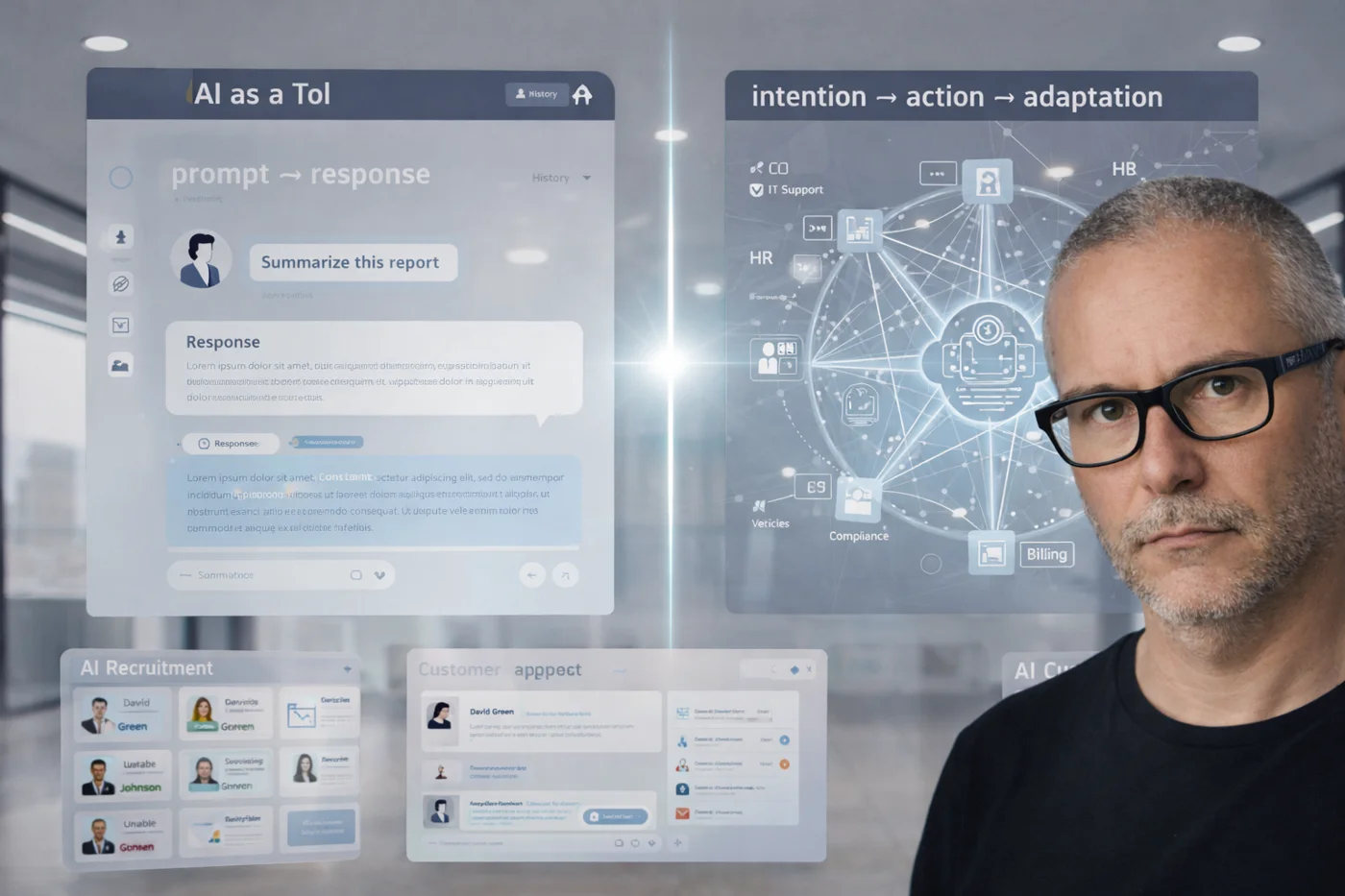
A tool: waits for input → produces output → stops.
An AI agent, on the other hand: observes a context → defines an objective → plans actions → uses tools → checks results → corrects the strategy.
And he can do it without asking for confirmation at every step.
It's no longer “prompt → response”. It is intention → action → adaptation.
Example: ChatGPT with a prompt responds and stops. A coding agent (Cursor, Copilot Workspace, Devin) receives a goal ("add login"), analyzes the code, chooses the files to modify, writes and tests—without asking you for confirmation at each step.
Because this changes everything
When AI becomes agentic, the implicit pact between us and technology changes.
🔹 At work: you no longer delegate only repetitive tasks. Delegate operational decisions. Today: recruiting systems that discard CVs and schedule interviews; customer care bots that decide refunds or escalations; tools that assign priority to tickets without going through a human.
🔹 In software: You don't just design flows. Behavioral projects. Today: agents who read emails and calendars and reply or resend; pricing systems that adjust prices in real time; automations that choose what to order in the warehouse.
🔹 In leadership: you won't just lead people. You will lead people + autonomous systems. Already today in logistics, anti-fraud and trading someone "guides" algorithms that make decisions per second.
And here comes the real critical point.
The question few are asking
Everyone talks about power. Of speed. Of productivity.
Few talk about responsibility.
Because when a system chooses a priority, discards an option, takes an initiative... someone has to answer for it.
Agentic AI does not eliminate error. It amplifies it if it is not governed.
It's not a technical question
This step isn't just advanced engineering. It's a cultural choice.
We are deciding whether to use AI as a lever of thought or as a substitute for thought. Whether to build systems that ask for oversight or systems that bypass it.
The difference is not in the model. It depends on who designs it and with what limits.
A line has already been crossed
Many companies today already have: agents that plan, systems that decide priorities, automations that act on real data.
Concrete cases: CV screening that excludes candidates before a recruiter sees them; chatbots that close complaints and refunds without going through an operator; anti-fraud devices that block transactions; algorithms that optimize shifts and assignments. Often without calling them “agents”. Often without saying it openly.
The line is not “when will it arrive”. The line is: did we really notice?
🔥 Let's stop for a moment
If tomorrow you had an AI agent capable of acting without asking permission, in which area would you NEVER use it?
Write it in the comments with just one word (e.g. finance, HR, safety, healthcare, justice). The answers will say much more than any slide.
In the next episode we will talk about control and power: who really holds the keys to the AI we are building.
If you want to follow the series, stay here.
From now on, AI is no longer just a technical question.