
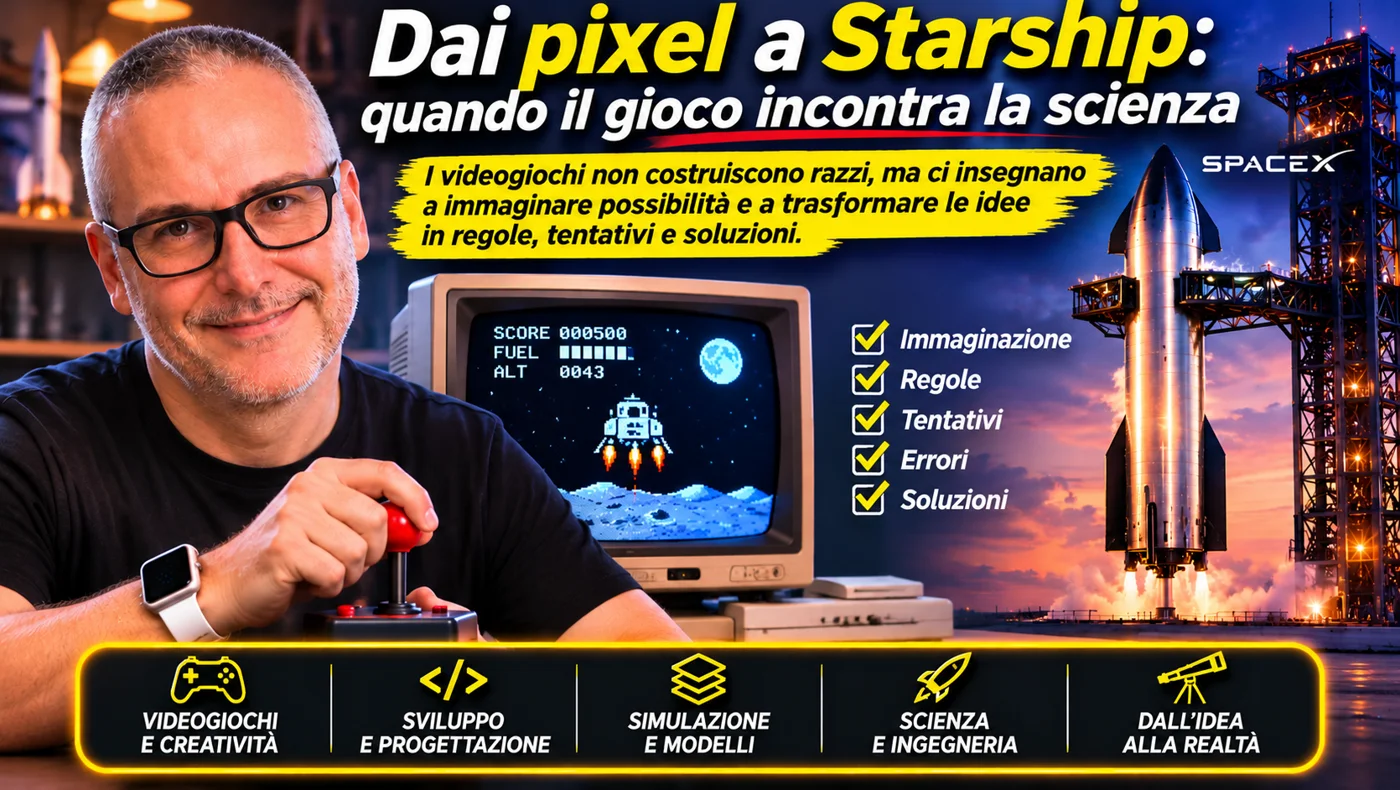
Video games do not build rockets, but they teach us to imagine possibilities and turn ideas into rules, attempts and solutions
In the 1980s, in front of a joystick, we tried to land a “missile”. It was actually a lunar module: a few pixels on screen, thrust to control and gravity to keep in check.
The game was simple. Pressing the wrong button or correcting the trajectory too late was enough to crash. You started over and tried again.
Today we watch images of Starship returning and being caught by the tower's arms. The scene seems almost impossible: an enormous vehicle returns to the ground and is caught in midair. But between that video game and a real spacecraft lie decades of study, design and testing.
The point is not that the game anticipated Starship or taught us how to build it. It did not. The point is that behind a landing game there was already a question belonging to science and engineering: how do you guide a descending vehicle and bring it to the right place?
A game is an idea turned into rules
A video game takes an idea and gives it form. It establishes what the player can do, which rules govern the world and what happens after each choice.
In a flight game, those rules can recall real concepts: gravity, speed, thrust, fuel, direction. The on-screen version is greatly simplified, but it allows us to grasp an important principle: every action has consequences.
The player tries a maneuver, observes the result, changes strategy and tries again. It is not a physics lesson or a faithful spacecraft simulation. It is a small interactive model, simple enough to let us experiment with our minds and hands.
That is why video games can be much more than a pastime: they let us explore a “what happens if…?”. They invite us to imagine possibilities, understand a system's rules and find a way to achieve an objective.
Developing them was a different challenge
Playing is one thing. Creating a game is another story entirely.
Before GenAI became an accessible tool, much of the creative and technical work had to be done directly by people. They had to design rules and levels, write code, draw characters and environments, build animations, create or adapt sounds, test the game, find errors and fix them.
In the 1980s there was another obstacle: machines had extremely tight limits. Little memory, basic graphics, limited computing power. Every idea had to reckon with what the computer could actually handle. Imagining a world was not enough: you had to work out how to represent it with a few pixels and limited resources.
This required creativity, but also method. A game must be understandable, respond to the player's actions and remain interesting enough to make them continue. If something does not work, you go back, change a rule and try again.
That is why developing video games is a formidable training ground for imagination and creativity. You start with an idea and turn it into a system other people can explore. You learn to design, solve problems and work within limits. And you feel that training especially when you develop games, not merely when you play them. :D
Generative artificial intelligence tools can now help at certain stages, for example by suggesting code or producing drafts of images and texts. But they do not automatically decide what experience we want to create, which rules make it fun or whether everything really works. The idea, the choices and the checks remain fundamental.
From imagination to reality
A lunar landing game compresses a complex problem into a few elements: a trajectory, thrust to adjust, a surface to reach. Starship faces an incomparably more complex reality. A spacecraft's return involves calculations, materials, software, controls, simulations and tests.
On a recent mission, the Starship spacecraft returned after more than 22 hours of flight and was recovered at the base by the tower's arms. The Super Heavy booster, however, was not recovered: the attempt was aborted after a technical problem. This, too, is part of the difference between a game and real engineering: problems are not solved with a new button to restart, but through analysis, modifications and further tests.
We can, however, recognize a kinship in the way of thinking. Imagination formulates a possibility. Science tries to describe the phenomenon and understand which laws govern it. Engineering uses that knowledge to design, build and verify a solution.
The video game did not design the rocket or predict its mission. It made familiar, in a simple form, a problem that would otherwise have remained abstract. It let us try, make mistakes and try again, turning a scientific question into an experience.
It is not magic. It is imagination meeting the rules of nature, and knowledge becoming a practical attempt. Before seeing an idea fly, someone must be able to imagine it. Then it takes years of work to make it land.
References
- La Repubblica / Reuters video
- Sky TG24 — Starship spacecraft recovery and unsuccessful booster recovery