
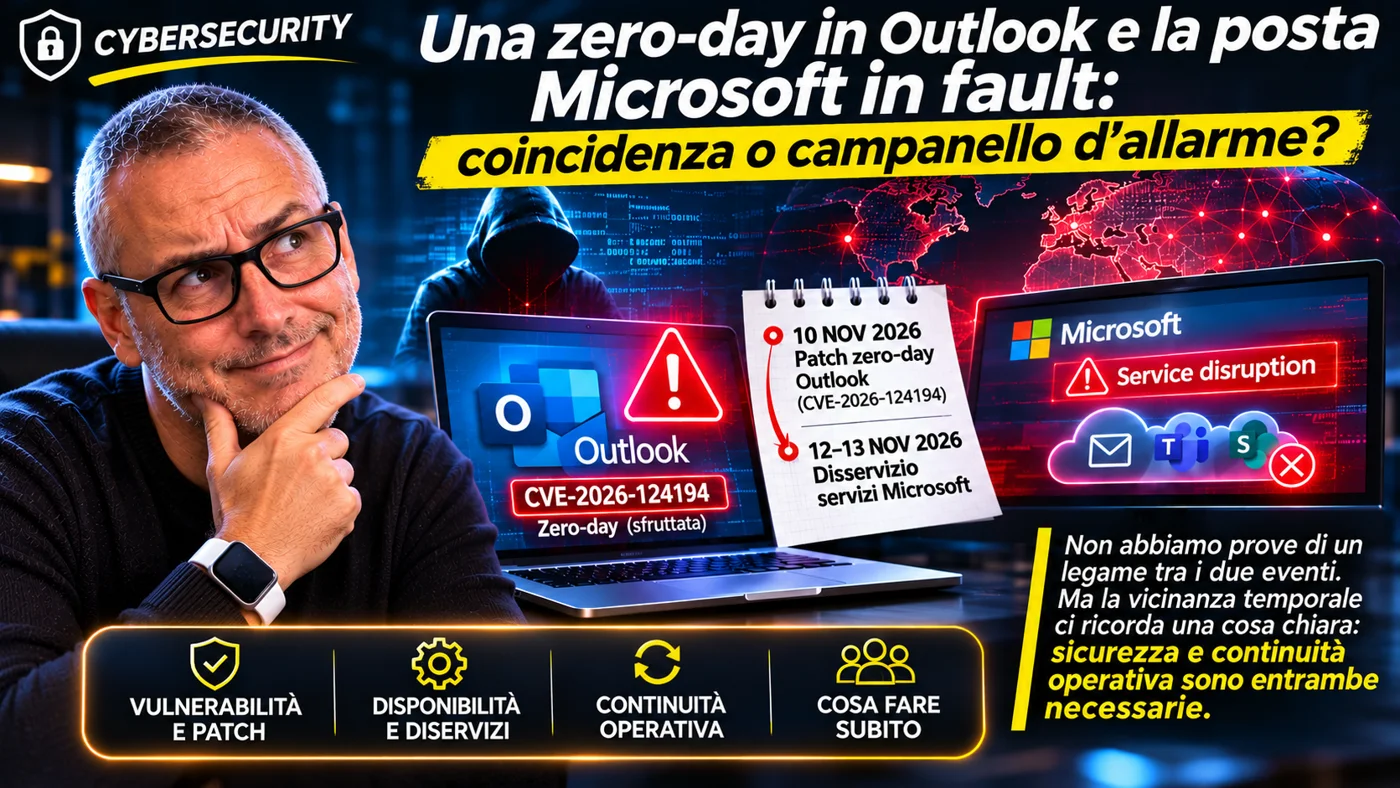
On November 10, Microsoft fixes a zero-day vulnerability in Outlook that has already been exploited in attacks.
A few days later, between November 12th and 13th, a fault caused problems for mail and other Microsoft services.
The temporal proximity is striking. It is natural to wonder whether the two events are connected.
The correct answer, today, is conservative: we have no public evidence demonstrating a link.
Two different events, in the same ecosystem
The vulnerability CVE-2026-124194 affects Outlook. CISA included it on November 10 in the catalog of actively exploited vulnerabilities. Technical analyzes describe a case in which opening a specially crafted file can lead Outlook to contact a remote resource and, under certain conditions, expose authentication information.
This doesn't mean that your password is automatically stolen, nor that the leak alone causes your email to be blocked. The risk described concerns the security of authentication; user interaction is required to exploit it.
The disservice, however, concerns availability: users are unable to regularly access email or other services. Microsoft attributed the incident to a technical problem in the management of its infrastructure and ruled out a cyber attack in widespread communications. This is the company's explanation; it is not equivalent to a complete independent technical report.
In simple terms:
- a vulnerability may put confidentiality or authentication at risk;
- a fault can make a service unavailable;
- coincidence over time does not prove that one caused the other.
Because coincidence deserves attention
Because it concerns the same provider and services on which communications and daily activities depend. But precisely for this reason we must be rigorous: asking questions is legitimate; turning a suspicion into a conclusion is not.
The available information allows us to say that an Outlook vulnerability was patched after being exploited and that, in the same week, Microsoft faced a serious outage. They do not allow us to state that the fault was caused by that vulnerability, by an attack or by an attempt to cover up an accident.
To clarify a possible connection, verifiable technical elements and a reconstruction of the accident would be needed. Until then, any causal link remains a supposition.
The lesson does not depend on the cause
Whether it's an attack or a failure, the question for businesses and professionals is the same: what happens when an essential tool is unavailable?
Are there alternative procedures for communicating? Do people know where to find emergency instructions? Are systems and applications up to date? Is it clear who to contact if an unexpected attachment has opened?
These days it is useful:
- apply the Office and Microsoft 365 updates indicated by Microsoft, checking your version;
- do not open unexpected attachments and be wary of messages that promise to "restore" your account or email;
- if a suspicious file has been opened on a company device, notify the IT department and follow its instructions;
- maintain continuity procedures for activities that cannot stop together with the mail.
The coincidence between a zero-day and a fault is a wake-up call, not proof. It reminds us that security and business continuity are both necessary: protecting accounts, keeping services available, and preparing to work when they aren't.
Doubt can be useful. Disinformation is not. Awareness, however, can no longer be postponed.
Sources
- CISA — Catalog of Actively Exploited Vulnerabilities (entry CVE-2026-124194)
- Microsoft Security Update Guide — CVE-2026-124194
- TheSoftware — November 2026 Patch Tuesday and zero-day Outlook
- Microsoft Service Health (current state of services; not a historical reconstruction of the incident)
- RaiNews - updates on the Microsoft outage on November 13
#Cybersecurity #MicrosoftOutlook #ZeroDay #CVE2026124194 #CyberResilience #ContinuitaOperativa #Microsoft365