
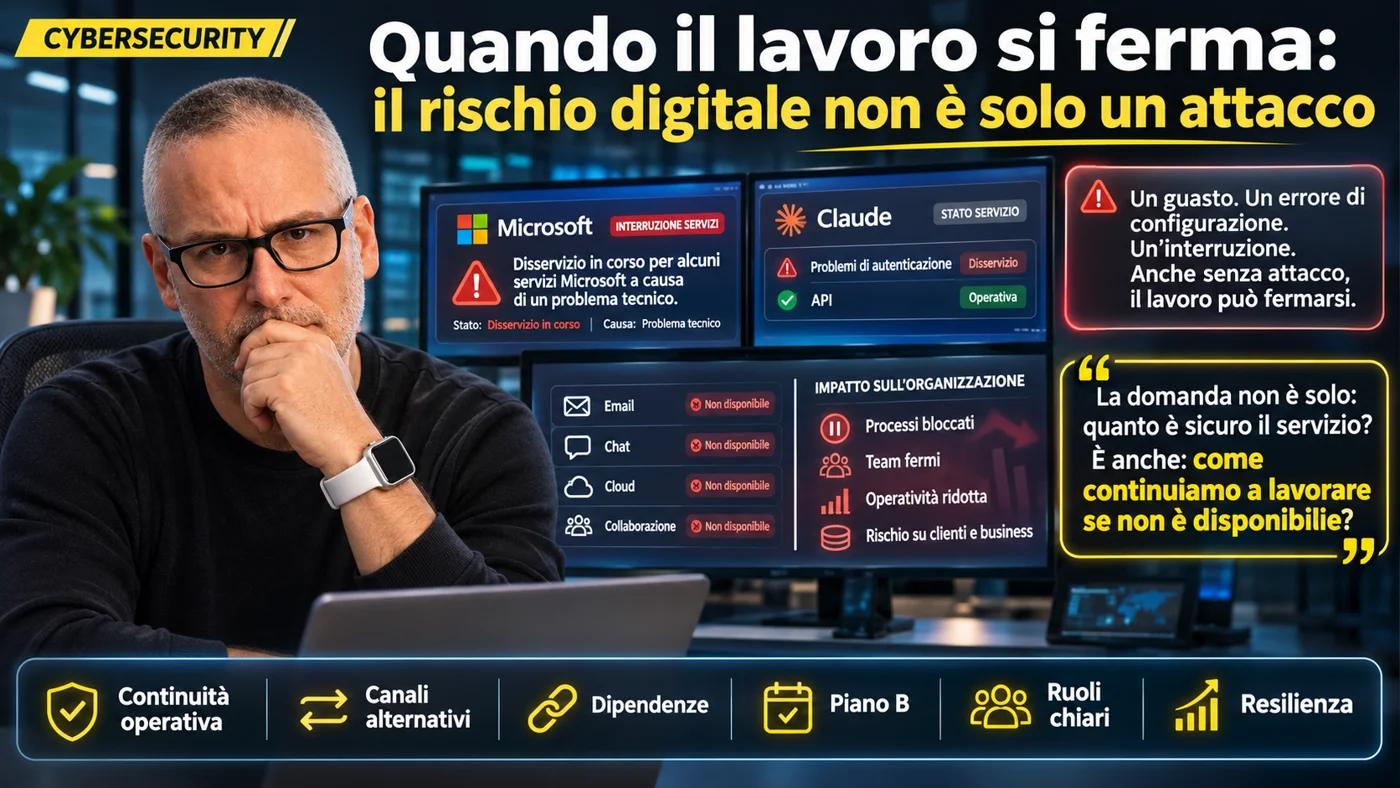
It doesn't take a cyber attack for an organization to shut down.
One failure may be enough. A configuration error. A problematic update. An interruption in a service on which all others depend.
The recent outage involving Microsoft services brought to life an uncomfortable question: how much of our work can continue if an essential digital tool is unavailable?
Microsoft has indicated an internal technical problem linked to traffic management and excluded, in the communications released so far, the hypothesis of a cyber attack. It's a plausible explanation: a failure or misconfiguration in an interconnected infrastructure can propagate and cause widespread outages. The extent of the outage alone does not demonstrate hostile action; at the moment, no elements proving an attack have been publicly presented.
This, however, does not mean that every doubt is resolved. The company's explanation is the available reference, but does not amount to a full independent verification. While waiting for more details, it would be incorrect to say that it was an attack; it would be equally premature to transform the initial information into a definitive certainty.
Whatever the cause, one lesson remains: An outage can stop work even without a cyber attack.
And today, November 13, Claude also reports problems: the official status page reports authentication difficulties impacting claude.ai, Claude Code, Claude Console and Claude Cowork, while Claude's API is operational. The report is under investigation. There is no element to link this episode to the Microsoft outage or to attribute a common cause to the two. But the fact that multiple essential digital tools are experiencing problems around the same time makes our reliance on external services even more evident.
How big is the impact?
On Friday 13 November, Sky TG24 reported Microsoft outages in 74 countries; an update from Corriere della Sera spoke of over 16 hours of interruption. These are numbers that measure the spread and duration, not the count of people actually affected.
There is currently no published verified count of people who have been unable to work, nor a consolidated estimate of global economic losses. The figure of 140,000 Downdetector reports cited in the estimate must be verified by indicating the source and time window; however, reports do not equate to unique individuals or all affected users.
A scenario estimate, not a count
To try to give an order of magnitude, a simulation can be built using the proposed hypotheses: 430 million Microsoft 365 seats/subscriptions for the corporate and educational sector and approximately 400 million personal Outlook accounts. These values must be verified with primary sources and are not necessarily unique people: seats, subscriptions and accounts are different units and can overlap.
Applying the assumed percentages — impact on 30–40% of the corporate user base and 10–15% of the personal user base — the calculation produces approximately 130–170 million business/school users and 40–60 million personal accounts. Adding the extremes together gives a scenario of around 170–230 million. It is an arithmetic simulation based on unmeasured percentages, not a statistical estimate of the accident. The wider range of 100–250 million proposed in some reconstructions is not a confidence interval and should not be presented as established data.
Knowing that the outages were reported in 74 countries does not, in itself, allow us to calculate what share of users in those countries were affected. For the same reason, comparison with an alleged total of 830 million does not prove that "one in five Microsoft users" lost access: the catchments may overlap and we do not know which users suffered an actual interruption.
The cost also cannot be deduced from the number of countries or duration alone. It depends on which services and processes were unavailable, for how long and for which organisations. Without a transparent methodology, talking about a precise figure — or billions lost — risks turning an estimate into a fact.
What we know is already enough to ask the right question: how many essential activities depend on services that we do not directly control, and how much does it cost not to have an alternative?

Different causes, similar consequences
An attack and a failure have different origins.
In the first case there is a hostile action: someone tries to compromise, interrupt or steal data.
In the second there may be a human error, a software defect, an infrastructure change or a capacity issue.
Yet, from the point of view of those who have to work, some consequences may be similar:
- the mail cannot be reached;
- meetings and communications stop;
- applications and business processes become unavailable;
- teams are unable to coordinate;
- decisions and activities remain pending.
It does not mean that a failure is equivalent to an attack. It means that the continuity of work can be exposed to both.
Dependence is a risk, even when the service works
We've grown accustomed to thinking of mail, chat, cloud storage, and collaboration tools as always available.
This availability is precious. But when an entire organization — or a chain of organizations — depends on a few central services, their disruption can have far-reaching effects.
The problem is not using the cloud or relying on external providers. The problem is not knowing what happens when that service, or the connection that takes us to it, isn't there.
The question to ask is not only:
«How secure is the service?»
It is also:
«How do we continue to work if the service is not available?»
Resilience prepares before the emergency
Operational continuity cannot be improvised while the mail is already out of order. It requires concrete choices, proportionate to the importance of the services and the risks of the organization:
- identify the processes that block when a digital service is not available;
- define alternative methods for communications and urgent activities;
- maintain emergency procedures accessible even outside the main systems;
- clarify roles, priorities and channels for updating employees, customers and suppliers;
- know supplier dependencies and realistic recovery times;
- test scenarios periodically, don't just have a plan on paper.
An alternative procedure does not have to replicate every tool. It must enable people to make decisions, coordinate and protect essential activities.
Safety also includes the ability to restart
We often measure safety by asking ourselves whether we were able to prevent an accident. It is a necessary question, but not a sufficient one.
We must also ask ourselves how capable we are of absorbing an interruption, limiting its effects and resuming activities in an orderly manner.
This is resilience: not the promise that nothing will ever stop, but the preparation to manage what can stop.
An outage does not automatically prove that there has been an attack. And an attack is not the only event capable of blocking work. Confusing the two generates alarm and misinformation; ignoring the risk of disruption breeds unpreparedness.
Awareness is holding both truths together.
The next time an essential service is unavailable, the difference won't just be the cause of the problem. It will also do it as much as we were ready to continue.
Because digital addiction is no longer a theoretical risk.
It is a condition of our daily work. And it can no longer be ignored.
#Cybersecurity #DigitalResilience #ContinuitaOperativa #Microsoft365 #Claude #CloudComputing #BusinessContinuity #DigitalResilience