
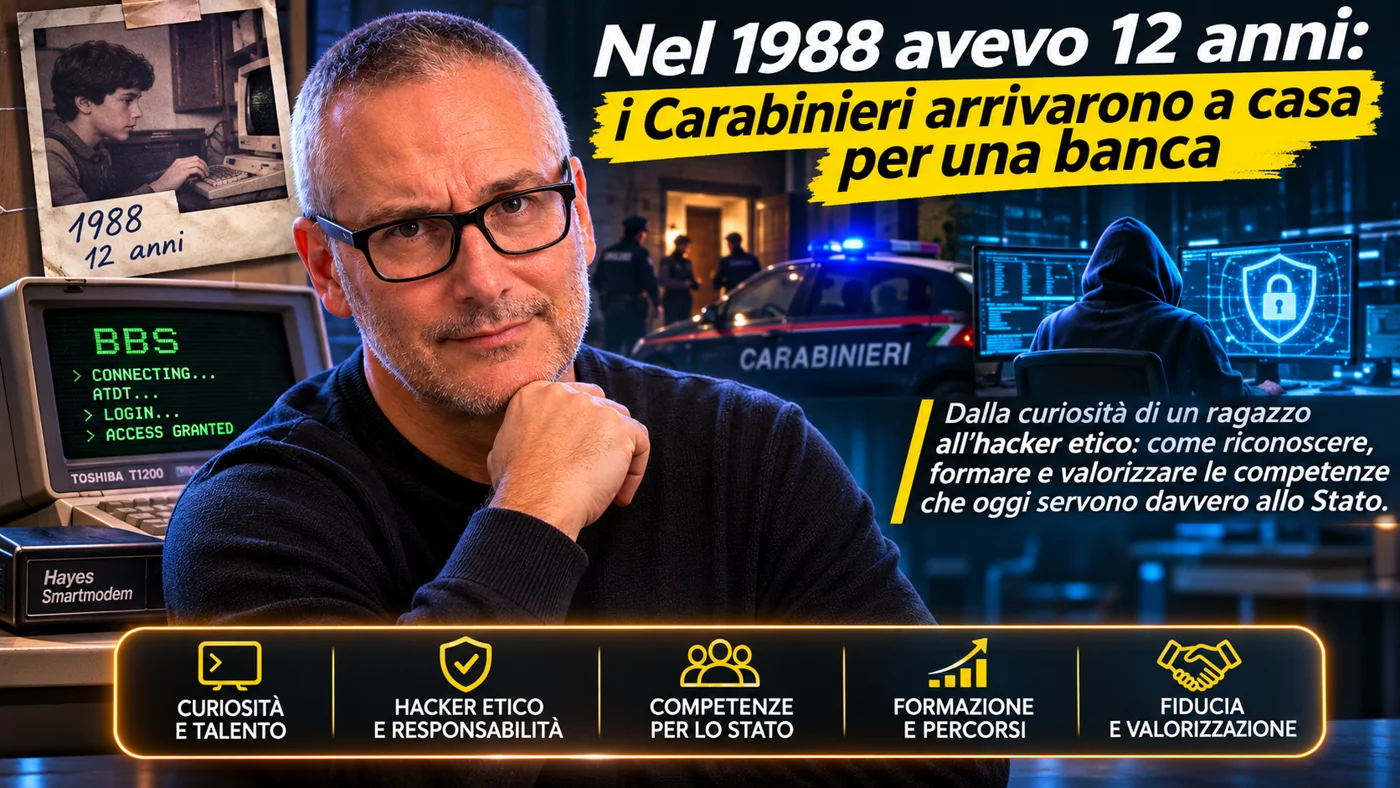
I was twelve years old when I discovered that, with a computer and a telephone line, I could go much further than I imagined.
So far away that, one day, the Carabinieri knocked on the door of the house.
But let's start from the beginning.
It was 1988. The Internet, as we know it today, practically did not exist. No Google, no smartphone, no YouTube tutorials. If you wanted to understand how something worked, you had to study it, take it apart, experiment. And often make mistakes.
My father had a Toshiba T1200, a laptop that would make anyone smile today. He used it primarily for writing documents, working with Lotus 1-2-3, and downloading mail through a Hayes Smartmodem.
For him it was a work tool.
For me it was a door to an unknown universe.
I couldn't tear myself away.
I spent days, nights, weeks looking at that screen. I studied the programs, tried to understand how they worked, modified what I could, wrote code. Sometimes I simply stood there, in front of the flashing cursor, fascinated by the idea that that machine could do something I didn't yet know.
I had no online courses, AI assistants or search engines to ask for a solution.
I had manuals, trial, error, and a seemingly inexhaustible amount of curiosity.
And above all I had discovered something extraordinary.
That computer could talk to other computers.
All it took was a telephone line.
For a twelve year old boy, it was something very close to magic.
The day curiosity crossed the border
I had learned to use AT commands on the Hayes modem. I enjoyed modifying the software I used for communications, understanding what happened during a connection, exploring BBSs, those digital communities that existed long before social networks.
One day I found the telephone number of a bank.
And I did what a curious, technically enterprising and decidedly reckless boy shouldn't have done.
I tried to connect.
Once.
Then another.
And yet another.
Until, at a certain point, I entered.
I was inside a bank's computer system. I was twelve years old.
I had no authorization. I didn't even have an adequate understanding of the consequences of what I was doing.
I wasn't looking for money. I was trying to understand how far I could go.
But this distinction, however important for understanding my motivations, did not make my behavior legitimate.
Then the Carabinieri arrived.
And suddenly what, in my child's head, had been an experiment turned into something terribly real.
The world I had explored through a screen had knocked on my door.
It wasn't a game anymore.
The difference between being able and having the right to do so
Almost forty years have passed.
Since then, IT has become my profession. I have gone through generations of technologies, systems, architectures and infrastructures. I saw the birth of the Internet, the cloud, modern cybersecurity and today artificial intelligence.
But that story left me with a lesson that I still consider fundamental.
Knowing how to enter a system does not mean you have the right to do so.
You can be brilliant, know every detail of a protocol, spot a vulnerability that no one else had seen.
But talent doesn't give you permission to push boundaries.
This is what distinguishes a security professional from someone who hacks a system without consent.
Not the technical ability.
The responsibility with which he uses it.
Yet, when I read discussions today about how the state should recruit the best hackers to defend its infrastructure, I can't help but think back to that little boy in front of the Toshiba.
Because there is a question that we continue to ask ourselves too little.
How many extraordinary talents are we losing simply because we don't know how to recognize them, educate them and offer them a path?
What if that little boy was born today?
Imagine a twelve year old today.
He has a computer, access to the Internet, artificial intelligence tools capable of assisting him in writing code, and an amount of information that in 1988 would have seemed like science fiction.
He can learn in a few months things that took us years of trying.
It can build software, analyze protocols, study the functioning of complex infrastructures.
But it can also cross a border without understanding its gravity.
Technology has multiplied the possibilities. It did not automatically raise awareness.
That's why I believe the problem isn't just preventing young people from doing something wrong.
It's teaching them what they could do extraordinarily right with the same skills.
We need laboratories, authorized testing environments, safety competitions, tutors, training courses that do not stifle curiosity but teach it to live with rules and responsibilities.
Technical talent does not necessarily arise within a university, a company or a traditional training path.
Sometimes it is born in a bedroom, in front of a screen, while everyone else is sleeping.
And he still doesn't always know what to do with his own intelligence.
Does the State really want the best hackers?
We get to the point that prompted me to write this reflection.
The need to attract top-level professionals in public cybersecurity is often discussed.
Very right.
But let's try to change perspective.
Why would someone capable of finding a critical vulnerability, designing complex systems or defending strategic infrastructure choose to work for the State?
By vocation? Certainly, for some.
Out of a sense of responsibility? Also.
But we cannot think that invoking the public good is enough to convince highly sought-after professionals to accept any conditions.
The best skills need to be recognised, valued and put in a position to produce results.
We need adequate tools, managers capable of understanding technical work, clear responsibilities and autonomy proportionate to the role.
And you also need competitive pay.
We cannot expect to defend strategic infrastructures with excellent skills and then consider those skills a cost to be reduced.
Of course, national security requires controls, procedures, confidentiality and continuity.
But organization and flexibility are not necessarily contradictory.
The State could create paths capable of involving professionals who already operate in the market, through specialist assignments, structured collaborations and projects with precise objectives, where safety conditions allow it.
Because the real question is not just how much an expert costs.
This is how much it can cost not to have it when someone decides to attack a system on which thousands or millions of people depend.
Talent is not enough. But without talent we don't get far.
I'm not proposing that we celebrate those who hack computer systems.
I'm not suggesting that unauthorized access should become a credential to show at an interview.
And I don't think that those who demonstrate great technical skills should automatically receive trust and privileges.
I'm saying something different.
We must learn to recognize abilities, distinguishing them from behaviors, and build paths in which they can be legally exercised, verified and valorized.
Because talent without responsibility can become dangerous.
But a system that is unable to recognize talent risks becoming fragile.
Certifications, qualifications or standardized selection procedures are not enough. We also need practical tests, assessments of people's real abilities, method, judgment and reliability.
And above all we need someone willing to believe that a capable young person, even when he makes mistakes, can learn to make better use of what he knows how to do.
Without canceling his responsibilities.
Without building a myth around it.
But without even giving up on educating him.
Nearly forty years later
When I think back to that Toshiba T1200, I don't just remember the technology.
I remember the feeling of having something immensely bigger than me in front of me.
I remember the nights spent looking for answers to questions no one had asked me.
I remember curiosity.
And I remember the Carabinieri.
I don't consider that intrusion a merit. It was a mistake, and I understand the gravity of it much better today than I did as a twelve-year-old.
But I cannot ignore that the same curiosity that led me to overcome a limit is what, over the years, has pushed me to study, build, invent and dedicate my life to technology.
The difference was learning where that curiosity could and should stop.
Today I wish a kid with the same passion had many more opportunities than I had to learn that distinction sooner.
And I would like that, once he becomes a professional, he also finds a State capable of recognizing the value of his skills.
Because we can have all the defense technologies in the world.
We can purchase platforms, software, monitoring tools and artificial intelligence systems.
But in the end it will always be the people, with their talent and sense of responsibility, who will make the difference.
In 1988, a 12-year-old with a modem managed to cross a border he shouldn't have crossed.
Today, almost forty years later, I wonder how many kids with extraordinary abilities are in front of a computer, at this very moment, without yet having found someone to show them how to use them in the right way.
And how many of them, one day, could become the very people we need to protect our country.
The question I leave you with is this: are we really capable of recognizing a talent outside the box, or do we only start to consider it a value when someone manages to fit it into a box?
This reflection comes from a [LinkedIn post on the recruitment of hacker skills for the State](https://lnkd.in/p/dwcQPpYG), which brought back memories of an episode from my childhood.
#Cybersecurity #EthicalHacking #Talento #CybersecurityItalia #Innovation #PublicAdministration #DigitalCompetences