
A generalist model is accessible to everyone. Competitive advantage arises when a company's people know how to adapt it to their processes, their knowledge and the unique way they solve problems.
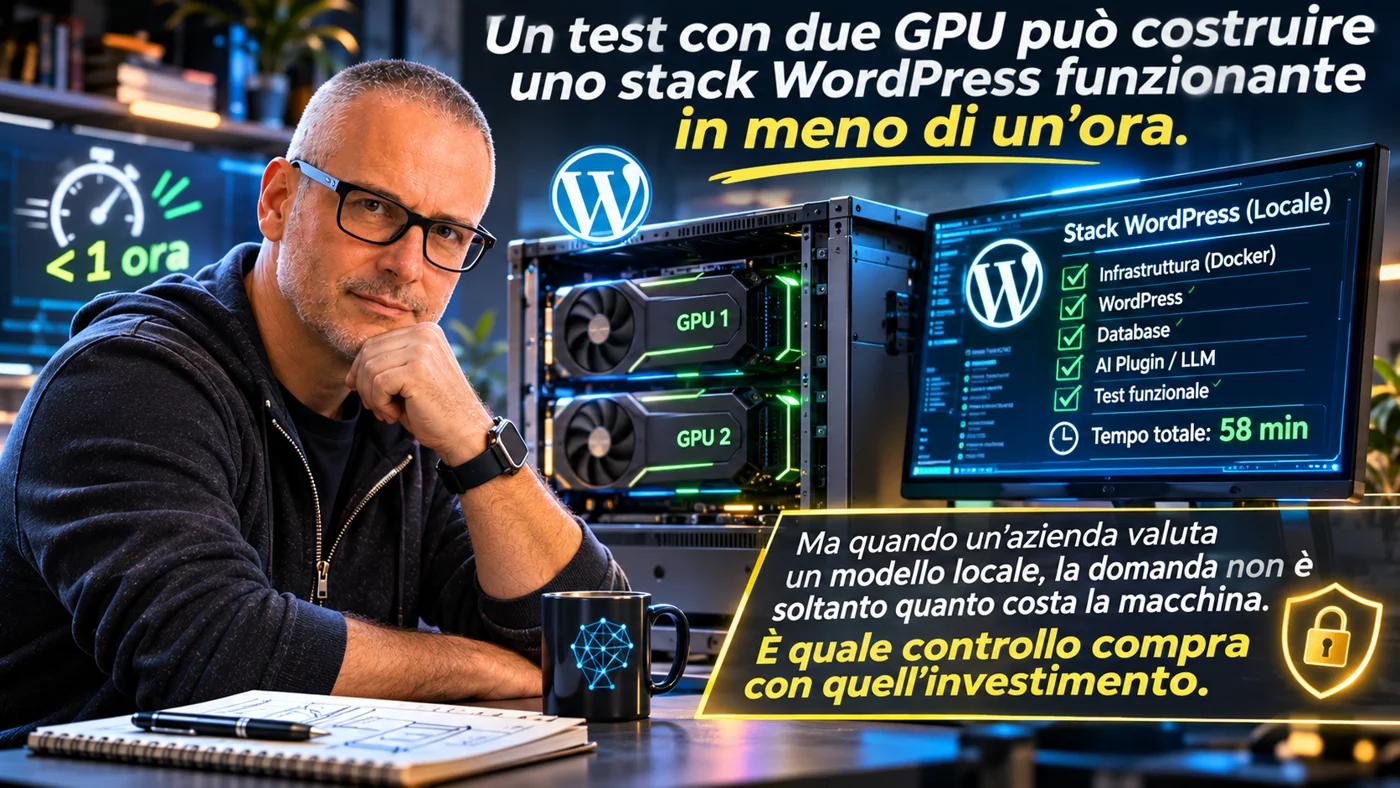
For some time now we have been talking more and more about local AI. I wanted to look at the topic through a concrete test: a Qwen model running with vLLM on a machine with two NVIDIA RTX 4090s of 48 GB each.
The task was structured: create a WordPress stack with Docker Compose, configure WordPress, PHP and MariaDB, develop a custom theme, add Mailpit and phpMyAdmin, automate the installation with WP-CLI and correct the problems that emerged during execution.
According to the reported results, the session lasted 53 minutes and 43 seconds, with an average speed of 20.5 tokens per second. The GPUs worked at 100%, with around 45 GB of memory used per card. The four services were active and application checks were completed.
The test shows that a local model can address a concrete development task. But the strategic question for a company is not just: how much does it cost to produce these tokens?
It's: What can we build with a model we control and the knowledge that only our organization has?
The generalist model is not yet a competitive advantage
A generalist model is powerful, but it is also available to competitors. Can write code, summarize documents and propose solutions. On his own, however, he doesn't know how a specific company designs its products, approaches difficult cases, evaluates tradeoffs, or has learned from its mistakes.
That knowledge lives in code, documents, processes, past decisions and above all in people's experiences. It is the know-how that distinguishes one company from another.
If a company uses AI only as a general assistant, it largely gains capabilities that others can also obtain. If, however, he can relate the model to his own knowledge, evaluate its responses and improve it on the tasks that matter, he can transform a common technology into a tool that is closer to his own way of working.
This is where local AI can become a long-term choice. Not because the model installed in the company is automatically better, but because the organization can develop skills, tools and improvement cycles that remain part of its assets.
Security: don't just be compliant
For an innovating company, protecting source code, customer data, product specifications and operational information is more than just an obligation. It's protecting what took years of work and that your competitors don't have.
A model managed in your environment can offer more direct control over where code and data is processed, which repositories the system can consult, and who is allowed to use it. This can reduce exposure to external vendors, if the entire architecture is designed and configured correctly.
The distinction is important: local does not automatically mean safe. Networks, logins, logs, telemetry, backups, dependencies, updates and related tools must be governed. A poorly secured internal server can expose information just as much as a poorly configured service.
NIS2 makes the need to manage risk even more clear, but security should not begin and end with compliance. The deeper question is: does our know-how remain under our control? And are we able to demonstrate it along the entire path, from data to model, from model to product code?
It's not enough to train a model
Saying “let's train the model on our data” seems simple. In reality, companies must first understand what problem they want to solve and which method is suitable.
For example, if the model needs to respond using up-to-date internal documentation, it may be more appropriate to link it to authorized sources and retrieve the relevant content at the time of the request. If instead he needs to learn recurring conventions, formats or specific behaviors, targeted adaptations or supervised training on curated examples can be evaluated.
They are not interchangeable solutions, and none alone guarantees correct answers. We need selected data, consistent permissions, representative tests and people who know how to recognize when the result is useful or wrong.
Above all, the company must avoid confusing the quantity of data with the quality of knowledge. A messy archive does not become know-how just because it is connected to a model. We need people capable of choosing what matters, preparing examples, defining evaluation criteria and updating the system without losing control.
Hardware is capital. Skills are what make it productive.
In the test, the configuration was estimated at around 18,300 euros worth of hardware. Assuming an average absorption of 1.2 kW, continuous operation for a year would be equivalent to approximately 10,512 kWh. At the rate indicated in the test, the energy would cost around 4,565 euros, excluding air conditioning. Hardware and first year of energy would therefore bring the estimate to around 22,865 euros.
These are figures to be verified on the actual conditions of the machine and the company. They do not include cooling, maintenance, parts, space, depreciation, upgrades and management. And 24-hour operation must be compared with real use.
But considering hardware only as a cost to be reduced is reductive. For a company with adequate loads, it can be an infrastructure investment: available computing capacity, operational control and the ability to experiment without paying every single request to an external supplier.
The most important investment, however, is in people. Skills are needed to integrate models into processes, prepare and protect data, adapt behavior to use cases, verify results, measure quality and govern updates.
Without these skills, the company owns an expensive machine that runs a generalist model. With these skills, he can build a system that incorporates his own way of working and that improves through a controlled process.
GPUs provide the power. It is people who transform it into a distinctive ability.
The comparison with an API must also measure the strategic value
For sporadic or generalist use, an API can be cheaper and easier to manage. The price per million tokens, however, is not the whole story: it is necessary to compare equivalent activities, quality obtained, volume, review times and overall cost.
And the cost does not exhaust the decision. An external service can offer a more capable model or free the company from infrastructure management. An internal model may instead be preferable when confidentiality, data control, customization or vendor-independent availability have concrete value.
The correct question is therefore not "local or cloud?" for the whole company. It is: for which activities is proprietary control and know-how worth more than additional costs and responsibilities?
The answer may be different for each workflow. You can use a local model for confidential code and internal knowledge, an API for occasional or more complex tasks, and no model when the risk outweighs the benefit.
An asset that accumulates over time
Local AI makes strategic sense when it becomes part of a path: the company identifies important processes, protects its knowledge, experiments on real cases, measures the results and trains the people who will be able to improve the system.
What accumulates is not just the model. It is the ability to understand what information is needed, how to transform it into useful tools, what errors to prevent and how to verify the work produced. This experience cannot be bought with a GPU and cannot be obtained by installing software.
The model can be generalist. The use that an organization builds around it can become unique.
For companies that develop applications and innovate, this is the real issue: not saving a few euros on tokens, but preventing their competitive advantage from being wasted or entrusted without awareness to tools they do not control.
Hardware is an item of investment. Skills are what give it value.
The final question, then, is not just how much the model costs. It is whether we are building, within our company, the people and capabilities necessary to transform a generalist model into an asset that remains ours.
#ArtificialIntelligence #AI #LocalAI #LLM #NIS2 #Cybersecurity #SoftwareDevelopment #Innovation