
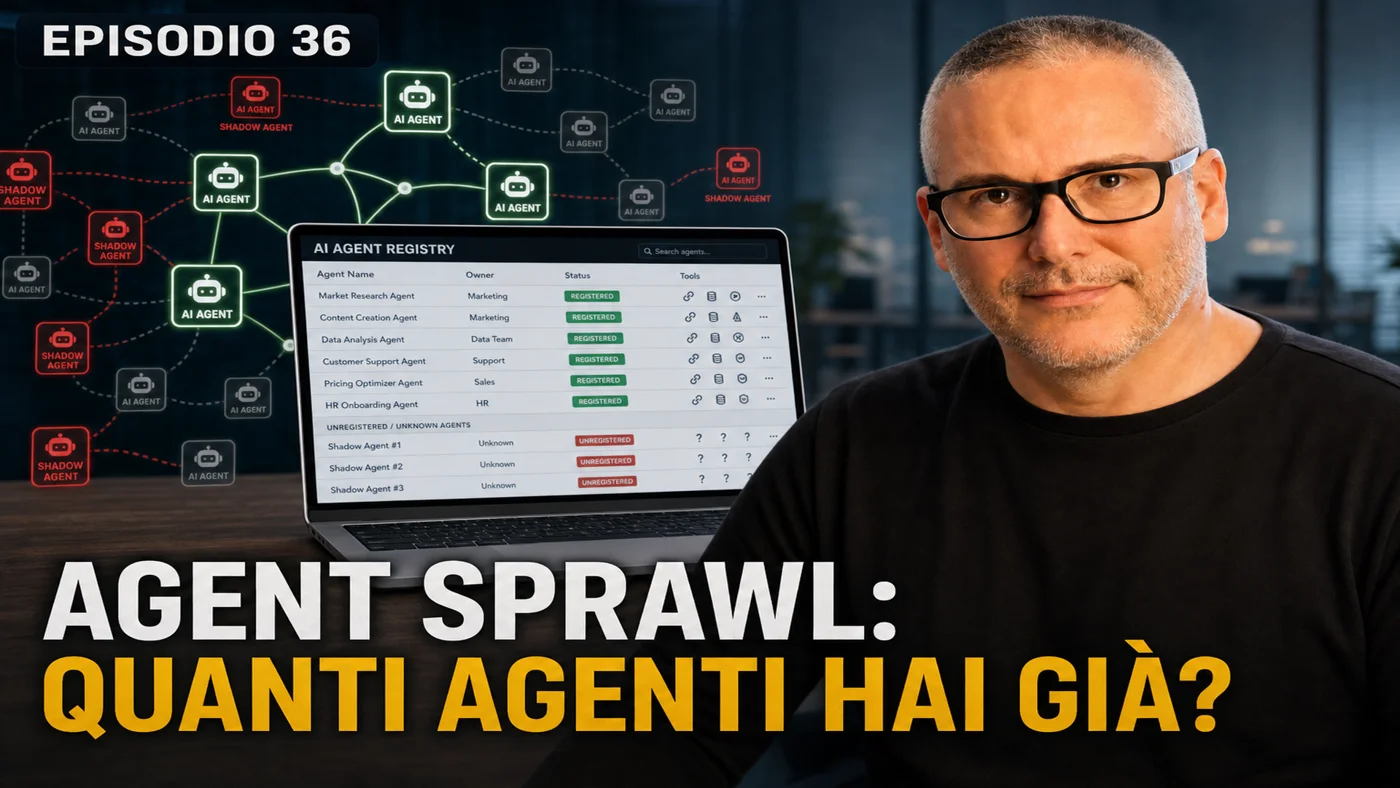
🔴 Episode 36
The question of 2025 was: How do we build an agent?
The question for 2026 is: How many agents do we already have in production — and who governs them?
It's not rhetoric. It's the problem that's emerging in board rooms, audits, and security teams. Industry estimates indicate that the vast majority of enterprises already have agents or agent workflows that security teams didn't know about. Shadow AI is no longer just "someone uses ChatGPT". It's agents taking action, accessing systems, making decisions — with no owner, no log, no audit trail.
It's called agent sprawl. And it's the first real test of AI governance in production.
From chatbots to agents: what has changed
A chatbot responds. An agent observes, decides, acts — often without asking for confirmation at every step.
It can:
- read emails and reply
- query databases and CRM
- call internal and external APIs
- perform multi-step workflows
- delegate to other agents
The leap is not of degree. It's natural. A chatbot gets an answer wrong. An agent messes up an action — and the action has real-world consequences.
In 2025 many organizations have experimented. In 2026 many are in production — often without having updated governance, security and ownership.
What does agent sprawl mean
Sprawl = uncontrolled proliferation. Typical patterns:
| Patterns | What happens | Risk |
|---|---|---|
| Functional duplication | Three officers do the same thing in different departments | Costs, inconsistency, no one responsible |
| Shadow agents | Created by teams or individuals, outside IT/security | Unauthorized access, data exposed |
| Orphan Agents | Deployed and abandoned, no owner | Permissions active, no one deactivates them |
| Permission creep | Agent born read-only, then they give him write, then admin | Blast radius increasing |
| Chains of delegation | Agent A delegates to B who delegates to C, no one sees the flow | Amplified errors, zero traceability |
No malice needed. No more speed without inventory.
Because it has become a board topic
Three convergences in 2026:
1. Volume. MCP (Model Context Protocol) and tool-calling have made it easy to connect agents to dozens of services. A compromised or misconfigured agent doesn't access a tool — it accesses an ecosystem.
2. Regulation. EU AI Act, ISO/IEC 42001, NIST AI RMF: audit trail, human supervision, accountability. An agent without an owner is not compliant — even if the model is great.
3. Incidents. First public cases of agents acting out of scope — emails sent, data modified, APIs called in loops. Not apocalypse. Operational incidents that no one knows how to classify.
The board's question is no longer "do we use AI?". It's "do we know what AI is doing on our behalf?"
The trap: governance as afterthought
Classic pattern:
- Innovation team deploya agent → promising results
- Other teams want one → copy, adapt, vary
- Security asks for inventory → no one has the complete list
- Audit asks for owner → no one is formally appointed
- Accident → no one knows who to deactivate what
Adding governance after sprawl costs 10 times more than building it day one. There's no need to block innovation. We need registry, owner, lifecycle before there are hundreds.
The agent registry: minimal control
Pattern emerging in 2026 — agent registry:
| Field | Why it is needed |
|---|---|
| Name / ID | Identify the agent |
| Purpose | What does it do, for whom |
| Human Owner | Whoever answers is wrong |
| Autonomy | Read-only, suggest, act-with-approval, fully autonomous |
| Tools and data | What access |
| Status | Draft → approved → production → retired |
| Data deployment / review | When it should be reviewed |
No agents in production without owner named. It's not bureaucracy. It's accountability — the same logic as the CSIRT contact for cyber incidents.
Clear lifecycle: obsolete agents retire, they do not remain active due to inertia.
Three levels of autonomy, three levels of control
Not all agents are the same. Governing everything the same way is wasteful. Ignoring the differences is risky.
| Level | Behavior | Minimal governance |
|---|---|---|
| Observe | Reads, analyses, suggests | Log, periodic review |
| Act-with-approval | Proposes action, human approves | Human-in-the-loop, audit trail |
| Autonomous | Acts within a defined mandate | Tight limits, real-time monitoring, kill switch |
More autonomy = more controls. Not option.
What to do now
1. Discovery — survey known and shadow agents: IT, security, team by team. Asking “who uses what?” it's not enough. Look at APIs, logs, integrations.
2. Owner — each agent in production has a responsible name and surname. Not "the AI team". A person.
3. Log — also a shared sheet at the beginning. Better imperfect and alive than perfect and empty.
4. Policy MCP/tool — deny-by-default on tool access. Agent accesses only what is needed.
5. Kill switch — procedure for deactivating an agent in an emergency. Tested, not theoretical.
The thread with the series
Ep. 1: The AI stops responding and starts deciding. Ep. 35: The Omnibus doesn't save you on compliance. Ep. 40: NIS2 and AI, a single perimeter.
Ep. 36 is the operational point: the agents are already here. Governance must reach them — or accidents, audits and regulators will reach them.
🔥 Your reality
Do you know how many agents or agent workflows are active in your organization — and who owns each?
Tell in one line in the comments (also: "we don't know yet").
In the next episode we will talk about liability: who pays when the agent acts alone.
If you want to follow the series, stay here.
The question of 2026 is not whether to use agents. That's if you know how many you have.