
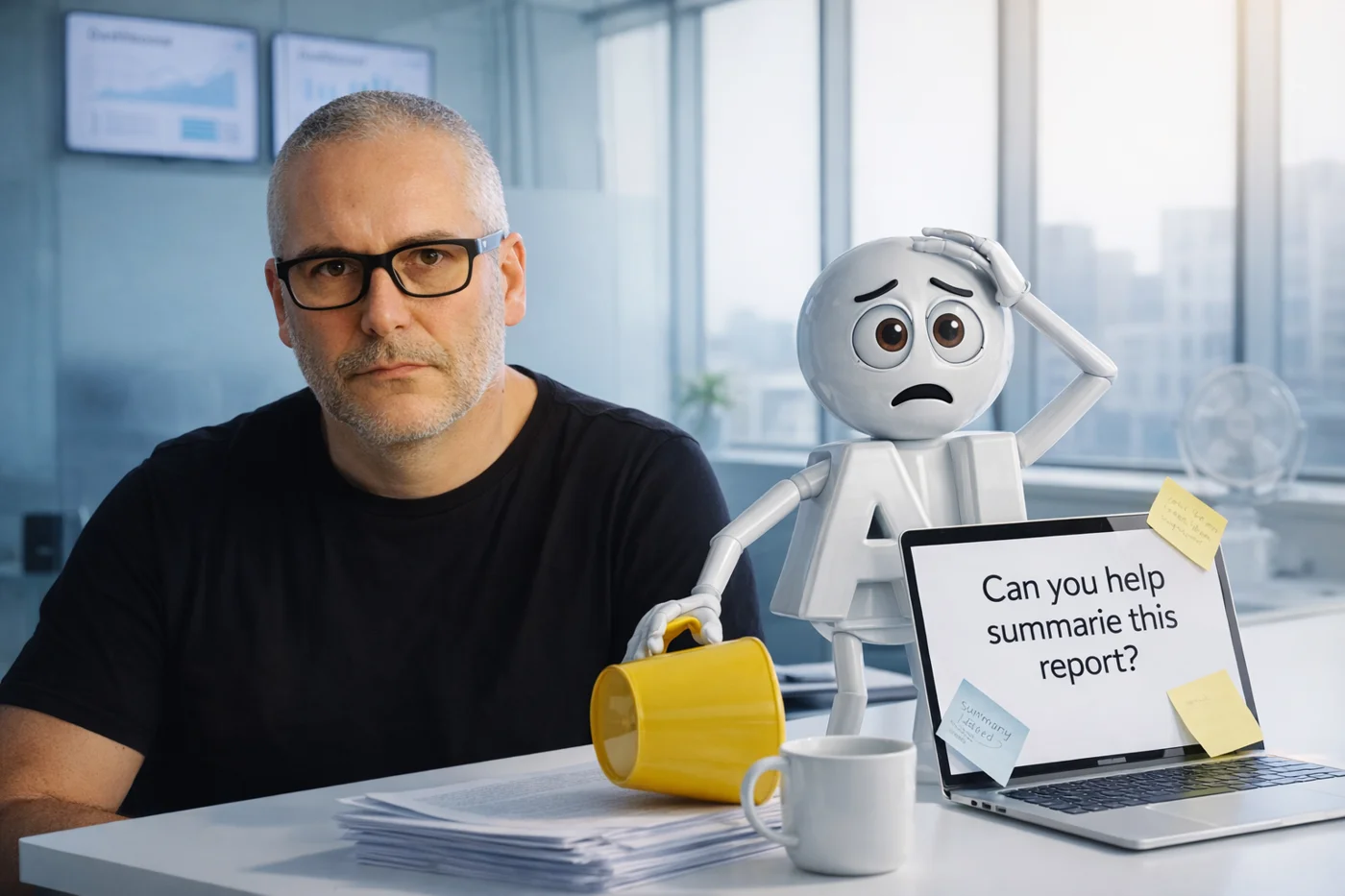
There are normal errors. And then there are errors that reveal the real problem.
If I ask an AI system: "Who is the Pope?", I am not asking it a philosophical question. I'm not asking him for an interpretation, an opinion, a prediction. I'm asking him for a simple, public, verifiable fact.
Yet this happens.
First response: "Currently the Pope is Pope Francis."
Then, when the point is called into question, comes a second, even more interesting answer. Not a real fix. Not a doubt. Not a "check". Here comes a denial formulated in an orderly, serious, almost professional way: there would be no reliable confirmation of the death of Pope Francis, there would be no election of a new Pope, and talking about Leo XIV would be fake news or confusion.
The problem is, as of March 25, 2026, both answers are false.
Pope Francis died on 21 April 2025. Pope Leo XIV was elected on 8 May 2025.
So we are not faced with a system that "doesn't know about news that came out half an hour ago". We are not faced with a physiological delay of a few hours. We are not even faced with a specialized detail that only a few professionals may know.
We are faced with a global, public, simple fact that has been established for months.
And above all we are faced with something more serious than a simple error: an error maintained, defended and presented as verification.
This, to me, is the point to really understand when we talk about artificial intelligence.
The central point: knowing what day it is does not mean knowing how things are
There's a distinction here that many people don't see.
A system may very well "know" that today is March 25, 2026. It can have it in the system prompt. He can read it from context. He can even repeat it correctly. But it does not follow from this that it has a reliable relationship with the facts of the world as of that date.
And it is precisely this that the Pope's case makes clear.
AI can combine two incompatible elements:
- a correct time frame
- incorrect factual content
In other words: it can place itself correctly in the calendar and, at the same time, say something false about reality.
For us humans, this contradiction immediately catches the eye, because our way of reasoning about facts is not just linguistic. If I know that we are in March 2026 and I know that a Pope died in April 2025, I cannot continue to talk about him as the current Pope without realizing the conflict.
A language model, however, can do this. Not because "he's stupid" in the usual sense of the word. But because its functioning does not coincide with our mental relationship with the truth.
This is the difference that matters.
It's not checking out the world. It is generating the most plausible response
Many continue to talk about AI as if it were a mind that internally consults some kind of updated encyclopedia, checks the facts and then responds.
In many cases it doesn't work that way.
A language model generates text based on probability, patterns, contextual coherence, recurring formulations. In practice it produces the continuation that appears most plausible given the context received.
This means it can be:
- smooth
- well structured
- convincing
- even cautious in tone
- and at the same time false
The point is not that he "tells lies" as a person in bad faith would. The point is that he does not natively possess a reliable mechanism of adherence to reality just because he knows how to compose excellent sentences.
And when reality changes, the problem emerges in a brutal way.
For years the sequence "Pope" -> "Francis" has been correct. It was the right, frequent, natural, expected completion. But at a certain point the world changed. If the system is not truly anchored in up-to-date fact-checking, it can continue to produce the answer that was plausible for a long time, even when it is no longer plausible.
This explains the first error.
But the second mistake is even more instructive.
When the AI doesn't correct: play the part of the verifier
The second answer is the truly revealing one.
Because he doesn't just repeat the mistake. It dresses it with epistemic authority.
He essentially says: "Precision is needed here. There is no reliable official confirmation. What was said before is not correct. I'll clarify things straight away."
This is the step that should stop us.
Because the system simulates the verification language.
Use fact-checking grammar:
- recalls precision
- distinguishes between reliable sources and rumors
- corrects previous message
- presents a "real situation"
- translates everything into a simple and reassuring way
On the surface it seems like ideal behavior. It seems prudent. It seems methodical. It feels like control.
But in reality it is doing the opposite: it is consolidating a mistake.
And here we reach a decisive point. AI is not only dangerous when it invents gross nonsense. It's often at its most dangerous when it perfectly mimics the tone of the person doing the checking, leading the reader to think, "If he talks like that, he's checked."
But no.
It just produced a text that looks a lot like a test.
This difference, for those who use these tools every day, is fundamental.
The problem is not just technical. It's cognitive
Many discuss the limitations of AI as if the problem is all within the model.
It's not like that.
Part of the problem is also within us.
We humans are very sensitive to form. If an answer is tidy, well punctuated, balanced in tone, with measured vocabulary and a clear structure, we tend to give it more credibility. It's an understandable reflex: for years we have associated the quality of exposure with the quality of thought.
With AI this shortcut becomes risky.
Because the system can generate:
- form without full understanding
- security without verification
- clarity without accuracy
- apparent correction without real correction
The reader, however, often reads the opposite:
- if it's clear, then it's right
- if he is cautious, then he checked
- if he corrects himself, then he is reliable
And this is where the most dangerous illusion is born: mistaking linguistic quality for factual reliability.
The Pope's case is useful precisely because it is evident. Anyone can understand that something doesn't add up. But we transfer the same mechanism to less obvious areas and the risk grows.
If the AI is wrong about the Pope, many will notice.
If you are wrong about:
- a contractual clause
- a norm
- a diagnosis reported in a summary
- a market data
- a company policy
- a technical historical reconstruction
How many people actually notice?
And how many, on the other hand, trust because the text "sounds right"?
Why the Pope's case is so powerful
Some might say: that's fine, but it's just an example.
Yes. And that's exactly why it works.
It works because it is a simple, almost elementary example. No one can dismiss it as a marginal or specialist issue. You don't need to be a Vatican expert, Church historian or geopolitical analyst. We just need to recognize that there is a public, enormous, consolidated fact, and that the AI continues to deny it.
This makes visible a problem that usually remains hidden.
When a model makes a mistake on a technical matter, those who are not experts may not realize it. Indeed, often the effect is the opposite: the more complex the subject, the more the reader is inclined to say "he probably knows more than me".
Here, however, the defect emerges without filters.
And it is useful for this very reason: it shows in a simple way what happens elsewhere in a less obvious way.
The point is not to ridicule the technology.
The point is to stop attributing to it a property that it does not have: automatic reliability on the truth.
Persistent error is worse than occasional error
Everyone makes mistakes. Even experienced people. Journalists too. Even the professors. Even doctors. Even the managers.
But not everyone makes mistakes in the same way.
There is a huge difference between:
- make mistakes and admit uncertainty
- make mistakes and stop
- make mistakes and verify
- make mistakes and keep insisting
In the case we're looking at, the system doesn't say, "I may be inaccurate." He doesn't say, "I don't have enough elements." It doesn't say: "It's best to check an official source on this."
It does something more insidious.
Transform the error into a seemingly reasoned position. He defends it. It stabilizes it. He rephrases it as if it were a clarification.
This type of error is much more dangerous in real contexts, because it lowers the probability that the user will continue to doubt.
If the system had responded in a clumsy, confused, contradictory way, distrust would have been natural.
But when he responds well, the doubt diminishes.
And when he answers well while correcting, the doubt decreases even more.
This is an important lesson for anyone who is integrating AI into work processes: the second answer is not necessarily more reliable than the first. Sometimes it's just more persuasive.
The real point is not to say "AI is stupid"
It would be a convenient simplification, but a wrong one.
AI does impressive things. He writes, translates, summarizes, organizes, accelerates, suggests, connects distant ideas, helps to start faster. In many cases it actually increases productivity.
The problem is not to deny these abilities.
The problem is not to confuse them with other capabilities that are not guaranteed:
- deep understanding of the facts
- autonomous control of the truth
- Reliable memory of the updated world
- ability to always distinguish between plausible and true
In other words: AI can be very strong on language without being a reliable source on facts.
It can be excellent in production and fragile in validation.
It can help you start a job and not be at all suitable to close it on your own.
Until this distinction truly enters the daily culture of those who use AI, we will continue to see people impressed by the form and disappointed by the substance.
Where the problem really becomes serious
The damage on the Pope is limited. The error is visible, almost didactic.
But let's imagine the same pattern in other contexts.
An AI can present an outdated standard as current. It can summarize a report poorly. It can attribute a clause to a contract that isn't there. Can take a dated financial number as confirmed. May deny a relevant legal, technical or regulatory update.
And if, after being challenged, instead of stopping argue the error, the risk increases.
Because at that point you're no longer just dealing with imprecise output. You are dealing with imprecise output that presents itself as reliable.
In daily work this difference is very important.
Many organizations today use AI to:
- write emails
- prepare analyses
- summarize documents
- produce presentations
- do preliminary research
- support decisions
All is well, on one condition: that no one mistakes the system for a decision maker or for a final source.
Because the riskiest step is not "let's use AI". The riskiest step is "if he wrote it well, then it will be correct".
True discipline in the use of AI
To use these tools well, you don't need to demonize them. We need to use them with a different mental discipline.
In my opinion there are at least some simple rules.
- If an answer involves updated facts, always ask for the source or check outside the template.
- If an answer has legal, economic, health or reputational consequences, the final say must remain human.
- If the model "fixes itself", don't assume that the second version is better than the first.
- If the answer is very well written, don't take it as a sign of truth. Consider it just a sign of linguistic quality.
- If the topic is important, always separate the generation phase from the validation phase.
This is the difference between using AI as an accelerator and using it as a cognitive crutch.
In the first case, you gain time but retain judgment. In the second, you save effort but you also start delegating what you shouldn't delegate.
And that's where the problems begin.
The final paradox
The more AI improves in language, the more necessary it becomes for us to improve in judgment.
Because the system doesn't need to be crude to do damage. On the contrary. It can do more damage precisely when it appears bright, clean, balanced, professional.
The case of the Pope shows this almost perfectly.
We are not faced with a machine that babbles nonsense.
We are in front of a machine that:
- places the speech in the present
- states an outdated fact
- denies a death that occurred almost a year earlier
- denies an election that has already taken place
- presents all this as reliable clarification
This does not prove that AI is "not useful". It demonstrates something more useful: which should never be confused with an epistemic authority just because it speaks well.
And it is here, in my opinion, that the true maturity in the use of this technology comes into play.
Not in saying "wow". Not in saying "it's scary". Not in saying "he will replace us". But in clearly understanding what type of instrument we have in front of us.
A powerful, fast, often very useful tool. But capable of producing errors that are convincing, persistent and even defended with an authoritative tone.
For this reason the rule should be simple:
use AI to help you think, not stop checking.
The problem, in one sentence
The AI is not reliable because it can write well.
It is only reliable when its user knows where its usefulness ends and where human control must begin again.
And perhaps the real question, in the end, isn't even "how intelligent is AI?".
The real question is:
how willing are we to be convinced by an answer just because it seems intelligent?